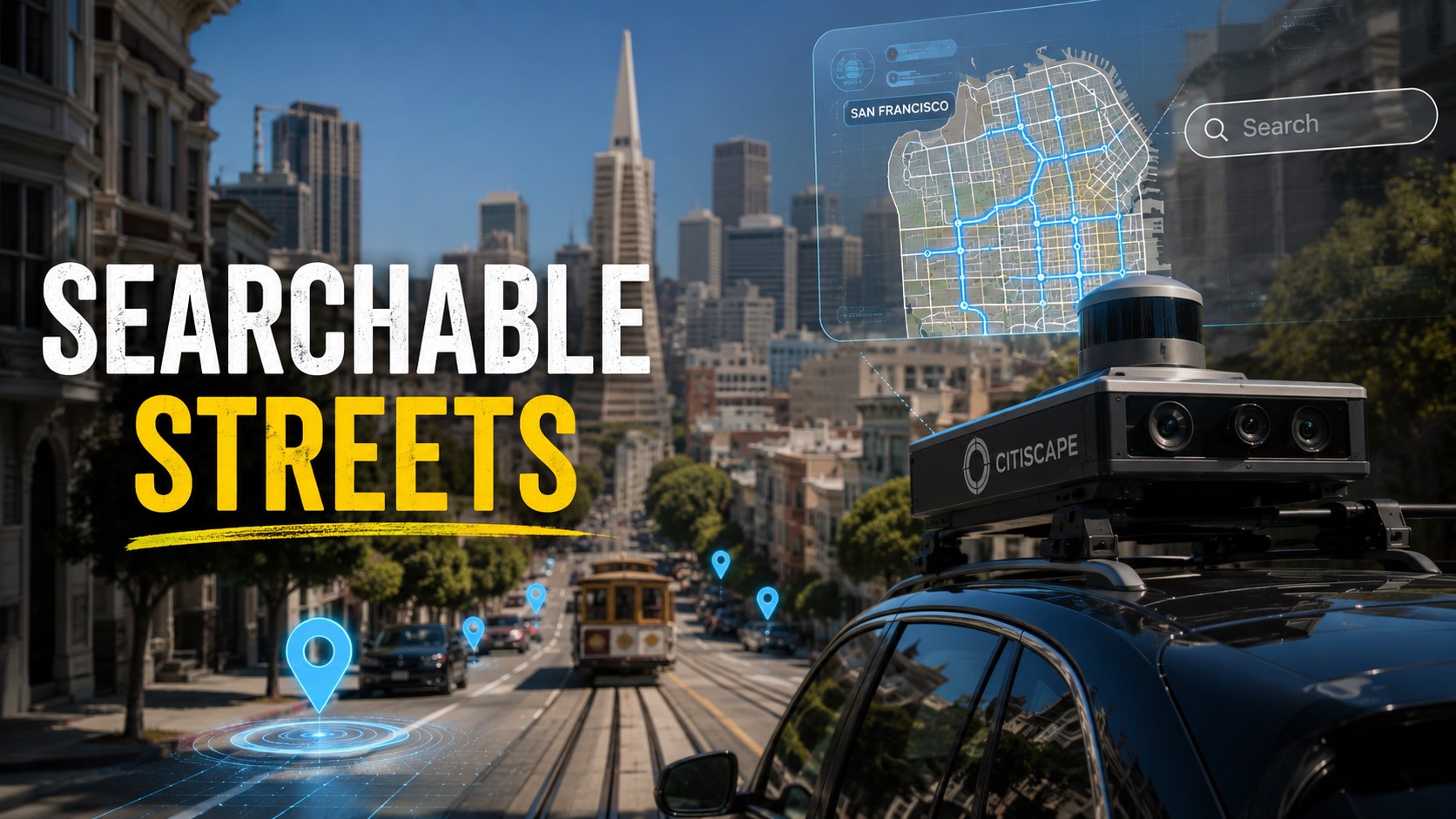
Walk down Market Street right now and more than 100 high-definition cameras are watching you. Not police cameras. Not doorbell cams. A startup called Orchestra — not to be confused with several other companies sharing the name — has mounted 4K lenses on private businesses across San Francisco, streaming footage around the clock. According to Business Insider, 900 more cameras are planned across major commercial corridors within six months. The company’s own pitch? It’s building “AGI for Cities.” That phrase should make you pause mid-crosswalk. For broader context on how covert tools are reshaping urban monitoring, see recent reporting on a surveillance app built to track political dissidents.
The City as a Dataset
Imagine Google Maps crossed with a always-on DVR — except it’s watching everything happening on your block, in real time.
A detective retraces a stolen vehicle’s route through the Mission District. An insurance adjuster reconstructs a fender bender on Valencia Street without leaving the office. Here’s how Orchestra makes that possible: raw video feeds get converted into structured data identifying objects, vehicles, and incidents in real time. The company’s products — the Omniscience Engine and the Orchestra Network — let authorized users search and rewind footage by place, time, object, or incident. An autonomous-vehicle company could study pedestrian flow patterns. A real-estate firm could analyze foot traffic on a commercial block. Readers weighing public versus private monitoring options may also want to review Home Security Systems experts recommend.
What Orchestra’s platform reportedly offers:
- 100+ cameras currently live in SF; 900 more planned across major commercial corridors
- Footage converted to structured data identifying objects, vehicles, and incidents
- Faces are blurred; re-identification uses clothing and shoes instead of facial recognition
- Raw footage retained but reportedly never sold to customers, with access tightly restricted
- An AI agent called “Robocop” pre-investigates incidents before a human reviews the case
Public Safety or the Panopticon as a SaaS Product?
Orchestra’s stated privacy protections are real — but the workarounds are worth examining closely.
Orchestra says it avoids residential neighborhoods and blurs all faces. No facial recognition. But the re-identification workaround deserves a hard look: the system can reportedly identify anonymized individuals by their clothing and shoes. You’re not a face in the database. You’re a pair of red Nikes and a denim jacket.
That distinction matters less than it sounds. Clothing-based tracking can reconstruct a person’s movements across a city just as effectively as a face match — and it currently operates in a legal gray zone that civil liberties advocates have flagged as underregulated. This parallels how the White House app was caught secretly tracking users every four minutes without their knowledge.
Customer targets, according to Business Insider, include:
- police departments
- insurers
- autonomous-vehicle companies
- real-estate firms
Each receives structured analytics rather than raw video. Security controls include role-based access, audit logs, and chain-of-custody protocols — tools designed to limit who can pull what data and when, though their real-world enforcement depends entirely on who’s watching the watchers.
If Orchestra scales beyond San Francisco — and the business model strongly suggests it will — who writes the rules for a searchable city? Your shoes are already in the frame.