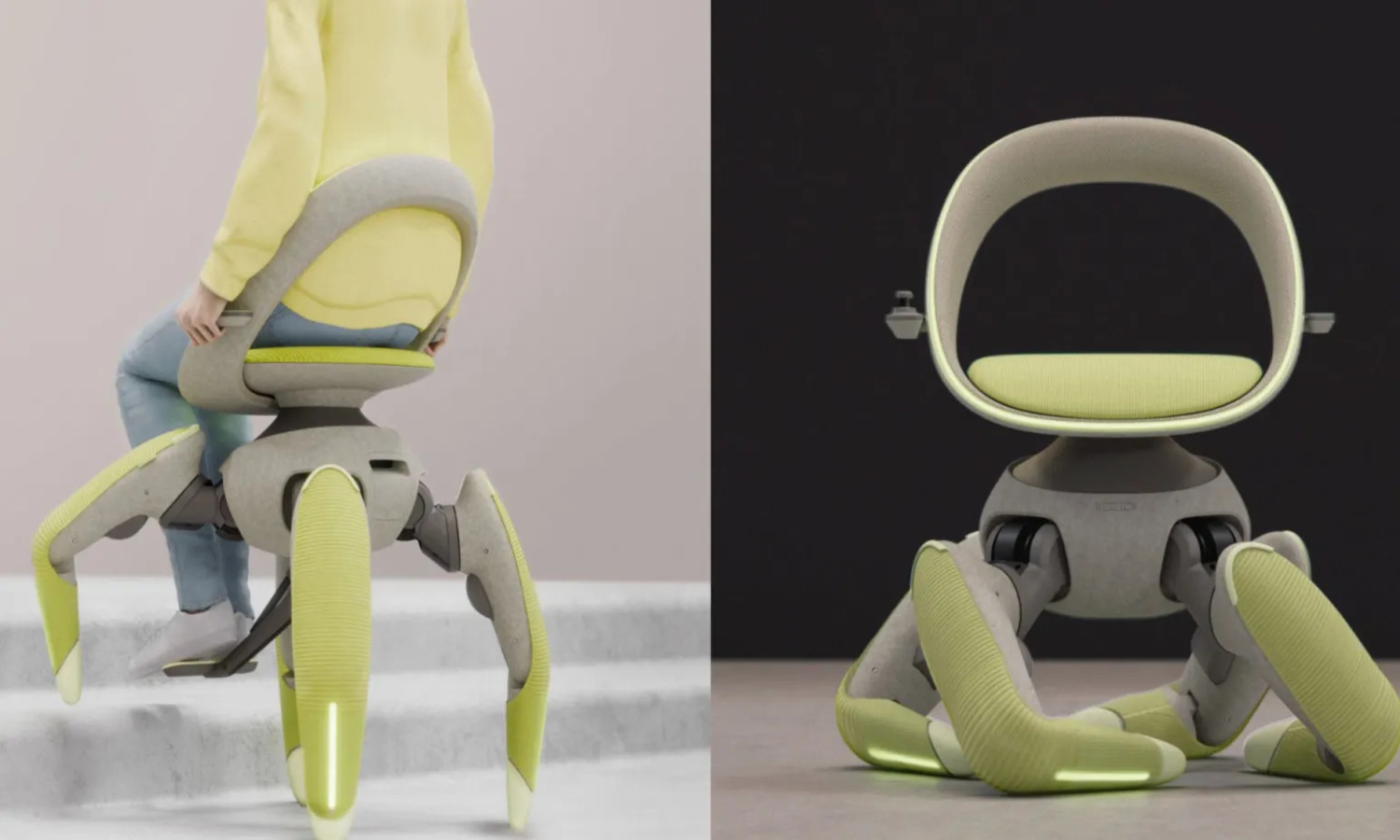
For wheelchair users, a staircase is often a full stop. The building wins. Ramps help when someone remembered to build one. Stair lifts work when the staircase is wide enough to fit one — which, in older Japanese homes with their steep, narrow flights, it often isn’t. Toyota’s answer to this decades-old standoff is Walk Me: a four-legged robotic mobility chair designed to walk where wheels cannot, unveiled as a prototype at the Japan Mobility Show 2025 in Tokyo.
It looks like what would happen if a very practical engineer watched too much nature footage of mountain goats and then got access to Toyota’s ADAS lab.
What the Chair Actually Does
Four independently actuated legs handle every surface; the seat stays level while they do it.
Here’s what Walk Me brings to the problem:
- Four robotic legs, each with independent actuation and embedded sensors, move like articulated limbs rather than wheels on a track
- Stair climbing follows a specific animal-like gait: front legs test the step height first, then lift and pull the chair up; rear legs push the weight from behind
- Automatic stabilization keeps the seat level while the legs negotiate whatever the floor is doing underneath
- LiDAR maps the environment in real time, detects obstacles, and plans foot placements — the user provides direction; the chair handles the footwork
- Legs fold compactly for car storage; soft coverings on each limb make it look considerably less like industrial machinery
On stairs, the motion is reportedly jerky — a limitation Toyota’s own demonstrations don’t obscure. On flat ground, it smooths into something closer to a glide. According to reporting by Interesting Engineering, the system was conceived specifically for the narrow, steep staircases common in older Japanese homes, environments where permanent lifts are impractical and standard wheelchairs simply stop.
Toyota is routing the same sensing and autonomy expertise it builds into its vehicles — environment mapping, obstacle detection, autonomous path planning — directly into a personal mobility device. Honda spent decades on ASIMO. Hyundai acquired Boston Dynamics. The automotive-to-robotics pipeline is real, and Walk Me is Toyota’s entry point into that space.
Walk Me is a prototype. No price. No launch date. No safety certifications. Battery life, maximum stair height, payload capacity — none of those specs have been published. The engineering questions ahead of any commercial version are substantial.
But the direction matters. If Toyota can solve the cost, reliability, and regulatory puzzle, you’re looking at something that redraws what accessible means — not just in Japan, but everywhere buildings forgot to account for the people inside them.