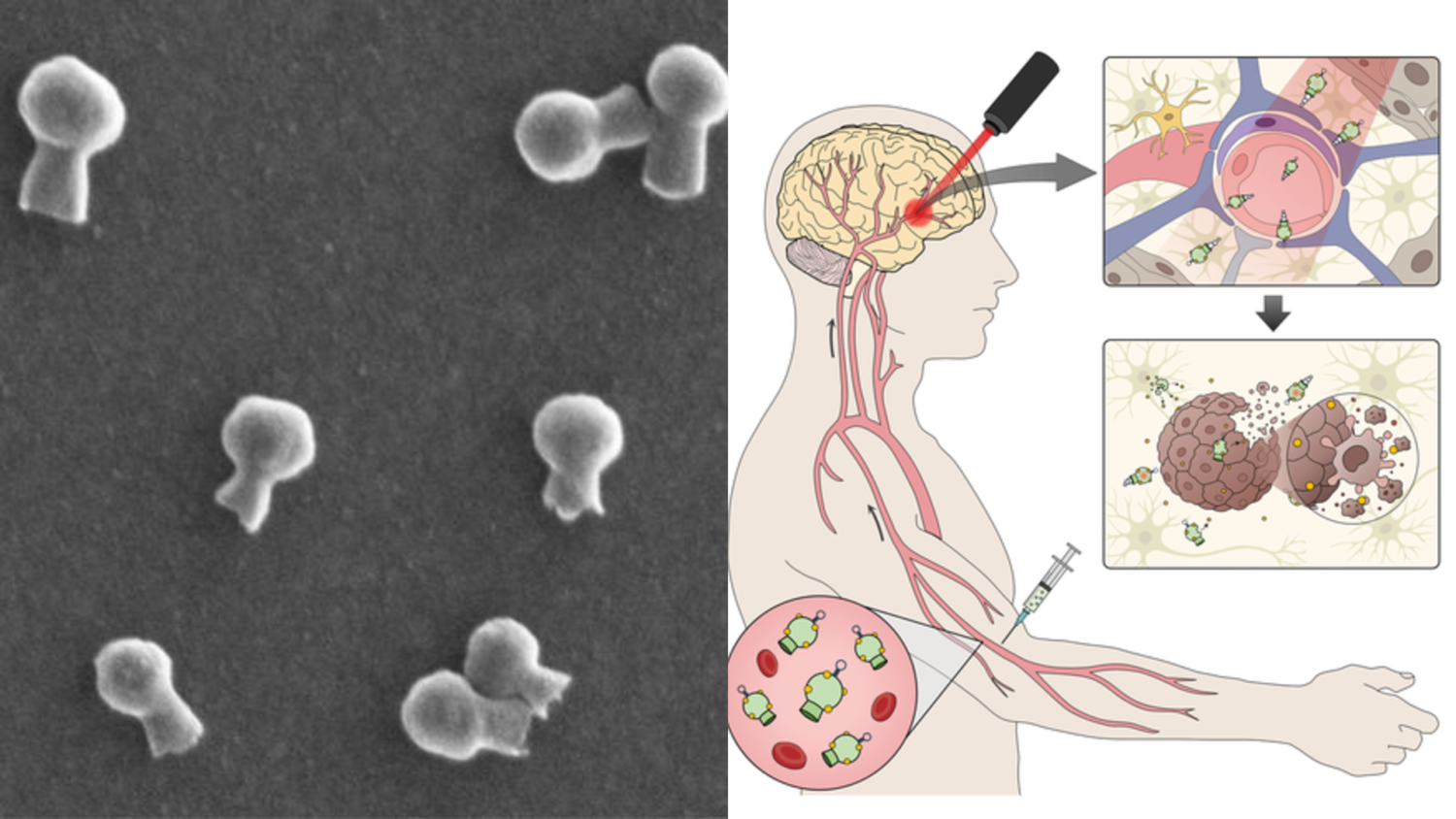
The blood-brain barrier is a protective cellular boundary that keeps pathogens and toxins out of the brain tissue. It also restricts the entry of many therapeutic drugs, preventing them from reaching brain tumors or diseased neural tissue. Caltech researchers have now demonstrated, in mice, a nanorobot system that actively crosses that barrier to deliver chemotherapy to brain tumors, according to a study published in Science Robotics.
250 Nanometers of Engineered Precision
Each bot combines biological targeting with externally triggered movement to push through the barrier rather than waiting to drift across it.
Each BrainBot is roughly 250 nanometers wide, hundreds of times narrower than a human hair, and built from biocompatible, biodegradable materials. DNA aptamers on the surface of each bot recognize and bind to cells lining the blood-brain barrier. Near-infrared light then heats the bots, triggering propulsion toward those cells, which transport the bots across to the other side, where the bots release their drug payload.
What the Mice Actually Showed
Activated bots delivered far more drug to mouse brain tissue than nonactivated ones, though these results apply only to an experimental animal model.
The team tested the system in an orthotopic mouse model of glioblastoma, one of the most aggressive forms of brain cancer, using doxorubicin as the chemotherapy payload. Activated BrainBots delivered approximately five times more drug to mouse brain tissue than nonactivated bots, while also slowing tumor growth and extending survival, according to the study. Researchers reported lower systemic toxicity compared to free-drug administration, though that finding is specific to this experimental model.
These are mouse results. They do not establish that BrainBots treat glioblastoma in humans, and the fivefold figure reflects drug concentration in mouse brains versus nonactivated controls, not a comparison to standard human chemotherapy regimens.
Why Active Transport Changes the Equation
Conventional delivery methods have real limits at the barrier; BrainBots attempt a more direct approach.
Conventional drug delivery across the blood-brain barrier typically depends on passive diffusion or receptor-mediated transport. BrainBots attempt to convert their brief contact with barrier cells into active, directed transport rather than relying on molecules drifting through on their own.
Parkinson’s Is on the Horizon, Not in the Data
Researcher Wei Gao named Parkinson’s disease as a possible future target; the study did not test it.
Caltech’s Wei Gao identified Parkinson’s disease as a possible future application, noting that the same delivery obstacle affects neurological disorders broadly, according to the Caltech institutional report. Any Parkinson’s application would require selecting an appropriate therapeutic payload and demonstrating delivery to the specific brain regions involved. Efficacy in disease models relevant to that condition would also need to be established. The current study supports Parkinson’s as a research direction, not as a near-term clinical option.
The Road to Human Trials Is Still Long
Light delivery through a human skull, long-term safety, and repeat-dose effects remain unresolved before clinical testing can begin.
No human trial timeline has been announced. Before clinical testing becomes feasible, researchers must optimize near-infrared light delivery through the human skull. They also need to characterize degradation completeness, immune response to repeated doses, and reliable targeting in a larger, more complex human brain. The BrainBot study is best understood as proof-of-concept evidence for a drug-delivery platform; a therapy ready for human use is a separate and much longer project.