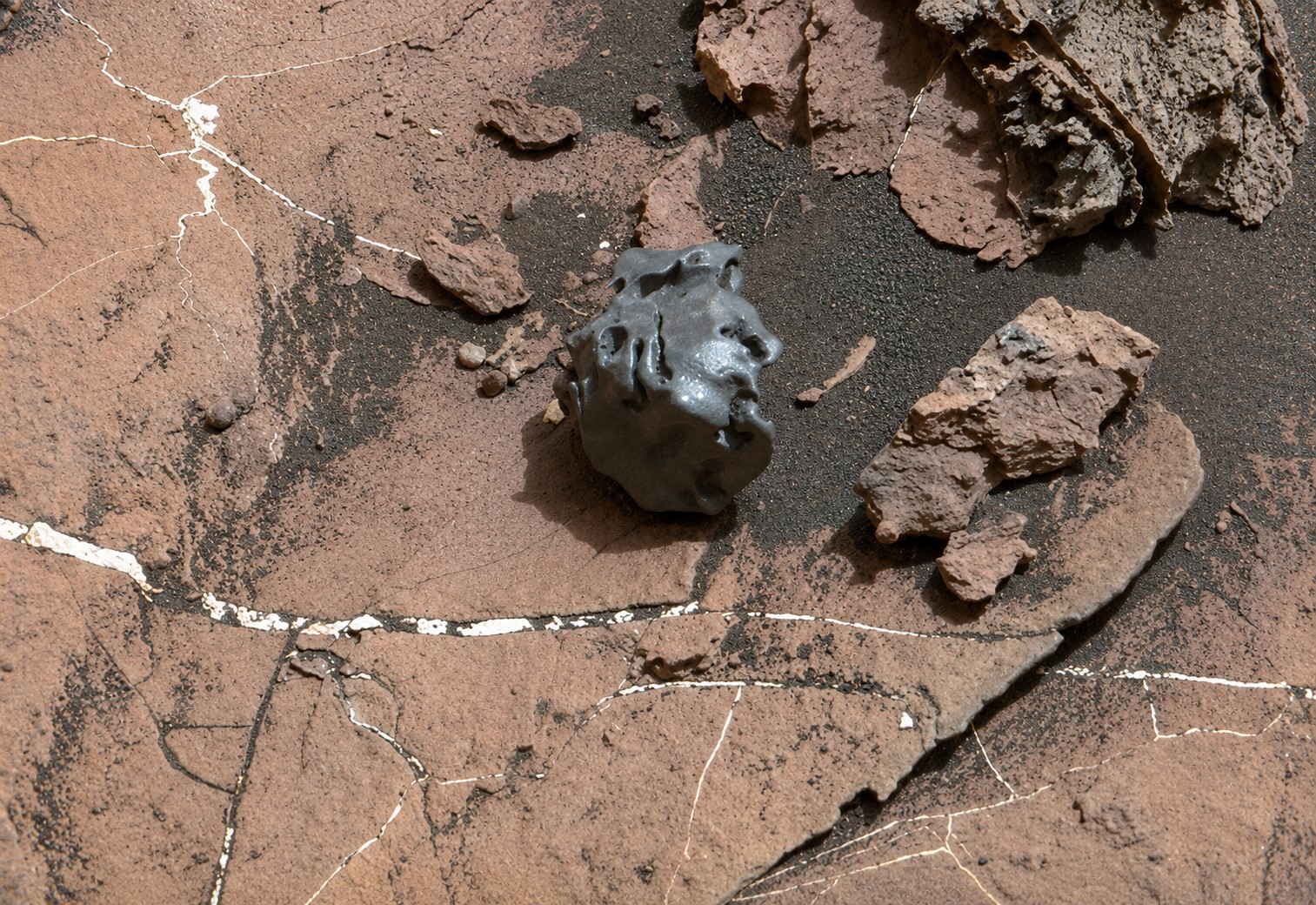
A slender, elongated rock on the Martian surface. That’s what NASA‘s Curiosity rover photographed in Gale Crater, where it has been operating since 2012. When UFO blogger Scott C. Waring resurfaced the image, he declared it an unexploded alien missile — proof of an ancient Martian war, the kind of advanced weapon technology that governments would supposedly “rush to obtain.” The image spread. Speculation compounded. And NASA, once again, had to explain geology to people who wanted artillery.
Waring estimated the object at “just over eight feet” long — a figure based on his own eyeball scaling of the photo, not any NASA-published measurement. Other social media users layered on their own readings: a crashed ship with broken wings, an aircraft with compartments holding mysterious “packages.” None of these interpretations come with technical data, dimensional analysis, or peer-reviewed support of any kind.
Mars Is Weird Enough Without the Conspiracy
The planet’s geology produces shapes that short-circuit the human brain — and this particular episode is far from the first.
NASA JPL spokesperson Andrew Good addressed this specific image in a Snopes fact-check: “It’s a wind-carved rock. We see a lot of odd shapes and textures in Martian rocks, usually due to them being sandblasted over eons into very smooth, swoopy shapes.” The phenomenon at work is pareidolia — your brain finding familiar patterns in random shapes, the same way you spot a face in a cloud. Mars geology is essentially a pareidolia factory running at full capacity.
This cycle repeats like a true-crime podcast that never resolves. Previous greatest hits include:
- The 2022 “doorway” on Mount Sharp — a natural bedrock fracture roughly 30 cm tall, about the size of a dog door
- A supposed “monolith” in orbiter imagery — a rectangular boulder whose apparent regularity was exaggerated by image resolution limits
- Spiky pillar rocks and formations that resemble layered chocolate cake — cemented fracture fills and sedimentary layers, now studied for climate history
Billions of years of volcanic activity, meteorite impacts, and relentless wind erosion produce shapes unlike anything found on Earth. Curiosity has discovered rocks composed of pure elemental sulfur. None of it requires aliens — just time, wind, and a planet with no plate tectonics to hit the reset button.
Recent software upgrades now allow Curiosity to autonomously select scientifically interesting rock targets, meaning more unusual images are on the way. Higher-resolution instruments and future sample-return missions will generate even more visually striking, context-poor photos reaching social media long before expert explanation catches up. The speculation cycle isn’t slowing down — if anything, it’s about to get louder.
NASA has found no evidence of extraterrestrial life on Mars. What it has found is a planet that’s genuinely ancient, strange, and worth studying on its own terms. That should be dramatic enough.