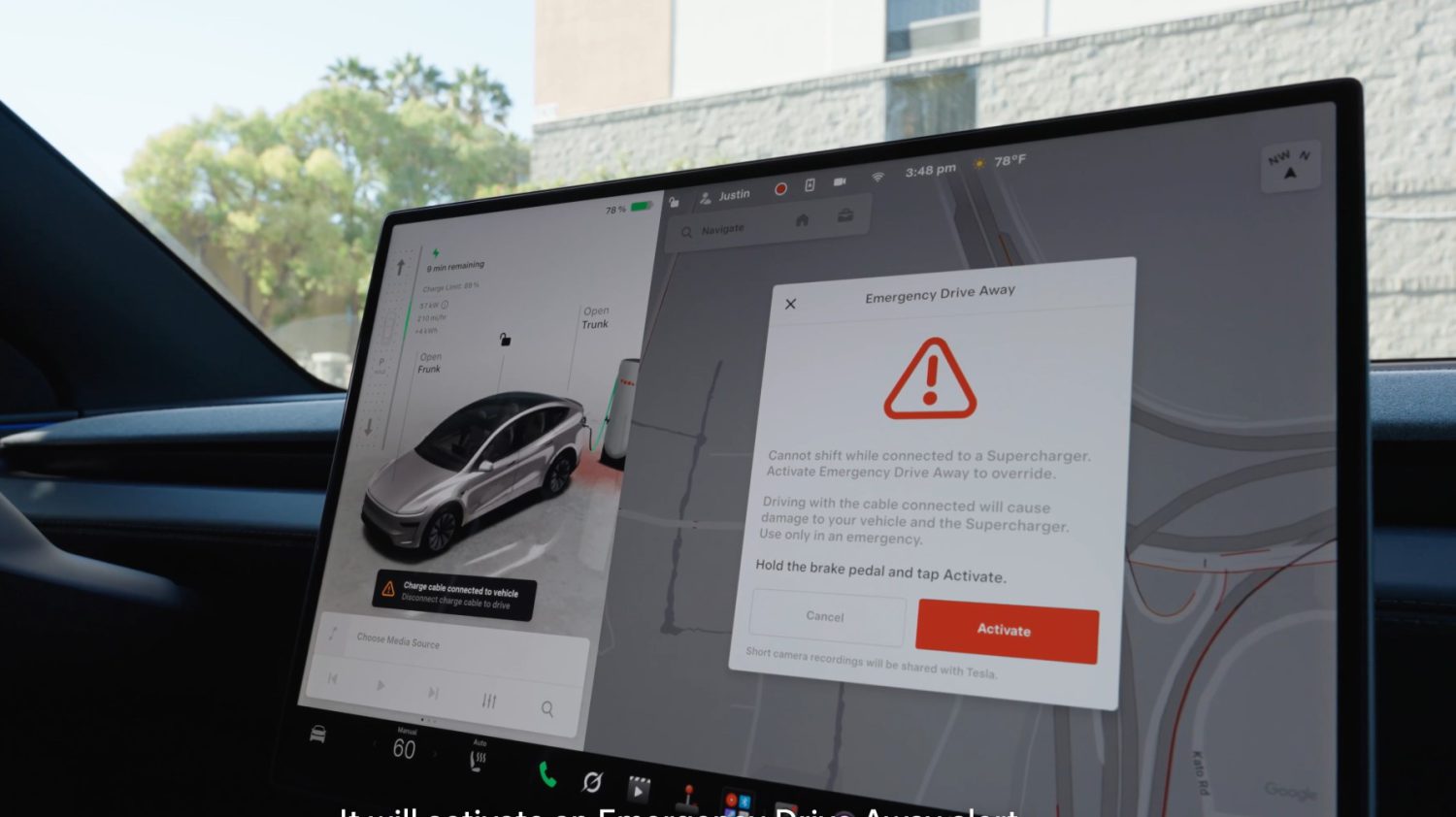
What if there was a threat appearing at a Supercharger stall with no time to exit the car, release the connector, and get back inside? Tesla’s new Emergency Drive Away feature addresses that scenario directly. Tesla Charging announced software update 2026.38.3 on October 1, 2026. It adds an emergency override that lets eligible vehicles drive away while still connected to a Supercharger. In a genuine threat situation, staying put can be more dangerous than the cost of damaging the hardware.
How It Works
The process takes seconds: press the brake, shift into Drive or Reverse while still connected, confirm the on-screen prompt, and the vehicle departs.
Press the brake and shift into Drive or Reverse while the cable remains connected, and a prompt labeled “Emergency Drive Away” appears on the main display. Confirm it, and the vehicle departs, leaving damaged connector and cable assembly behind.
No new Supercharger hardware or adapter is required. As Tesla Charging stated in its official announcement, “Emergency Drive Away lets you shift into Drive while still plugged into a Supercharger,” and the feature works with existing U.S. equipment.
The Cost of Using It
Tesla’s warning is direct: activating this feature will damage both your vehicle and the Supercharger.
The company’s own warning states plainly: “Use of this feature will damage your vehicle and the Supercharger.”
Expected damage covers the charging connector, charge port, and cable assembly, based on secondary reporting. Digital Trends reports repair estimates near $25,000, though Tesla has not published a universal figure. Actual costs depend on the specific vehicle, connector, port, and Supercharger hardware involved.
Tesla says video clips will be sent to the company upon activation. Deliberate misuse may carry additional penalties, though Tesla has not publicly specified what those penalties are.
This is not a feature to use casually, and Tesla has made that engineering reality explicit.
Who Gets It and Where
The feature requires software update 2026.38.3 and is currently limited to U.S. Supercharger locations.
Supported vehicles include Model 3, Model Y, Cybertruck, and Model S and Model X built in 2021 or later. Pre-2021 Model S and Model X vehicles are excluded. Owners outside those model years or regions currently have no equivalent option.
Canadian and other international Supercharger locations are not part of the launch. Tesla has not announced an expansion timeline.
Why Tesla Built It
Tesla’s charging leadership debated the feature for years before releasing it, and the company is urging owners not to misuse it.
Tesla charging executive Max de Zegher said the company debated the feature for years before releasing it and urged owners not to abuse it, according to Electrek. He also noted that Tesla selects Supercharger locations with safety in mind and may relocate stations it considers unsafe.
Emergency Drive Away reframes a long-standing EV charging rule. Under normal conditions, the cable is a safety interlock. In a genuine emergency, Tesla now treats the hardware as expendable so the people inside can leave immediately.