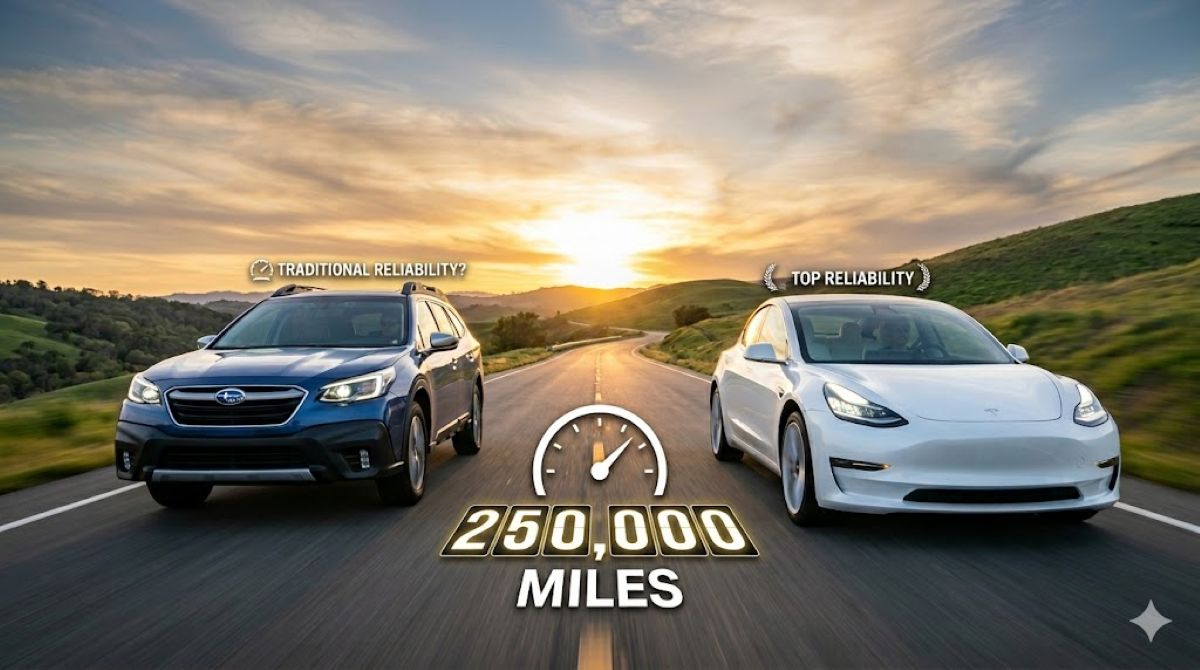
Battery anxiety keeps you from considering EVs for long-term ownership, yet new data reveals Tesla vehicles are twice as likely as Subarus to reach 250,000 miles. The iSeeCars analysis of 174 million vehicles found Tesla posting a 4.6% probability of hitting that quarter-million mark, compared to Subaru’s disappointing 2.3%. That’s not a rounding error — that’s a fundamental challenge to everything you thought you knew about automotive durability.
Tesla’s 4.6% likelihood ties it with GMC for sixth place overall and lands it third among luxury brands. While that’s still below the 4.8% industry average, it demolishes the performance of traditional European luxury darlings. Mercedes-Benz manages just 1.7%, BMW stumbles to 0.4%, and Audi barely registers at 0.3%. Your Tesla Model Y has better odds of becoming a high-mileage workhorse than your neighbor’s supposedly reliable Outback.
The Japanese still own the longevity game completely. Toyota dominates at 17.8% — nearly four times the industry average — followed by Lexus (12.8%), Honda (10.8%), and Acura (7.2%). These four brands remain the only ones exceeding the overall average, cementing their reputation as the automotive equivalent of Nokia flip phones that refuse to die. Toyota and Honda’s luxury divisions, Lexus and Acura respectively, benefit from the same reliability-focused engineering that keeps their parent companies at the top.
Here’s why Tesla’s result makes sense once you think beyond batteries. EVs eliminate most traditional failure points — no oil changes, no timing belts, no transmission fluid. Your Tesla’s drivetrain has roughly twenty moving parts versus thousands in a conventional car. That mechanical simplicity matters when you’re pushing toward 250,000 miles, even if battery replacement becomes inevitable during that journey.
Traditional reliability assumptions are crumbling faster than your phone’s battery percentage at a music festival.
The study’s limitations matter, though. Tesla’s shorter sales history means smaller high-mileage sample sizes, and brand-level averages hide model-specific variations. Some Subaru models likely outperform others dramatically. The methodology tracks which vehicles reach 250,000 miles, not whether they do so with original major components intact.
Still, this data should reshape how you think about EV ownership. If you’re shopping for a vehicle that needs to survive rideshare duty or cross-country road trips for the next decade, Tesla just proved it belongs in the conversation with Honda and Toyota. The question isn’t whether EVs can go the distance anymore — it’s whether traditional “reliable” brands can keep up with the mechanical simplicity of electric drivetrains.