
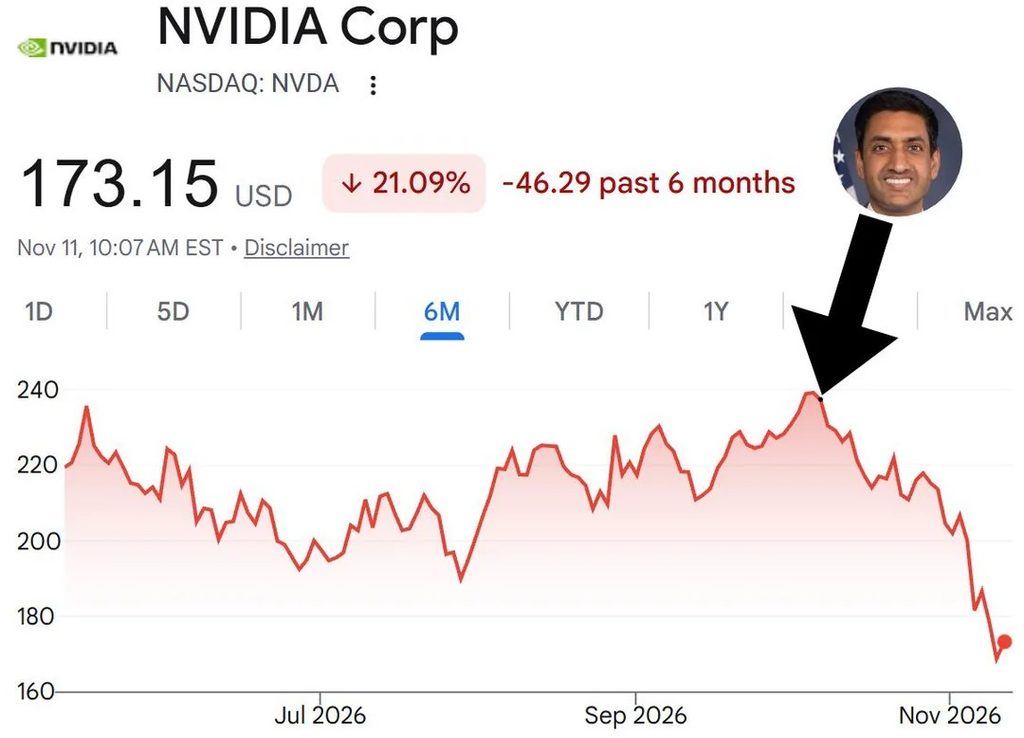
A trust associated with Rep. Ro Khanna‘s household reported selling Nvidia shares on Oct. 7, one day after the stock closed at a reported all-time high of $239.24 on Oct. 6. Khanna (D-Calif.) sits on the House Select Committee on Strategic Competition Between the United States and the Chinese Communist Party and has publicly advocated banning members of Congress from trading individual equities Data Feeds stocks.
What the Public Filings Actually Show
Disclosure rules reveal the transaction; they say nothing about the decision behind it.
Financial-disclosure trackers, including Capitol Trades and DisclosedHQ, recorded two separate sales: one on Sept. 4 and one on Oct. 7. Each was reported in the $1,000–$15,000 range.
Public filings also show Nvidia purchases earlier in 2026. The records do not indicate the household liquidated its entire Nvidia position.
Khanna’s Explanation
The congressman says neither he nor his spouse directed the trades.
According to available reporting, Khanna has said the investments are held in a diversified trust established by his in-laws before his marriage. An independent third-party trustee manages the trust, and Khanna says he and his spouse did not give trading instructions.
What the Evidence Does and Does Not Establish
Coincidental timing is not the same as improper conduct.
Available public reporting identifies no evidence that Khanna or his spouse had advance knowledge of subsequent controversies involving Nvidia CEO Jensen Huang or allegations related to Chinese intelligence connections, which Khanna’s office and others have noted remain disputed. Nvidia shares declined after those reports surfaced, but nothing in the public record connects the Oct. 7 sale to foreknowledge of that decline.
Congressional disclosure requirements make the transaction visible. They do not reveal trustee communications, the basis for any investment decision, or whether the seller held material nonpublic information. The filing shows a date and a dollar range; motive remains unknown.
The Legitimate Public Interest
The gap between a lawmaker’s stated position and his household’s financial activity is fair to examine.
Congressional trading trackers flagged the sale, and the scrutiny is understandable. Khanna has built part of his public profile on the argument that lawmakers should not hold individual stocks while in office. He cites conflicts of interest as his reason.
A spouse’s trust selling shares in a major semiconductor company the day after its reported peak creates a visible contrast with that position. The fact that Khanna also serves on a committee focused on technology competition with China sharpens that contrast further.
The transactions were small by market standards, and the trust structure predates Khanna’s political career. The sources reviewed did not identify a public regulatory or oversight investigation into the trades. The public interest here concerns the credibility gap that congressional stock-trading creates, not evidence of illegal conduct. That gap is what Khanna says he wants to close.