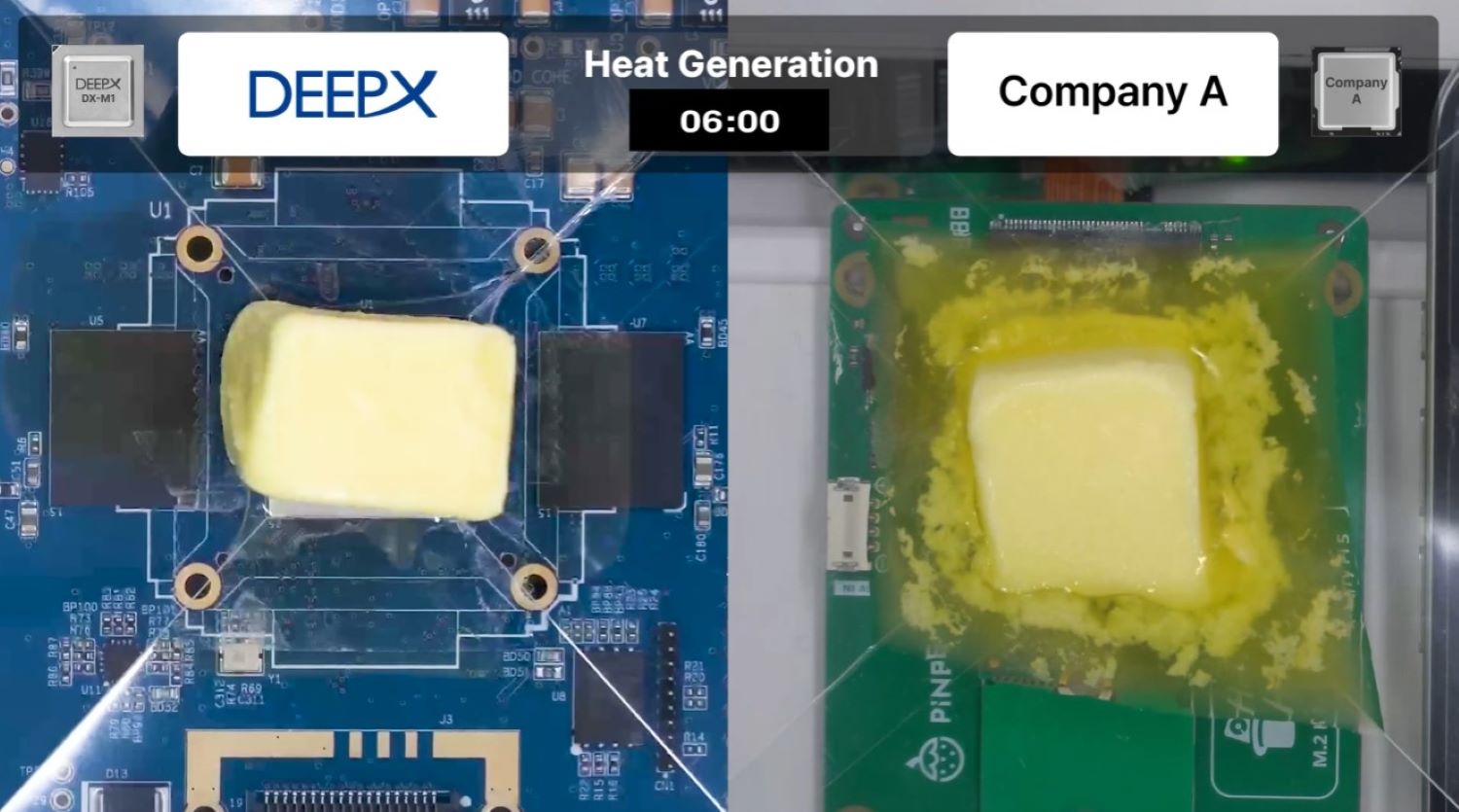
A demonstration with AI chips running inference workloads and sticks of butter resting on top of each one like tiny dairy judges, their fate entirely at the mercy of whatever heat rises from the silicon below. The butter on DEEPX’s DX-M1 stays firm. The butter on the competing chips softens and melts. It is the kind of product demo that makes you wonder if the marketing team moonlights as performance artists.
DEEPX CEO Kim Nok-won claims the DX-M1 ran 25 to more than 40 degrees Celsius cooler than competing chips during those demonstrations. That is a significant thermal gap, if the conditions were equivalent, and it forms the core of the company’s pitch.
The chip behind the stunt is a compact edge AI accelerator rated at 25 TOPS of INT8 performance within 2 to 5 watts. It ships in an M.2 module form factor with PCIe Gen3 x4 connectivity and targets computer vision, robotics, industrial systems, and autonomous devices, not the data centers running large language models.
That low-power profile is genuinely useful for edge deployments. Lower heat output may reduce cooling requirements, potentially making it easier to install the chip in robots, surveillance cameras, and industrial equipment where elaborate cooling systems or demanding power budgets complicate hardware design.
The butter test has one significant limit: melting point is not a semiconductor benchmark. Butter’s behavior on a chip surface depends on packaging, contact area, ambient temperature, workload duration, and clock frequency. A chip configured to run at lower clock speeds or reduced power limits will naturally run cooler, whatever its underlying architecture.
The available reporting does not name the competing chips used in the demonstration, and the workloads, utilization levels, and power settings were not independently verified. The demo is a company presentation, not a peer-reviewed test, and those two things are not interchangeable.
The DX-M1 also is not trying to unseat NVIDIA’s H100 or any data-center GPU. Those chips train and serve large-scale AI models at hundreds of watts by design. The DX-M1 handles inference at the edge, a different job in a different weight class. Conflating the two would be like comparing a cargo e-bike to a semi-truck because both haul things.
Independent benchmarks would actually settle this. They would need to match precision format, workload type, utilization percentage, and operating conditions across chips. Power measurements should be taken at the wall, capturing whole-system draw rather than chip-only estimates. Until that data exists, the butter test is a memorable visual and a plausible signal, not a verdict.
If the 2-to-5-watt rating holds up under real-world edge workloads, DEEPX has a legitimately interesting product for developers building compact AI hardware. The butter just cannot be the proof.