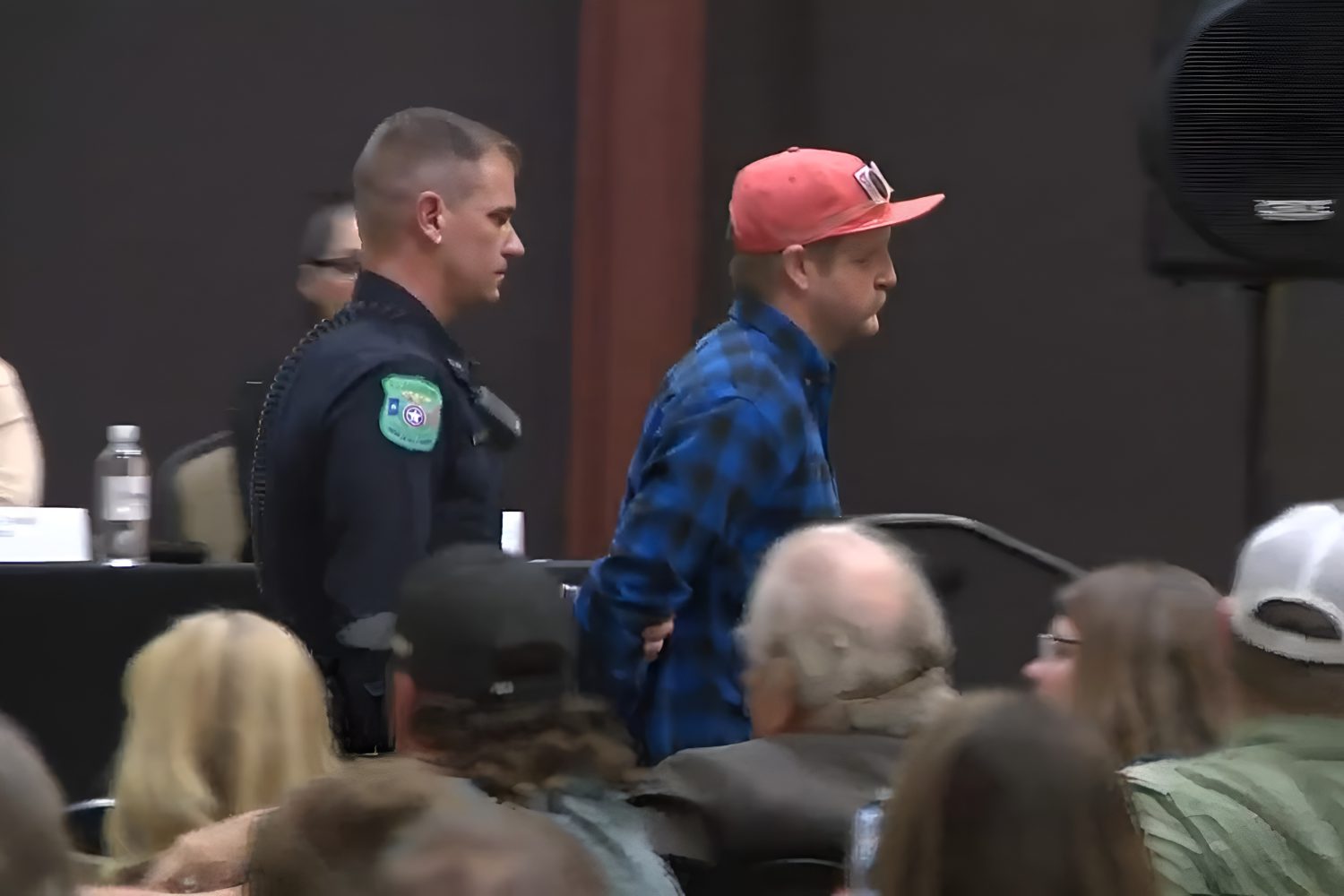
It is a packed Claremore City Council chamber, February 17, 2026. Farmer Darren Blanchard is wrapping up his remarks against Project Mustang — a proposed data center campus tied to Beale Infrastructure — when an officer says “Arrest him.” Blanchard had spoken roughly 30 seconds past a three-minute limit. He was handcuffed and charged with criminal trespass, a municipal offense carrying a maximum $200 penalty. He pleaded not guilty. Then he tried to get the records to fight it. That’s when things got expensive.
The $17,000 Paper Wall
The city priced public accountability like a legal retainer.
Claremore quoted Blanchard and his attorney Katie Griffin $17,125.44 to fulfill their records request. The breakdown:
- $16,540.44 in legal review and redaction costs for roughly 2,800 records
- $585 for 15 hours of staff search time
The city’s justification was that lawyers needed to comb through everything because the footage was shot in a “very crowded room” with an “incalculable number of people” whose privacy required protection.
Claremore also complained, in a letter to the Oklahoma Attorney General’s Office, that records released to Blanchard were “subject to wide distribution, including on social media.” You know this move — essentially arguing that public accountability becomes more dangerous when the public can actually see them. Worth a dry aside: Claremore had previously quoted $1,750 for just the bodycam footage before dropping it to $120 under scrutiny. The $17,000 ask fits a pattern.
“The City is foreclosed from charging search fees.” — Assistant AG Anthony Sykes
Assistant AG Anthony Sykes identified two fatal flaws in Claremore’s fee structure:
- The city had never posted a publicly available fee schedule — something Oklahoma’s Open Records Act explicitly requires. Without that posted schedule, the right to charge search fees disappears entirely.
- Claremore never demonstrated how 15 hours of staff time constituted “excessive disruption” of essential functions, nor did it explain why it billed at the city clerk’s rate rather than using a less costly employee.
No Privacy at a Public Meeting
If you attended a public meeting, you were already in public.
On the bodycam footage specifically, Sykes was blunt. Footage from a public meeting attended by scores of people carries no reasonable expectation of privacy. The city identified no state or federal law justifying redaction of any portion. His conclusion: Claremore “should be able to provide access promptly.”
“No one in attendance had any reasonable expectation of privacy.” — Assistant AG Anthony Sykes
Blanchard’s case isn’t a one-off. A Kansas teacher was arrested for clapping during public comment at a city meeting about data centers. A Texas man was arrested in his driveway a week after saying “bullshit” during a public meeting. Strict time limits and five-figure records fees form the procedural combination that determines who gets heard — and who simply gets worn down.
The AG’s opinion isn’t a court ruling, but it puts every Oklahoma city on notice: no posted fee schedule means no search fees. Claremore did not respond to 404 Media’s request for comment on the directive.