




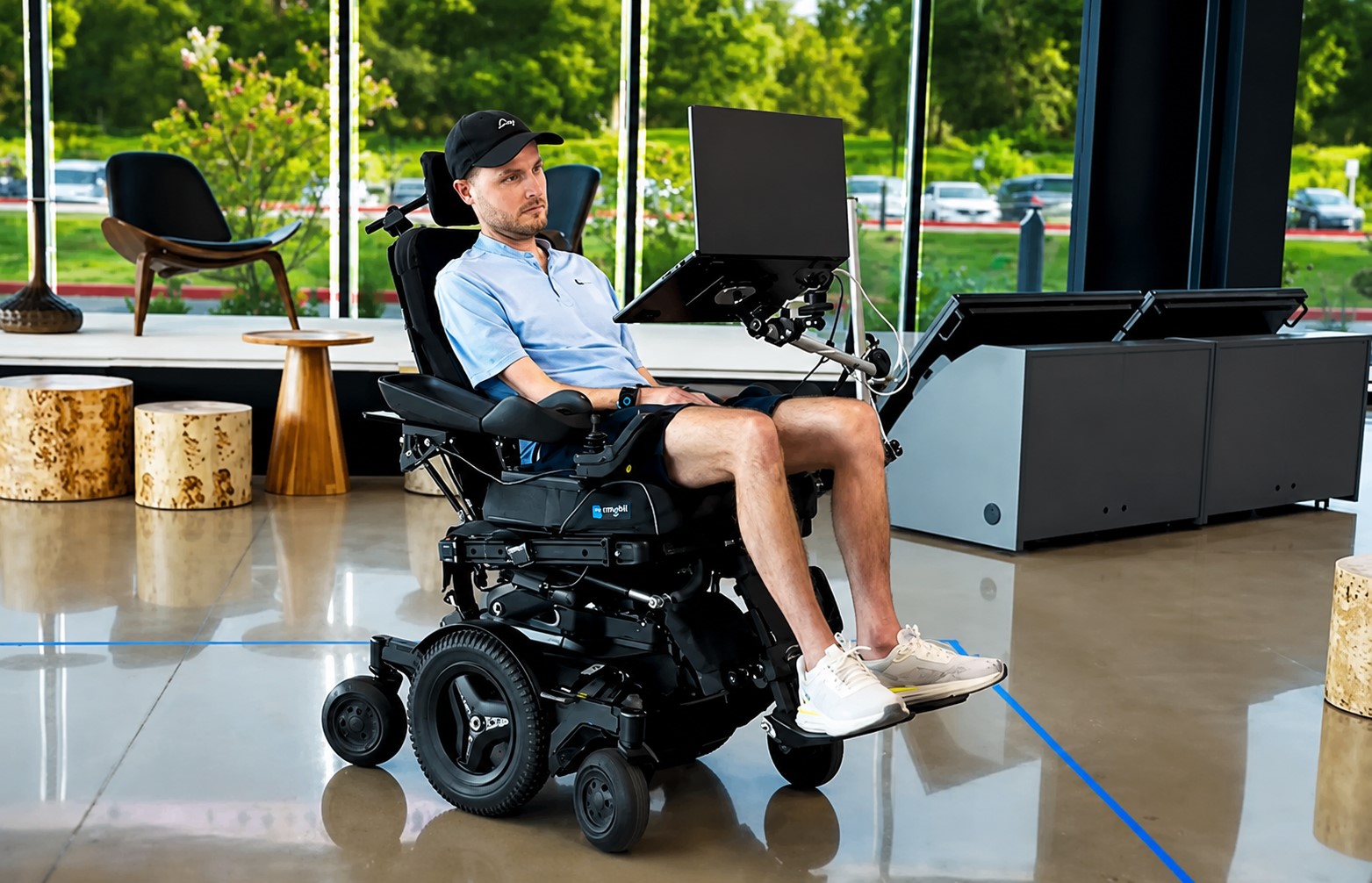
A quadriplegic person rolls through a room — no joystick, no breath tube, no head tilt. Just thinking about moving. That’s what Neuralink’s clinical trial participants are doing with the company’s N1 brain implant, a wireless chip implanted in the motor cortex that translates neural intent into wheelchair commands. The underlying mechanics are surprisingly literal: think about moving your hand right, and the chair turns right. It sounds like something lifted from a superhero origin story, but 21 enrolled participants are doing it in real trials right now.
How a Thought Becomes a Turn Signal
The N1 implant converts neural firing patterns into driving commands through a chain of hardware and machine learning that takes milliseconds — not magic.
1,024 electrodes on 64 flexible threads — each thinner than a human hair — sit inside the motor cortex, placed by Neuralink’s R1 surgical robot. A machine learning model reads the neural spikes and maps them to a 2D cursor moving along X and Y axes. That cursor becomes a virtual joystick. Custom electronics then translate joystick signals into commands any standard powered wheelchair already understands, according to TechEBlog’s coverage of the demo.
“The first patient could operate a cursor simply by thinking within minutes. It’s incredibly swift. The signals are interpreted, and artificial intelligence decodes them,” a Canadian neurosurgeon involved in Neuralink’s trials told CBC News.
Here’s what the system looks like in practice:
- Participants watch a live camera feed from the wheelchair streamed into a control program; the thought-driven cursor steers within that interface
- Pushing the cursor further in one direction increases speed; releasing attention auto-recenters it, and the chair slows and stops — no runaway motion
- One participant reported that traditional joystick controls left him slumped and in pain; thought-driven control let him sit upright
- An Irish participant with motor neurone disease drove through a London park four days post-surgery, using third-party software from German firm Homebrace
- The N1 remains investigational with no FDA approval; primary trial completion is projected around 2026, full study conclusion by 2031
The Gap Between Demo and Daily Life
Twenty-one global participants and no FDA approval means this technology is genuinely promising — and genuinely far from your doorstep.
If you’ve tracked BCI promises for years, the pattern is familiar: stunning demo, long regulatory slog. Non-invasive alternatives like EEG caps, eye-tracking systems, and sip-and-puff controls have existed for decades, but they trade precision for accessibility. What’s different here is signal quality — 1,024 intracortical electrodes versus surface-level noise. Motion that initially felt jerky reportedly smoothed out within minutes, pointing to rapid AI calibration rather than user practice alone. For context on body-worn motor-assist approaches, the robotic knee exoskeleton work coming out of academic labs shows how varied the assistive-mobility landscape has become.
Still, 21 participants globally is remarkable for neuroscience but thin for product validation. Questions about long-term implant safety, neural data privacy, and corporate control over brain signals remain open and serious — not hypothetical footnotes. Research into preserving brain tissue integrity is one adjacent field that may ultimately inform how implant longevity is assessed. Neuralink itself acknowledges “more to do” before independent mobility is broadly restored.
The same implant already used for gaming, typing, and posting on social media is now moving people through physical space. That’s a meaningful shift in scope. Readers curious about more accessible options in the meantime may find value in exploring smart gadgets designed to ease everyday life. The technology works in controlled settings — getting it out of them is the harder problem.


























