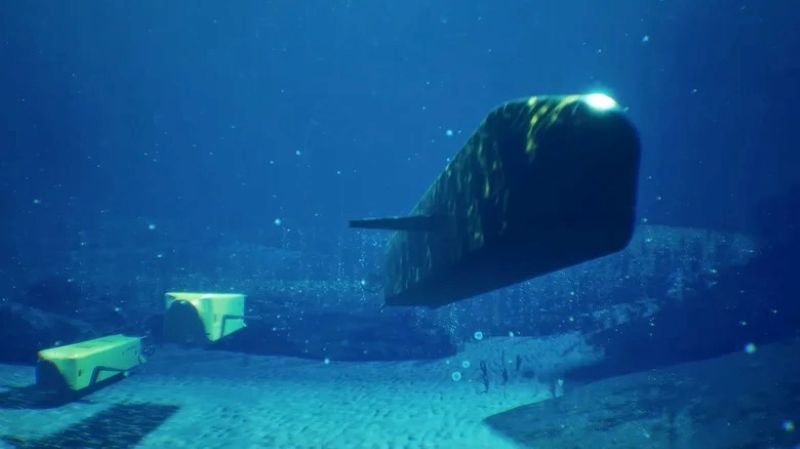
This isn’t your average military drone announcement. Lockheed Martin’s Lamprey Multi-Mission Autonomous Undersea Vehicle does something no underwater weapon has pulled off before: it latches onto any ship or submarine hull like a mechanical remora, recharging its batteries during the ride to wherever mayhem needs delivering. Unveiled February 9, the internally-funded project sidesteps the usual defense procurement glacial pace, handing the Navy a plug-and-play warfare tool that arrives at 100% charge.
Self-Charging War Machine Fits in Your (Very Large) Backpack
Twenty-four cubic feet of modular mayhem that reconfigures for any mission.
The Lamprey packs serious hardware into its 24 cubic foot payload bay. Think of it as underwater IKEA furniture—modular, configurable, surprisingly effective once assembled. That space accommodates:
- Anti-submarine torpedoes
- Electronic warfare systems
- Acoustic decoys that confuse enemy sonar
- Short-range UAVs for surveillance strikes
Built-in hydro-generators harness water flow during transport, eliminating the battery anxiety that plagues every autonomous system. No host modifications required—this thing clamps onto hulls using integrated docking anchors that would make a maritime Airbnb jealous.
Two Flavors of Underwater Chaos
Dual operating modes transform static sea control into dynamic warfare.
Paul Lemmo, Lockheed’s Vice President of Sensors, Effectors & Mission Systems, frames it bluntly: “The modern battlespace demands platforms that hide, adapt and dominate. Lamprey MMAUV was internally funded, letting us iterate at lightning speed and hand the Navy a true multi-mission weapon that detects, disrupts, decoys and engages on its own.”
The system operates in dual modes:
- Assured Access for reconnaissance and strikes
- Sea Denial for disruption and deception
After detaching, it loiters on seafloors autonomously, coordinates with other unmanned systems, and executes missions without human oversight. Think Roomba meets submarine warfare.
Naval Strategy Meets Silicon Valley Speed
Internal funding bypassed bureaucracy to deliver next-generation underwater dominance.
While traditional defense projects crawl through bureaucratic approval cycles, Lockheed’s internal funding let engineers iterate rapidly. The result challenges every assumption about underwater warfare persistence. Instead of single-use weapons or battery-limited patrols, the Lamprey creates persistent presence at lower cost than manned platforms.
At-sea testing validates autonomous capabilities that transform static sea denial into dynamic, adaptive control. You’re witnessing naval strategy evolution in real-time—where underwater drones become force multipliers rather than expensive torpedoes.