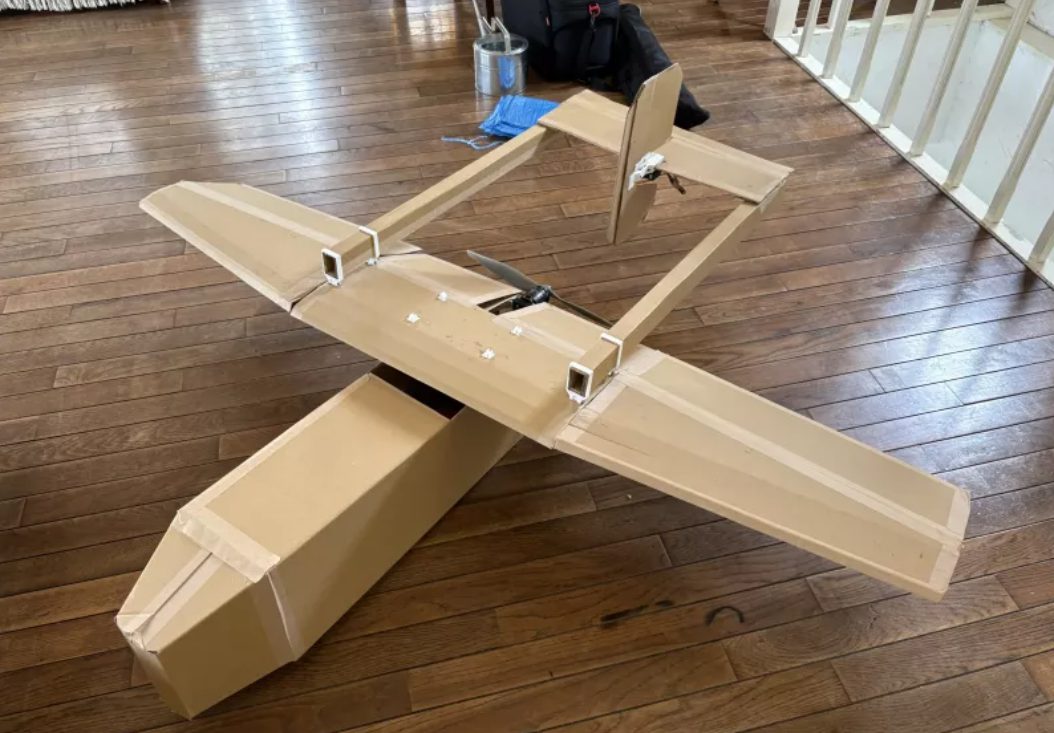
Our assumptions about military technology just got shredded like an Amazon box. Japan’s AirKamuy 150 drone—built primarily from corrugated cardboard—hits 74 mph while costing roughly the same as a decent gaming rig. The Japan Maritime Self-Defense Force isn’t just testing these things; they’re actively using them for training after Defense Minister Shinjirō Koizumi personally met with AirKamuy to discuss deployment.
This isn’t some garage experiment gone viral on TikTok. The cardboard airframe sports water-resistant coating, carries a 3-pound payload, and maintains 80-minute flight endurance across 50-mile ranges. More importantly, it assembles by hand in 5-10 minutes without specialized tools—meaning you could theoretically build swarms faster than IKEA furniture.
Mass Production Changes Everything
Flat-pack shipping enables 500 drones per container, revolutionizing military logistics.
While America’s Lucas drone costs $10,000 and manages 63 mph, Japan prioritized scalability over sophistication. The AirKamuy ships flat-packed—500 units per standard container—then assembles on-demand anywhere. Ukraine’s lessons hit hard: expensive precision systems become expensive targets, but disposable swarms overwhelm defenses through sheer numbers.
The cardboard construction isn’t just about cost savings. Lower radar reflectivity makes these drones harder to detect, while electric propulsion keeps noise signatures minimal. Compared to Iran’s Shahed series, the AirKamuy trades range for assembly speed and production volume.
Beyond Military Applications
Dual-use design targets civilian delivery and emergency response markets.
AirKamuy positions these drones for package delivery and disaster relief alongside military target practice. Emergency response teams could theoretically deploy communication relays or medical supplies without risking expensive equipment in dangerous conditions. The disposable nature that makes them perfect for military expendable roles also suits civilian missions where recovery isn’t guaranteed.
Japan’s broader “Shiraha” project includes even cheaper wooden drones at $450 per unit, all domestically manufactured following Ukraine battlefield lessons. This shift toward mass-produced expendables marks a fundamental change in military aviation doctrine. Your delivery drone might soon share DNA with tomorrow’s swarm weapons.