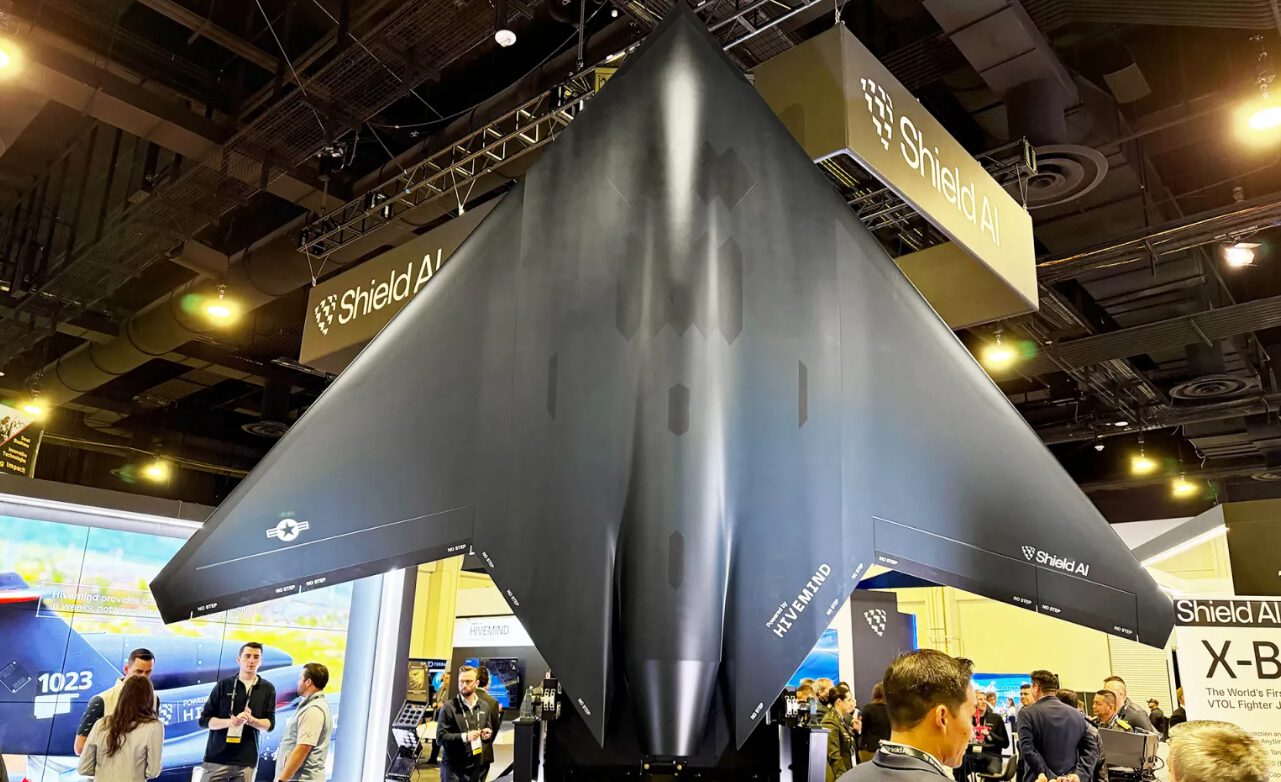
The X-59 autonomous fighter drone looks nothing like it did a year ago. Shield AI scrapped the original cranked-kite wing design for a sleek arrowhead profile with straight leading edges and dramatic sweep—think F-117 meets modern stealth fighter.
This isn’t just aesthetic tweaking. The redesign optimizes the jet-powered drone for higher-speed flight while maintaining its runway-free VTOL capabilities. According to Armor Harris, Shield AI’s senior vice president of aircraft programs, the transformation addresses speed limitations that would have constrained combat effectiveness in contested airspace.
Proven Power Plant Meets Vintage Vectoring Tech
Under the hood sits the same F110-GE-129 turbofan that powers F-15 and F-16 fighters—a deliberate choice for thrust, fuel economy, and the fact that over 3,400 units already exist in military inventory.
The real engineering magic happens at the business end. Shield AI paired this proven engine with a 1990s Axisymmetric Vectoring Exhaust Nozzle (AVEN) that Harris describes as “Indiana Jones-style” tech rescued from warehouse storage. Originally tested on the F-16 MATV program, the AVEN nozzle enables full-regime thrust vectoring that makes tail-sitter VTOL operations possible without traditional landing gear or ground support equipment.
Fighter-Class Performance in a Runway-Free Package
Size-wise, the X-BAT splits the difference between current collaborative combat aircraft and full fighters. It’s twice as large as typical CCAs but packing F-35-sized internal weapons bays capable of carrying 2,000 pounds of ordnance.
The performance envelope spans:
- Strike missions
- Counter-air operations
- Electronic warfare
- Aerial refueling missions through external buddy pods
With a 1,000-nautical-mile combat radius and 50,000-foot service ceiling, this 39-foot-wingspan drone delivers legitimate fighter capabilities without requiring vulnerable airbases or trained pilots. These capabilities rival those of hypersonic missiles in terms of strategic impact.
Disrupting Military Aviation Economics
The economic argument hits harder than the technical specs. According to Shield AI projections, 10 to 20 X-BATs cost roughly the same as one B-21 bomber. Production plans call for 150 units annually starting around 2029, with significant international interest already evident.
First prototype flights begin summer 2026 from the company’s Frisco, Texas facility, followed by tethered and free-flight VTOL testing by year-end. Harris admits they expect mishaps in their “hardware-rich” development approach—apparently channeling SpaceX’s philosophy of rapid iteration through controlled failures, similar to other innovative aircraft like the Phantom 3500.
If successful, the X-BAT could fundamentally alter military aviation by eliminating the traditional infrastructure requirements that make air power vulnerable and expensive.