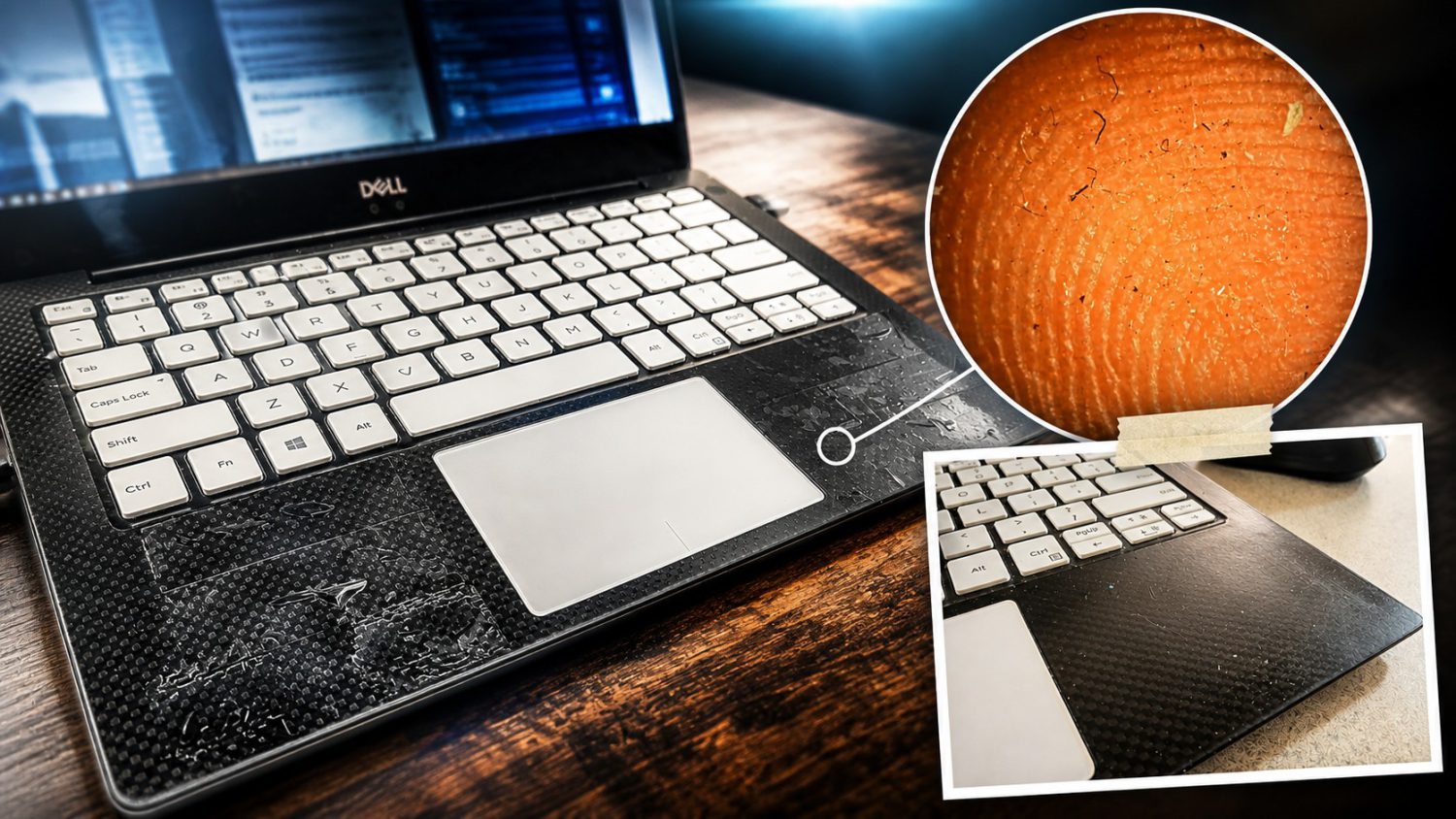
Dell’s 2018 XPS 13 9370 was pitched as precision-crafted hardware inspired by aerospace engineering. Strong. Light. Built to last. Parker Drouillard’s palms tell a different story. After years of daily use, his laptop’s soft-touch coating has worn through to bare carbon fibre — and the microscope footage he shared shows what appear to be fibres lodged in his fingertip. His description of typing on it: “like a cactus constantly pricking me.” Dell’s own marketing once boasted that the glass fibre in a single palm rest could wrap around the Earth almost five times. Impressive stat. Considerably less impressive when the material starts embedding itself in your skin.
When “Aerospace-Grade” Meets Your Actual Hands
Carbon fibre composites are only as safe as the coating protecting them — and that coating has a lifespan.
Carbon fibre composites are bundles of extremely fine filaments held together in a resin matrix. Intact, they’re genuinely impressive — high strength, low weight, cool to the touch. But “intact” is doing a lot of work in that sentence. Once the protective soft-touch coating wears through and the resin matrix degrades, those filaments can behave exactly like splinters — microscopic, sharp, and remarkably efficient at finding skin.
Drouillard’s pins-and-needles sensation and his microscope footage are user-reported and not independently verified by a lab. The mechanism, however, is consistent with how damaged carbon fibre composites behave — a degradation pattern well-documented in composite materials literature. This isn’t fringe speculation. It’s physics.
Dell’s marketing emphasized UV resistance and stain protection extensively. Mechanical wear from a human hand, apparently, was a less urgent concern.
Here’s what Dell’s own documentation confirms:
- The silver/black XPS 13 9370 uses a carbon fibre composite palm rest with a soft-touch coating
- The palm rest is a discrete, replaceable assembly per Dell’s official service manual
- OEM replacement parts are available through third-party resellers
- Dell has not publicly acknowledged this as a widespread issue or safety concern
Seven Years Later, the Bill Comes Due
No review cycle covers what daily friction does to a palm rest across half a decade.
No 2018 review flagged this — because no reviewer spends seven years with a laptop before filing copy. That’s not a knock on tech journalism; it’s a structural blind spot the entire industry shares. Standard review timelines capture first impressions, not long-term material fatigue.
The tape workaround Drouillard deployed works. It also represents a stark gap between premium positioning and long-term reality. The part is replaceable, which matters more than it might seem in an era where right-to-repair remains a fight, not a given. Dell had not responded to this specific case at time of writing.
Premium materials require premium long-term thinking from manufacturers. When the coating goes, what’s underneath it matters. If you’re still running an XPS 13 9370, check your palm rest now — and know that a replacement assembly exists if the surface has started to feel wrong.