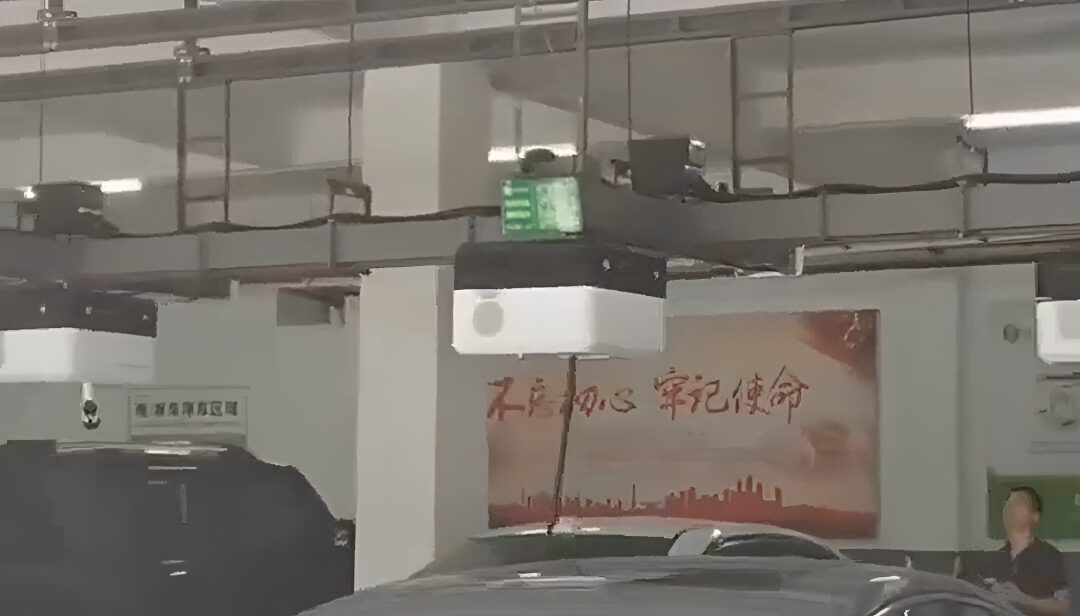
Circling cramped parking garages while your EV battery dies and charging spots stay occupied? Chinese engineers just eliminated that nightmare with robotic arms that deliver power from the ceiling. These overhead charging systems use trolleys mounted on rails to position charging cables directly above parked vehicles, turning any parking space into a potential charging station.
How Ceiling-Mounted Chargers Actually Work
The system resembles something from a sci-fi movie, but the mechanics are straightforward. Motorized trolleys glide along ceiling-mounted rails throughout multi-level parking garages, carrying charging cables that lower down to plug into vehicles below. When you park and request charging through an app, the nearest available trolley navigates to your spot and drops the cable. No more hunting for working chargers or dealing with tangled floor cables blocking walkways.
Space Efficiency Meets China’s Megacity Reality
This innovation addresses a uniquely Chinese problem: how to charge millions of EVs in cities where every square meter matters. Shanghai and Beijing already achieve 93% and 81% coverage within five-minute drives of city centers, but garage space remains premium real estate. Overhead systems could potentially boost parking utilization by 20-50% since traditional charging stations consume entire parking spaces even when not actively charging vehicles.
The Reality Check Behind Viral Videos
Before you get too excited, forum discussions reveal some practical friction. Users analyzing viral videos estimate 15-minute waits just for the robotic charger to position itself above your car—and that’s before the actual 5-7 hour charging session begins. As one forum user noted, “imagine it takes 5-7 hours charging, you need to stand there 15 minutes just to wait for the charger to come to you.” The promotional videos appear sped up, masking the reality of automated positioning delays.
Technical Foundation Built on China’s Charging Dominance
These installations leverage China’s 56 GW public charging network—the world’s largest—and newly updated GB/T charging standards effective through 2025. The country holds 40% of the global DC fast-charging market, with State Grid Corporation deploying over 80 high-power ChaoJi sites since 2022. This existing technical foundation and standardization make overhead automation feasible at scale.
Global Urban Future or Chinese Curiosity?
While China’s megacities drove this innovation, any urban area struggling with EV charging real estate could benefit. The technology remains early-stage, with obvious user experience kinks to resolve. But imagine never again circling parking garages hunting for open chargers—your spot becomes the charging station. That future might be worth a 15-minute wait.