This new approach embeds 200 kilowatts of wireless charging power directly into highway lanes for moving vehicles.
Range anxiety kills EV adoption, but Florida’s State Road 516 project flips the script entirely. Instead of building more charging stations, engineers are embedding 200 kilowatts of wireless charging power directly into three-quarters of a mile of highway. Your Tesla could theoretically gain juice while cruising through Orlando traffic at 70 mph.
How Magnetic Roads Actually Work
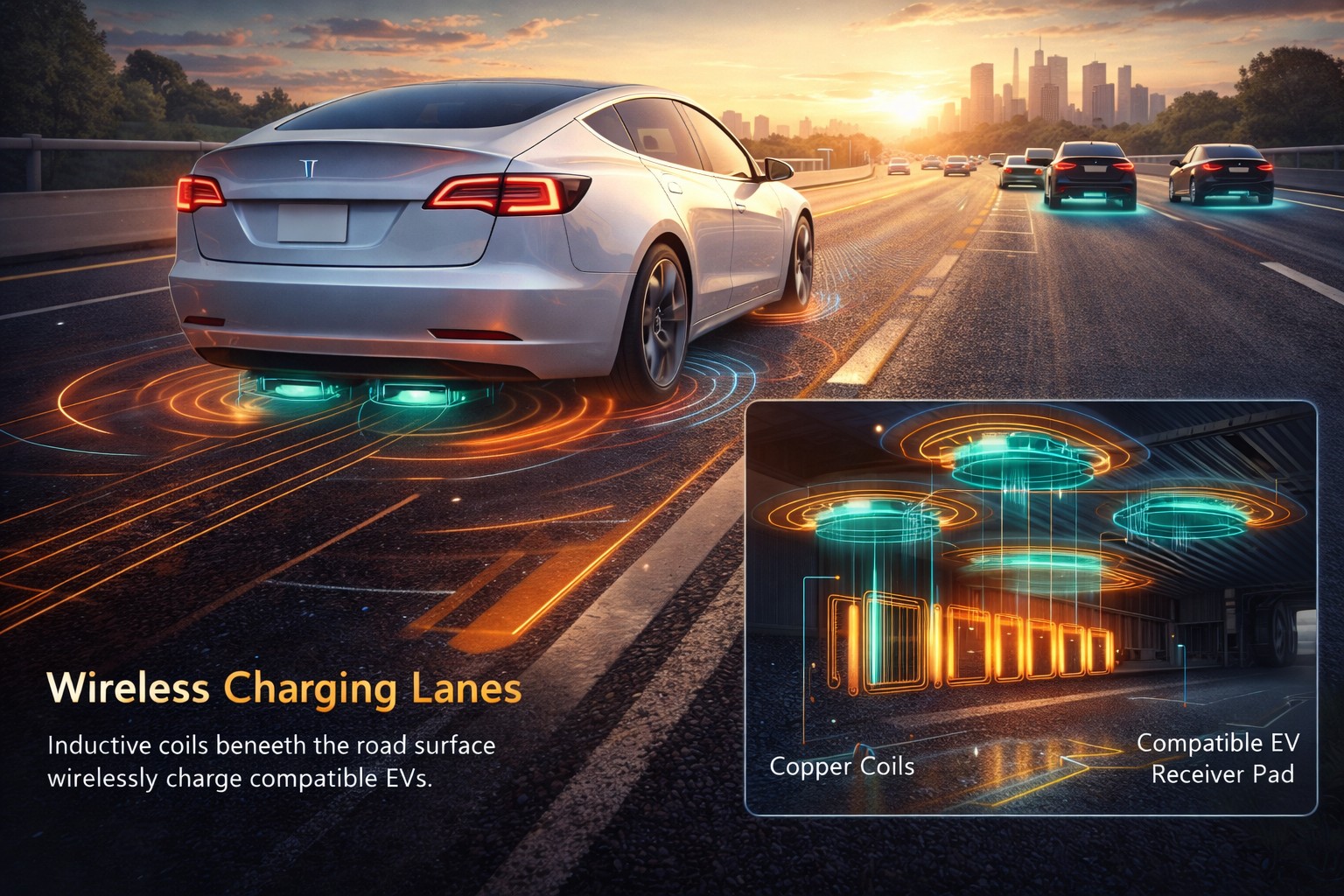
Inductive coils buried beneath asphalt create invisible charging lanes for compatible vehicles.
The technology sounds like science fiction but operates on basic electromagnetic principles. ENRX, the Norwegian company that won the $13.6 million contract, installs copper coils under the road surface that generate magnetic fields. Compatible EVs need receiver pads mounted underneath—think wireless phone charging scaled up dramatically. The system delivers power that exceeds most fast-charging stations, all while you maintain highway speeds. Construction starts in 2026 as part of a $500+ million expressway connecting Lake and Orange counties.
The Compatibility Reality Check
Only specially equipped vehicles can use the system initially, limiting immediate practical benefits.
Here’s where expectations meet engineering reality. Your current Model Y or ID.4 won’t benefit from Florida’s wireless lanes without retrofitting receiver hardware. The pilot launches with test vehicles designed specifically for the program. ENRX claims their system accommodates “different vehicle classes and battery types,” but automakers haven’t committed to integrating wireless receivers as standard equipment yet. SAE International is developing global compatibility standards, though that process typically takes years to finalize and implement across manufacturers.
What This Means for EV Adoption
Success could reshape how we think about vehicle batteries and highway infrastructure investment.
If wireless charging proves reliable at highway speeds, the ripple effects extend beyond Florida. Smaller battery packs become viable when roads provide continuous power, potentially reducing EV costs and weight. Range anxiety dissolves when highways function as charging networks. According to ENRX CEO Bjørn Eldar Petersen, “When you can charge while driving, range anxiety and frequent charging stops will be a thing of the past.”
The math matters too: at roughly $18 million per mile of charging infrastructure, this approach demands serious cost justification. However, compared to building charging stations every 50 miles along major corridors, wireless highways might actually prove cost-effective. The real test comes when ordinary drivers experience seamless charging at interstate speeds.