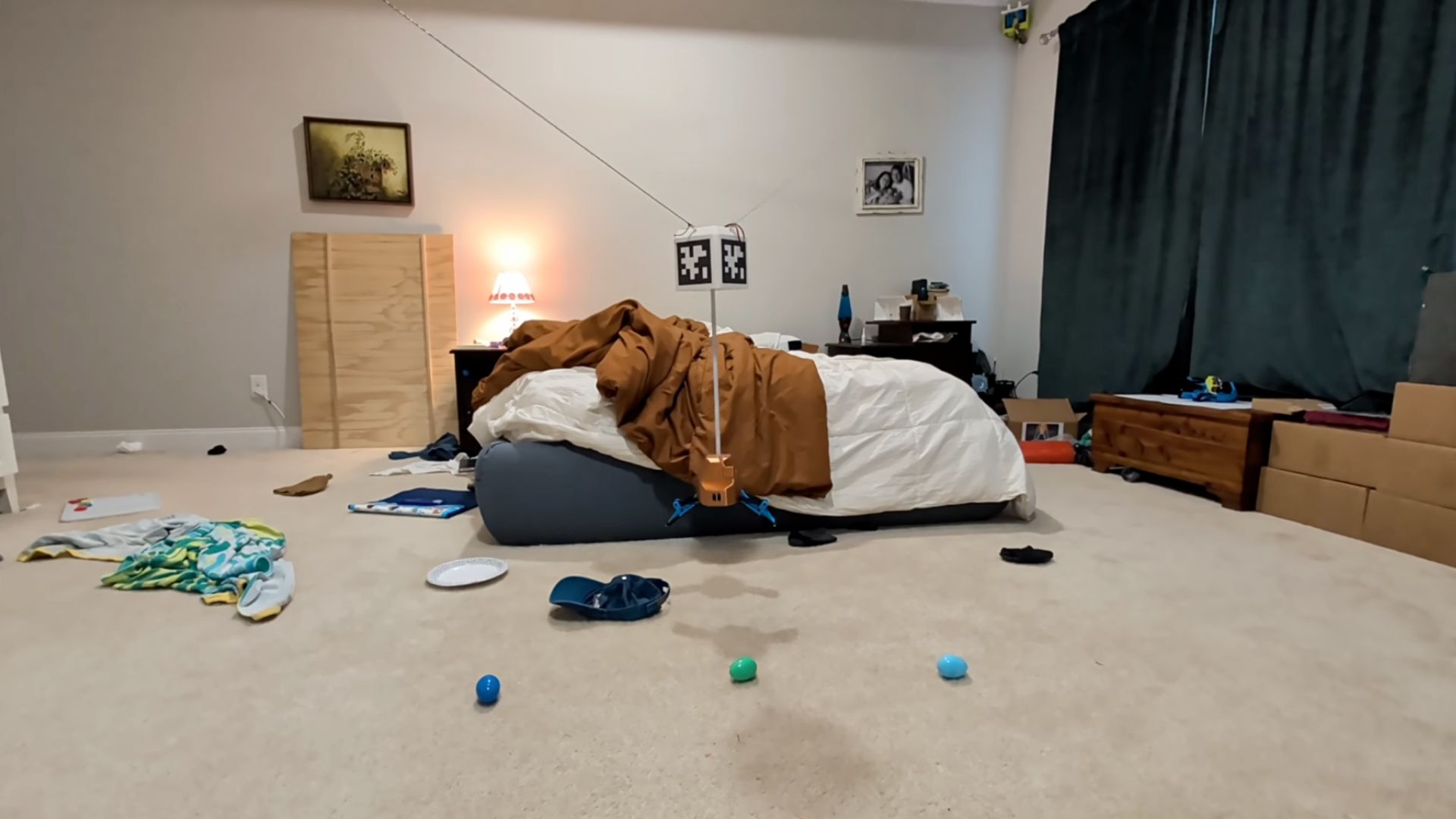
You know the scene. LEGO minefield. Socks everywhere. A stuffed animal graveyard stretching wall to wall. Your robot vacuum bumps into it all and gives up. Nifong, an engineer and parent, decided the solution wasn’t a humanoid robot or a smarter vacuum. It was a crane. His creation, Stringman, hangs from four anchors in ceiling corners and uses cable-driven mechanics to lower a small gripper anywhere in a room’s airspace. Think of it as a claw machine that actually grabs things — according to project documentation from Neufangled Robotics.
How a Ceiling Crane Learns Your Mess
Four motors, a Raspberry Pi brain, and imitation learning let Stringman sort clothes from toys without sending video to the cloud.
Four high-strength cables connect to motorized spools at the room’s corners. Reel them in or out, and the two-finger gripper reaches nearly any point in the room, including under furniture. The brain is a Raspberry Pi running LeRobot firmware — an open-source framework where you teleoperate the gripper once, and it learns to repeat the task on similar objects. Visual tags clipped to bins tell it where socks go versus stuffed animals versus trash. Swing-cancellation software keeps the suspended gripper from behaving like a pendulum mid-transit.
- Hardware runs roughly $1,000 as a DIY build or pilot kit from Neufangled Robotics
- Fully local processing on your home network — no video leaves your house
- Wall-outlet powered, so no battery anxiety
- Open-source under Apache 2.0 with OSHWA certification (ID: US002788)
Stringman can reportedly run autonomously for about an hour, picking up scattered clothing and toys, according to project documentation.
What It Can’t Do (Yet)
Flat objects, ceiling anchors, and dangling cables mean this is still a maker project, not an appliance — but the trajectory is worth watching.
Flat items like books defeat the gripper reliably. Installation demands drilling into four ceiling corners, which ends the conversation for renters immediately. Those operating cables also descend into your living space during use — Nifong himself notes tall occupants should “watch your head.” Compare that to the early Roomba era, when people baby-gated their stairs to keep a $200 hockey puck from tumbling to its death. Early-stage doesn’t mean pointless.
Stringman sits somewhere genuinely interesting: far cheaper than any humanoid robot, narrower in scope, but solving a task that actually matters to real households. The broader bet — task-specific robots mounted to existing infrastructure — feels more like sous vide cooking than hiring a personal chef. Precise, limited, and useful in ways that compound over time.
This isn’t ready for your non-technical neighbor yet. But the path to automated homes might run through the ceiling, not through a bipedal machine that costs more than a car.