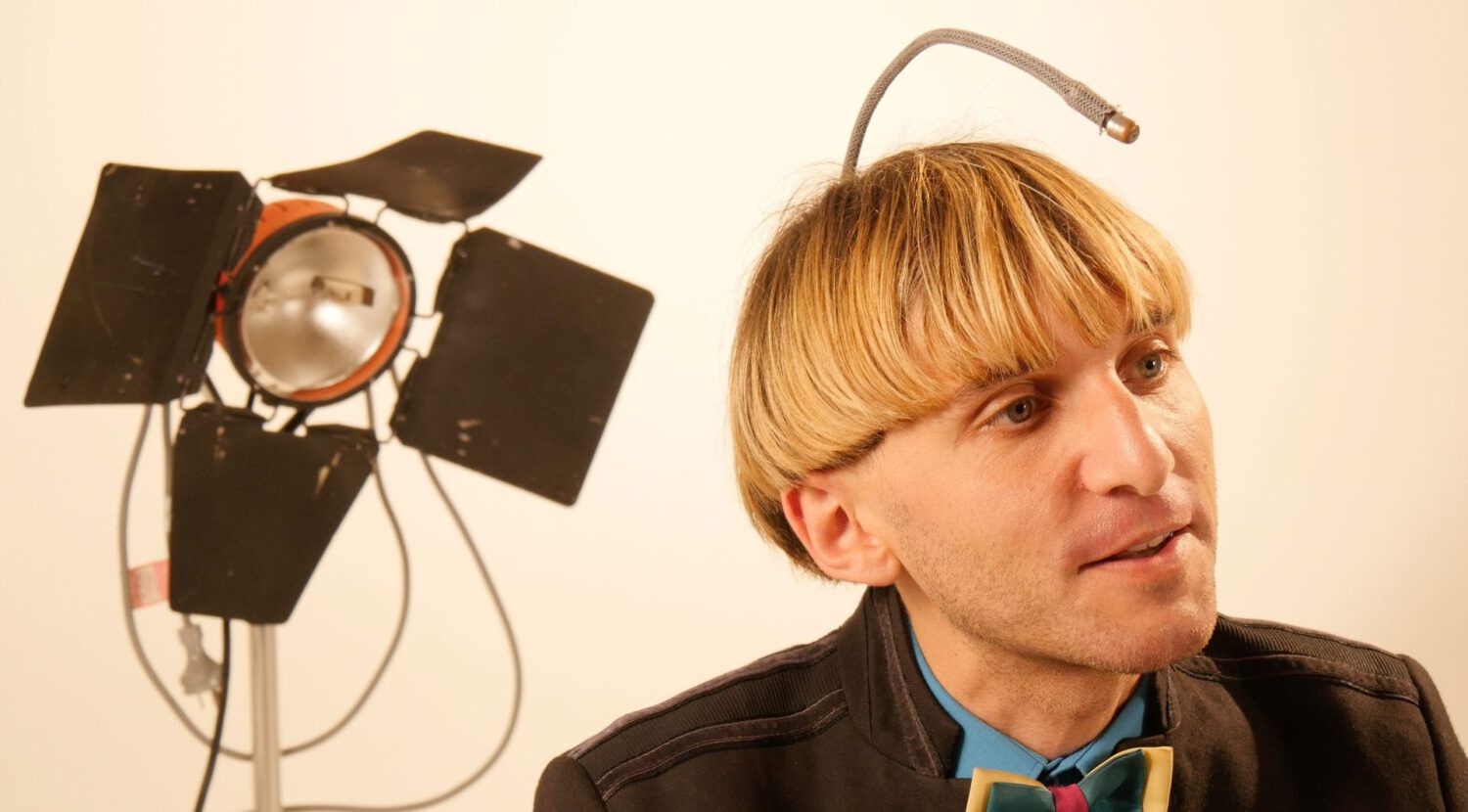
UK passport authorities made an unusual call: they permitted Neil Harbisson to appear in his official photograph with an antenna extending from the back of his skull. That single administrative decision, treating the device as part of his body rather than an object he was wearing, led Guinness World Records to recognize Harbisson as the world’s first officially recognized cyborg.
Harbisson was born with achromatopsia, a condition that produces complete color blindness. He has experienced the world in grayscale since birth.
The implant was placed in 2004 and extends from the rear of his skull. Harbisson treats it as an integrated sensory organ rather than a prosthetic or removable accessory.
A sensor at the tip of the antenna detects light frequencies and converts them into vibrations. Those vibrations travel through the skull via bone conduction, and Harbisson perceives them as pitches associated with specific colors.
The antenna also detects ultraviolet and infrared wavelengths, ranges that fall outside ordinary unaided human vision. Harbisson does not simply access a sensory experience that achromatopsia denied him; he perceives parts of the electromagnetic spectrum beyond what typical human vision can reach.
Publicly available accounts describe wireless capabilities built into the antenna. These have reportedly included receiving external images, signals, and internet data, extending the device’s function beyond passive light detection.
Harbisson uses the color-to-sound translation as the foundation of his artistic practice. His output spans cyborg art, music, portraits, and live performances, with the antenna functioning as a sensory and creative instrument rather than solely a medical aid.
A portrait session, for example, becomes an exercise in translating a face’s color palette into a musical composition. His work draws on color information from both the visible spectrum and the ultraviolet and infrared ranges his antenna can detect.
Harbisson co-founded the Cyborg Foundation alongside artist Moon Ribas. The organization promotes cyborg art and supports people seeking to extend sensory capabilities through technology. It also advocates for cyborg rights as a recognized category.
Harbisson’s story is straightforward to reduce to a novelty: a man with an antenna and a record-book entry. That reduction overlooks what his case actually raised. As implanted technologies move from experimental use toward medical and commercial applications, questions about bodily identity and legal protections for people who alter their sensory systems are becoming harder to avoid. Those questions, about when a device becomes a body part, who owns an implant, and what rights attach to it, remain largely unanswered. Harbisson’s passport photograph was one early data point. The frameworks to address what comes next are still being written.