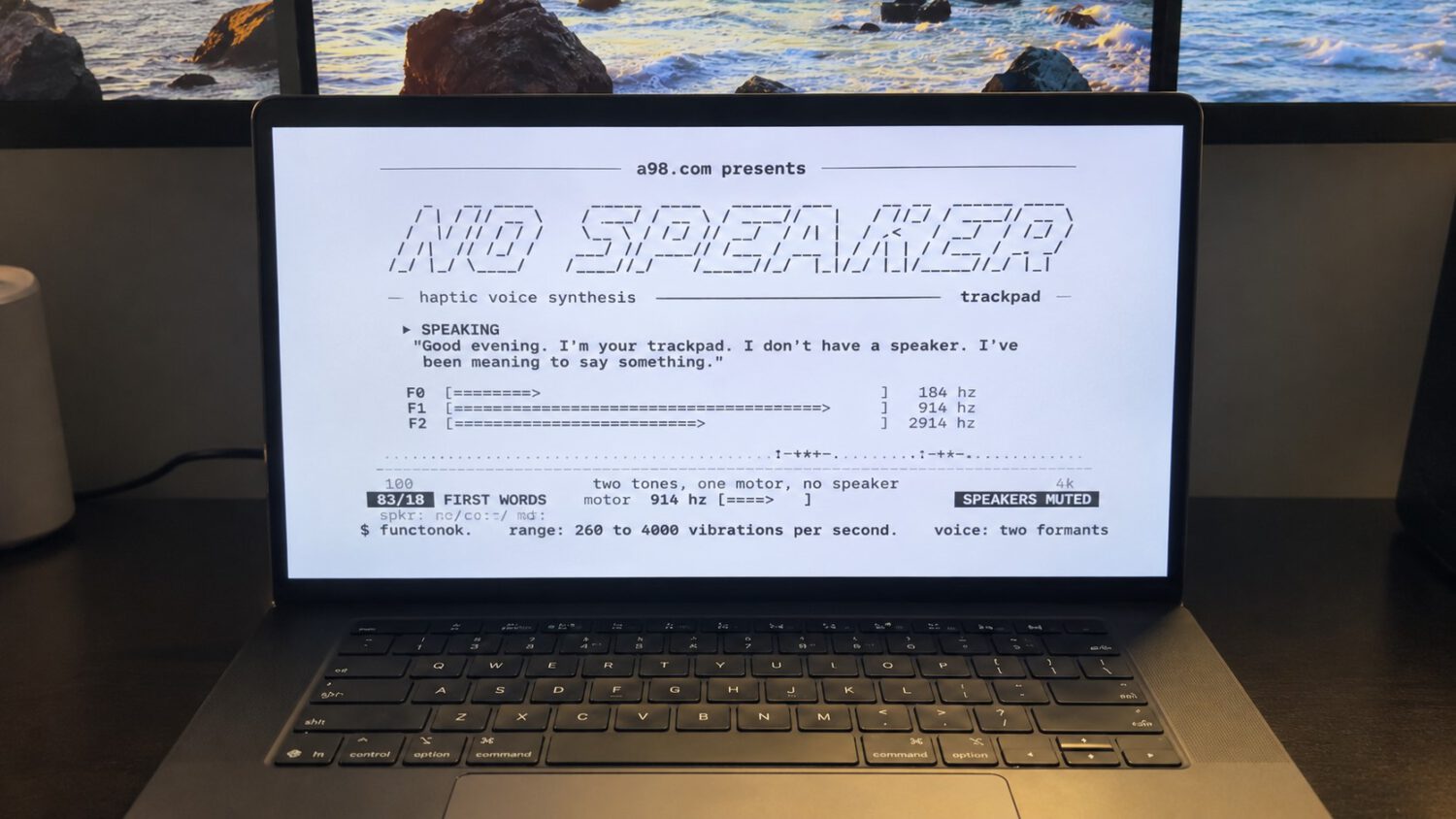
Mute your MacBook’s speakers completely, run the open-source tool, and your trackpad starts talking. That is the premise of NO SPEAKER, an experimental macOS project built by developer Cody Collier, known as os6 on GitHub.
The project drives the Force Touch trackpad’s haptic motor at rapidly changing frequencies. This causes the glass surface to vibrate fast enough to produce audible sound without touching the MacBook’s actual audio hardware. The tool requires Apple silicon Macs running macOS Monterey or later, or Intel Macs on macOS Ventura or later.
How a Click Simulator Becomes a Sound Source
The same motor that fakes a physical click turns out to have enough mechanical range to fake something stranger.
The Force Touch trackpad uses a haptic motor to simulate the sensation of a physical click by vibrating on demand. NO SPEAKER exploits that same motor by driving it at up to approximately 4,000 cycles per second, according to the project’s GitHub documentation.
At that frequency, the glass surface moves fast enough to function as a rudimentary sound-producing surface. Speech works through a two-step process: the software first generates audio using macOS’s built-in text-to-speech system, then simplifies the recording by selecting its dominant frequencies before replaying those patterns through the motor.
The output is quiet and distinctly robotic. MacRumors reports that Collier notes placing the MacBook on a hard table helps amplify the vibrations, and that comprehension improves when listeners follow the text displayed on screen at the same time.
What You Can Actually Do With It
The interactive features are real, but the tool’s scope is narrow by design.
You can type your own text, select a different installed macOS voice, and play test tones. Sliding a finger across the trackpad shifts a tone’s pitch in real time.
NO SPEAKER is not a system audio driver. Music, media files, and application sound do not route through it.
Three Constraints Worth Knowing
Private framework access, uncertain hardware wear, and strict compatibility requirements each limit how far the project can go.
The project’s most significant technical dependency is Apple’s private MultitouchSupport framework, which controls the motor’s behavior. Because Apple does not officially support this framework for third-party developers, any future macOS update could break compatibility. Readers encountering related issues may find broader context in common computer problems and solutions.
Motor longevity is also an open question. Collier says the software keeps the motor within its normal maximum operating strength, but sustained use over time has not been tested, according to MacRumors.
Supported hardware is narrow: a Force Touch trackpad is required, along with macOS Monterey or later on Apple silicon Macs and macOS Ventura or later on Intel Macs.
An Experiment, Not a Fix
NO SPEAKER earns its interest as a proof of concept, not as a practical audio solution.
NO SPEAKER is free, open source, and released under the MIT license on GitHub. Its practical value is limited.
The project does demonstrate something non-obvious: a tactile feedback component can produce audible output when driven at sufficient frequencies. That finding may interest accessibility researchers or hardware experimenters exploring unconventional alert or interface designs, though NO SPEAKER is not presented as a validated tool for any of those purposes.
It is not a workaround for a broken speaker. It is proof that the boundary between “touch” and “sound” is thinner than most Mac users assumed.