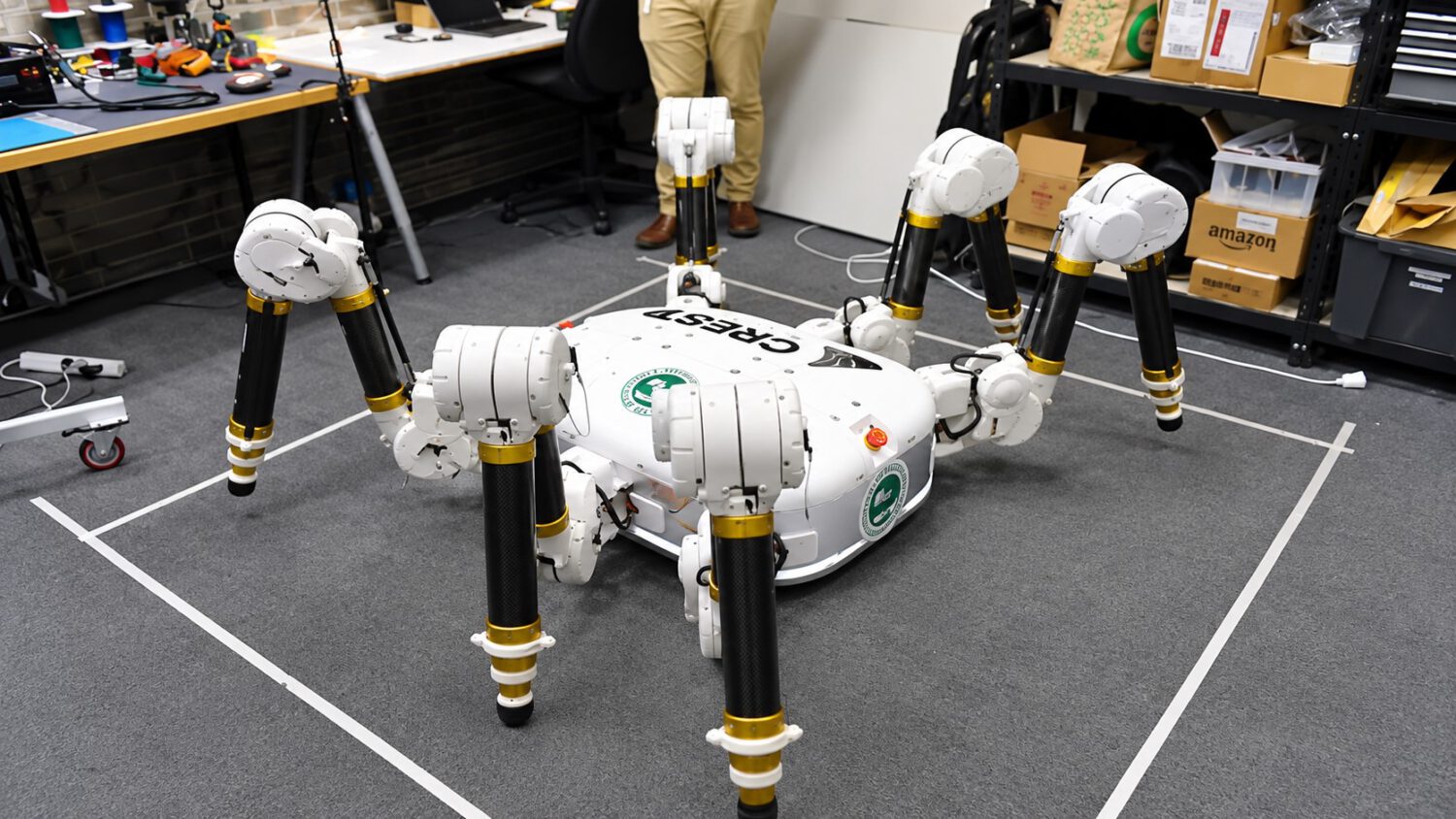
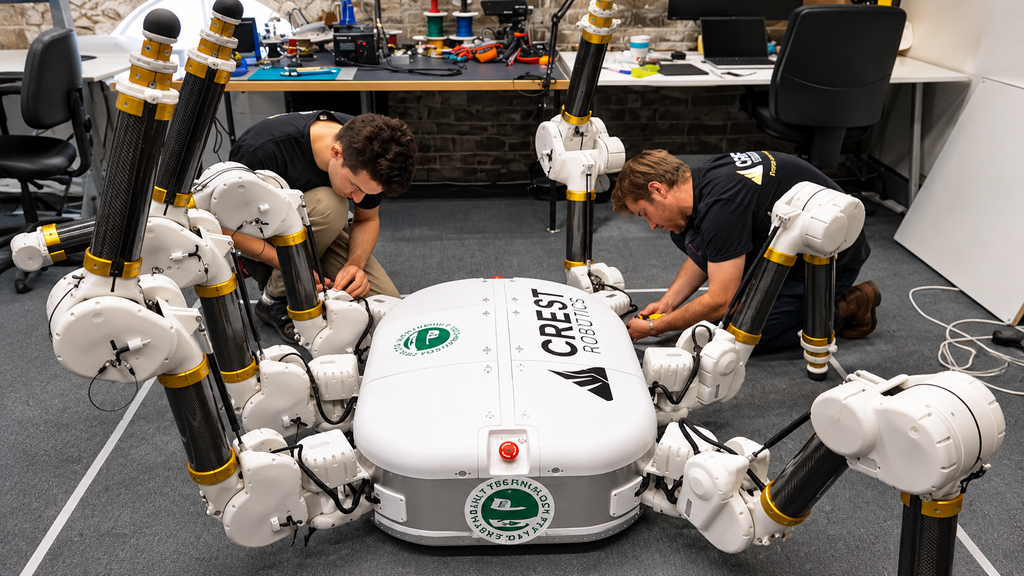
Many construction 3D printers work like oversized plotters, with a fixed gantry spanning the build area while the structure grows inside it. Charlotte, developed by Australian firms Crest Robotics and Earthbuilt Technology, flips that logic. Its six articulated legs, described in project materials as spanning more than 18 feet, let it reposition around and over the walls it is constructing rather than remaining confined by a rectangular frame.
Soil, Sand, and a Fabric Sleeve
Charlotte pairs with Earthbuilt’s large-format extrusion system to turn site-sourced material into compressed, layered wall sections.
Locally sourced material, including soil, sand, crushed brick, or waste glass, feeds into a fabric sleeve and gets compressed into successive layers intended to be load-bearing, guided by digital design files. The result is comparable to automated earthbag construction, a method with deep roots in low-cost housing, now directed by software and designed to reduce reliance on manual labor on-site.
The 24-Hour Claim, Properly Labeled
Crest Robotics and Earthbuilt Technology say Charlotte aims to complete a 200-square-meter structure in roughly 24 hours, though that figure is a projected target rather than a verified result.
The system remains under active development, and a scaled prototype has been demonstrated publicly. The developers position that speed, combined with on-site material sourcing, as a way to cut transportation costs and reduce dependence on cement-intensive construction methods.
Remote Sites First, Then the Moon
On Earth, the system targets remote or uneven terrain; on the Moon, it aims to build from the surface itself.
The system is intended to support curves, arches, and domes that standard masonry makes labor-intensive, which could benefit difficult or isolated sites where trucking in conventional materials is expensive. According to project descriptions, up to 99% of a lunar structure’s mass could potentially come from lunar regolith, the loose dust and broken rock covering the Moon’s surface. That would sharply reduce what needs to be launched from Earth, though the figure remains a design objective rather than a demonstrated result.
Crest Robotics and Earthbuilt Technology envision Charlotte building habitats, landing pads, radiation-shielding berms, and research infrastructure during future missions.
What the Moon Actually Requires
Lunar deployment would demand validation far beyond what any terrestrial prototype has yet undergone.
Charlotte’s foldable, lightweight build is intended to make transport easier than a stationary system, which is a genuine advantage on paper. But lunar deployment would require validation under vacuum conditions and temperature swings exceeding 500 degrees Fahrenheit between lunar day and night. Electrostatically charged dust can damage or impair mechanical systems, and low gravity changes how compacted material behaves.
No available reporting establishes that Charlotte has been tested under those conditions. No lunar mission selection, NASA certification, or vacuum testing has been identified for this system.
Still Seeking Collaborators
Crest Robotics and Earthbuilt Technology are seeking development and testing partners as significant engineering and regulatory questions remain open.
Significant open questions include structural certification, weatherproofing, foundation integration, plumbing and electrical routing, and fire resistance. Construction code compliance on Earth alone has not been established, let alone off it.
Charlotte represents a concept that bridges mobile autonomous construction with local-material sourcing in a distinctive way. What it is not, at least not yet, is a machine ready to break ground on the lunar surface.