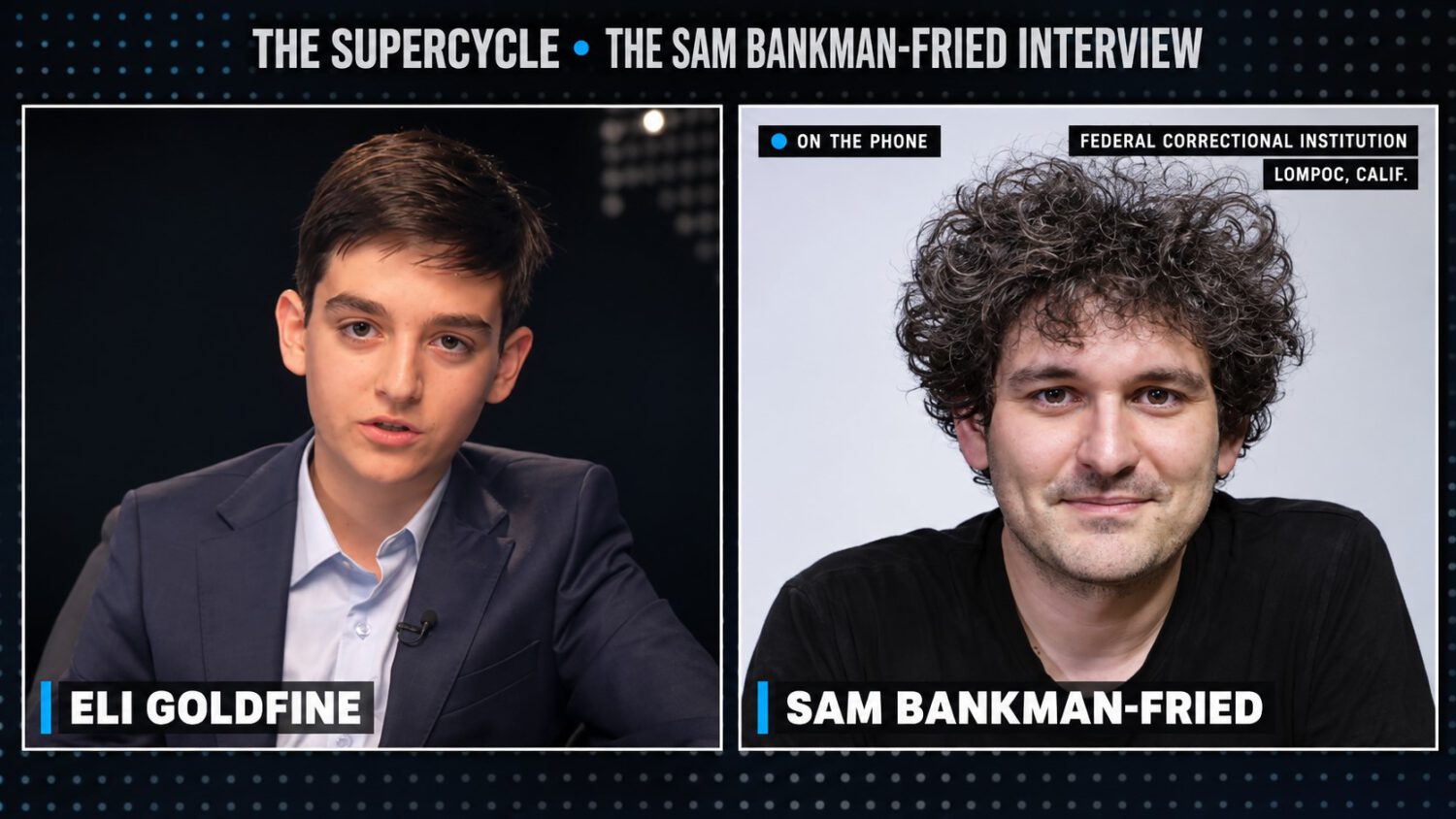
Eli Goldfine is 14 years old and hosts a technology and prediction-markets podcast called “The Super Cycle.” His most recent guest was Sam Bankman-Fried, speaking by phone from federal prison, where he is serving a 25-year sentence for fraud tied to the collapse of his cryptocurrency exchange FTX.
That detail matters before anything else does.
The Number
Bankman-Fried offered a rough personal estimate, not a scientific forecast.
Asked about the probability that AI could cause a catastrophic event affecting humanity, Bankman-Fried said the figure was “less than 50%, more than 10%,” settling at “somewhere in the 25% range.”
In AI-safety circles, this kind of estimate has an informal name: P(doom), shorthand for the estimated probability of an AI-driven catastrophe. Bankman-Fried’s figure is his subjective opinion, not a scientific finding or a position held by any research institution. Among researchers who study AI risk seriously, such estimates range from under 1% to above 50%, which illustrates how unsettled the question remains.
What He Actually Meant by “Catastrophic”
His definition of catastrophe extends well beyond a single apocalyptic scenario.
Bankman-Fried acknowledged the estimate depends heavily on how “catastrophic event” gets defined. He did not limit the term to literal human extinction.
His examples extended to scenarios where some people upload their minds into digital systems and others are left behind, a kind of civilizational fracture rather than a final endpoint. Depending on what counts as catastrophe, he suggested the range could run from roughly 20% to 60%.
Two Futures, Five Years
He described two broad trajectories and predicted rapid AI-driven displacement within the decade.
He framed survival as contingent on one of two paths: a “peaceful coexistence” between humans and AI, or a future where AI becomes hostile or simply indifferent to human welfare.
Bankman-Fried also predicted that parts of society could be absorbed or replaced “piece by piece” by AI within five years.
He characterized current AI systems as already possessing a form of general intelligence, reasoning that users can ask models a broad range of questions and receive responses comparable to those of an intelligent human. Both assessments are his own; neither reflects a scientific consensus.
The Credibility Problem Is the Story
His record of extreme risk-taking is not background detail; it is the frame for everything he says.
Before FTX collapsed in 2022, Bankman-Fried was an early investor in Anthropic, an AI safety company, through entities connected to FTX. He operated FTX under the framework of effective altruism, a philosophy that prioritizes decisions based on maximizing expected societal benefit. That framework explicitly accepts large risks in pursuit of large positive outcomes.
A jury convicted him on seven counts of fraud and conspiracy, including wire fraud and money laundering conspiracy. The Justice Department stated that he misappropriated billions of dollars in customer funds.
His record of extreme risk tolerance is not incidental context. It is the sharpest lens for evaluating his one-in-four estimate. The calm with which he offers it compounds the tension.
The Conversation Covered More Ground
The interview ranged across topics that go to the heart of Bankman-Fried’s disputed legacy.
The interview with Goldfine was not limited to AI. According to Goldfine’s published description on “The Super Cycle,” topics included whether FTX’s social ambitions justified the harm it caused, effective altruism, prediction markets, and whether Bankman-Fried would accept a coin flip for his freedom.
The interview reportedly addressed the harm caused by FTX. His self-assessment of the company’s legacy conflicts with court findings. Readers should treat it accordingly: as the perspective of a convicted defendant, speaking from a federal correctional facility, to a 14-year-old with a podcast.