There are two people sitting inside a room. Nobody steps outside, nobody glances through a window, and the parking lot just beyond the wall sits completely unobserved.
If reality works like a video game engine, there would be no computational reason to generate that parking lot at all.
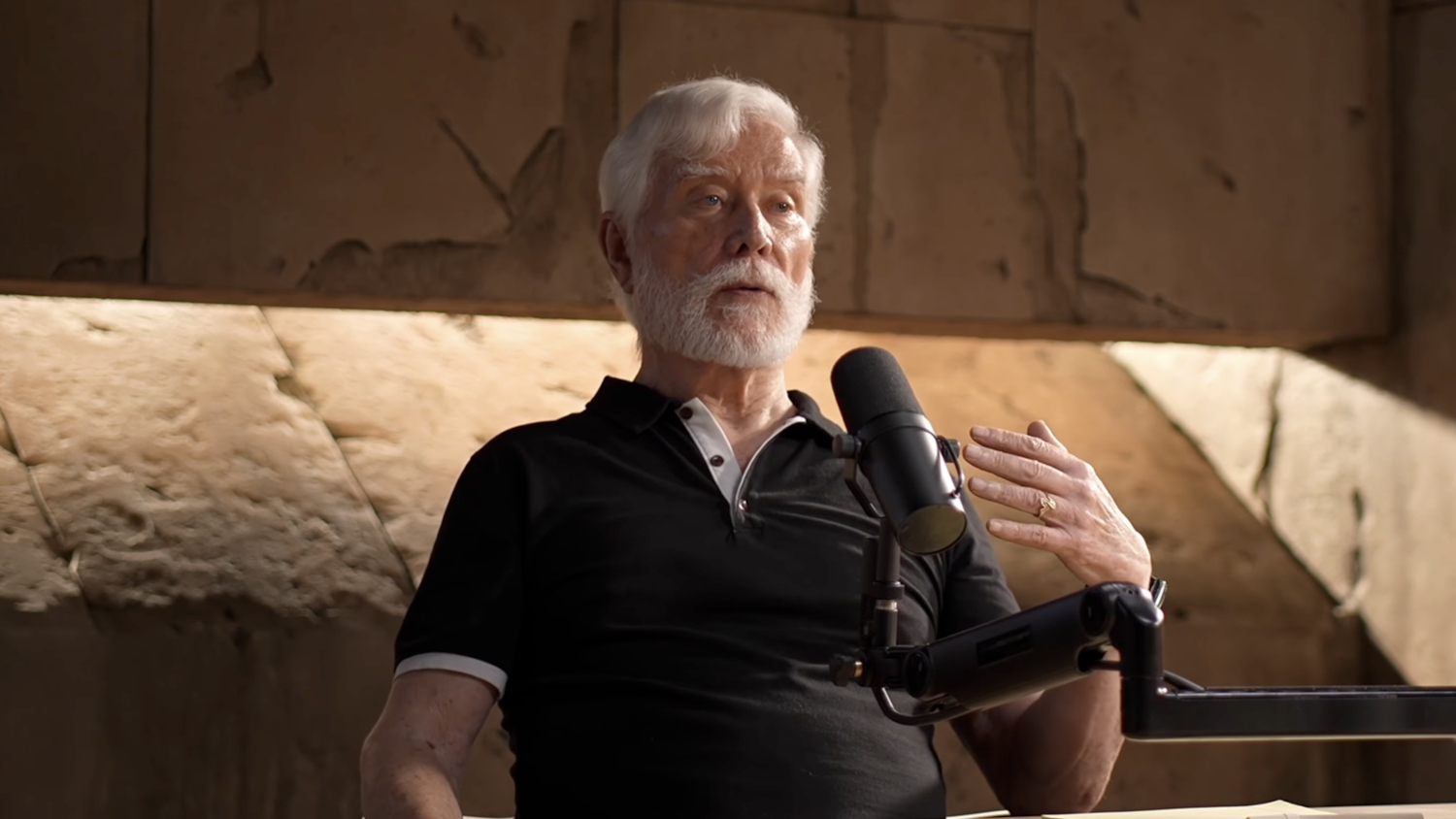
That is the core of a thought experiment that physicist and author Thomas W. Campbell uses to illustrate his theory that reality is fundamentally information-based rather than built from independently existing physical objects.
Who Is Campbell, and What Is He Claiming?
Campbell’s theory comes from his personal framework; it does not represent a NASA conclusion or finding.
Campbell is a physicist and author with a work history that includes NASA-related programs and U.S. Department of Defense missile-defense contracting. His framework, which he calls My Big T.O.E. (Theory of Everything), is his own intellectual project, and NASA has not endorsed it.
His central claim, attributed to his framework and not to established physics, is that reality does not consist of solid matter waiting to be observed. According to Campbell, reality resolves into specificity only when information becomes available to a conscious observer.
Render on Demand
The analogy resembles the optimization logic used in modern video game engines, though the resemblance is illustrative rather than literal.
Detailed environments in games are generated based on what a player can see. Distant or unobserved areas receive little or no rendering resources until a character moves toward them.
Campbell applies that same logic to the universe: a system running on finite computational resources would have no reason to fully specify a region of reality that no observer is accessing. The comparison is immediately intuitive for anyone who has watched a game stutter while loading a new area.
The Gap Between “Information-Based” and “Simulated”
Describing reality in terms of information is a legitimate theoretical approach, but it does not automatically establish that an external computer generates it.
Information-based descriptions of physical systems represent a genuine area of physics and information theory. Describing physical states in terms of information and relationships rather than fixed material properties is a recognized theoretical direction.
The leap from “reality is information-based” to “reality is generated by an external computer” requires additional premises. Campbell supplies those through his framework, but they remain unestablished by independent evidence.
Quantum Mechanics as Suggestive, Not Conclusive
Quantum observer effects resemble Campbell’s model in a surface way, but physicists note that multiple competing interpretations exist.
Campbell and others point to quantum observer effects as consistent with his model. When a quantum system is measured, its state resolves from a range of probabilities into a specific outcome. That resolution superficially resembles a simulation generating detail on demand.
Physicists caution that quantum measurement has multiple competing interpretations. None of them straightforwardly confirm that a conscious programmer sits outside the universe running the code.
A Wider Debate With No Settled Answer
Campbell is one of several thinkers who take the simulation hypothesis seriously, but no accepted evidence has confirmed it.
Philosopher Nick Bostrom formalized a probabilistic version of the argument in 2003. He presented a trilemma suggesting that sufficiently advanced civilizations could run vast numbers of conscious simulations, and that at least one of three uncomfortable conclusions must follow.
NASA-linked computer scientist Rich Terrile has also discussed the possibility in public forums. No accepted experiment has confirmed that humanity lives inside a simulation, according to NBC News reporting on the scientific debate.
Researchers have proposed conceptual tests that look for signs of finite computational resources in physical law. No proposed test has produced accepted evidence that the universe is simulated.
An Analogy Is Not a Proof
The parking-lot scenario clarifies the theory without confirming it.
The parking-lot scenario does what a good analogy should: it makes an abstract idea concrete and imaginable. What it cannot do is substitute for empirical evidence.
Campbell’s framework remains a speculative philosophical theory. It is worth engaging seriously, but it has not been validated by the scientific community.