Outrunning the cops in GTA has always been a speed problem. If the reported mechanics in GTA 6 hold up, it becomes an information problem instead.
What the Footage Shows
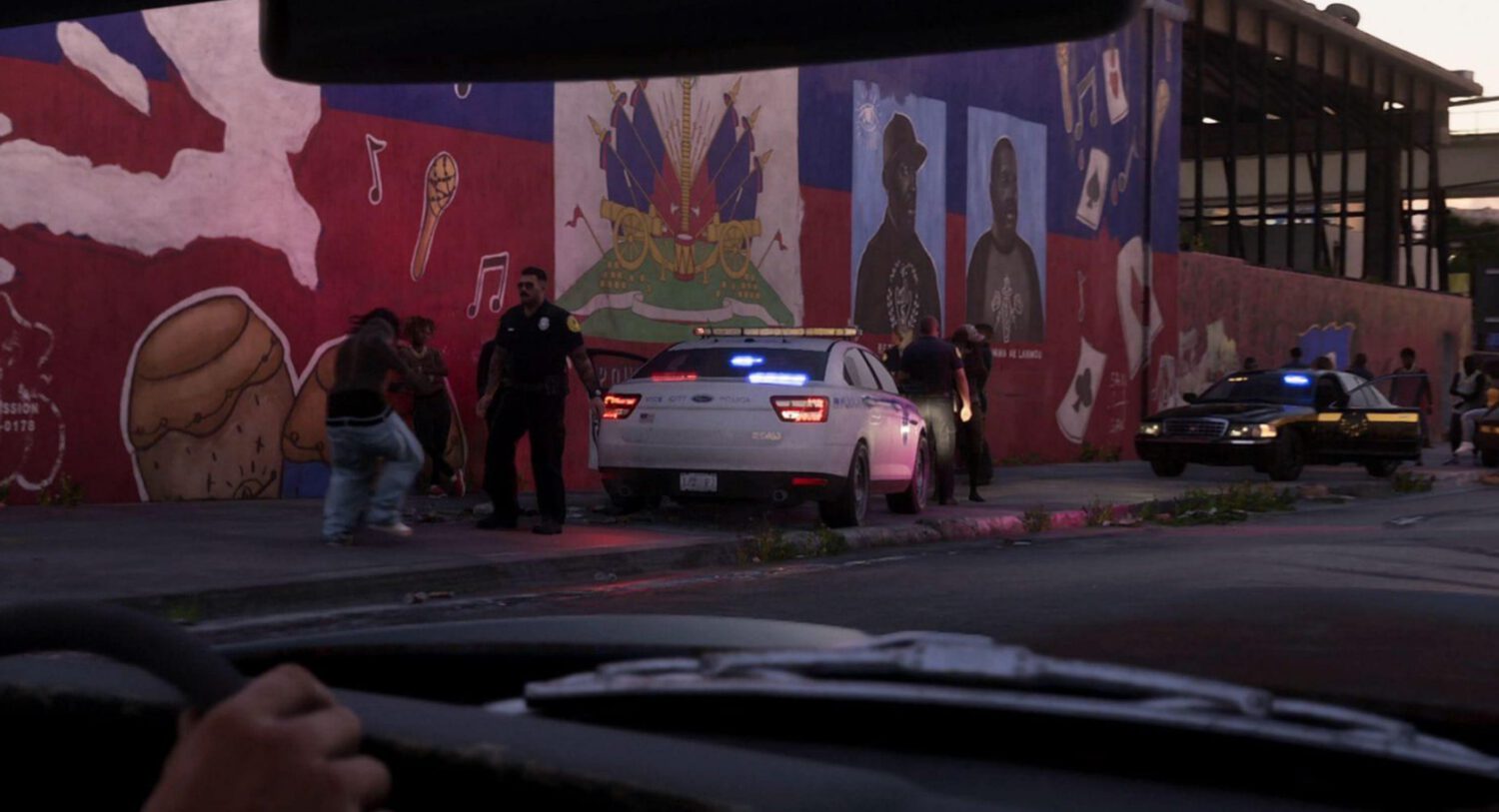
Circulated gameplay footage and reporting from a Rockstar hands-off demonstration point toward a wanted system built on multiple streams of evidence.
A gameplay video circulating online shows the player driving past a traffic camera while a HUD indicator appears on screen. Gaming outlets have interpreted this as the game signaling that the vehicle’s license plate is being scanned, though that reading is not confirmed by an official Rockstar source.
According to those reports, a camera sighting can alert police and open a search zone that persists after the player drives away. Staying on the same route after triggering the system reportedly allows law enforcement to continue tracking the vehicle, making the familiar tactic of simply accelerating away less reliable than in earlier games.
Changing Your Appearance Is Now a Strategy
A Rockstar demonstration reported by IGN describes clothing, vehicles, and companions as factors police use to identify a suspect.
Reporting from a Rockstar hands-off demonstration indicates that police account for a player’s clothing, vehicle, physical description, and companions when building a wanted status. Swapping vehicles, changing clothing, and separating from companions may reduce the information police have available, though whether those steps fully reset recognition has not been confirmed.
Security cameras and eyewitness reports reportedly feed the system as well, building a wanted status from multiple evidence streams rather than proximity alone. The specific traffic-camera mechanism and any license-plate-scanning indicator remain interpretations based on circulated footage rather than confirmed official features.
The Real-World Analogy, Handled Carefully
The reported behavior resembles how automated license-plate-reader networks connect repeated sightings into a movement history, though the comparison is an analogy.
The behavior described in these reports resembles how automated license-plate-reader networks operate in the United States. Flock Safety, one prominent operator of such networks, captures plate, vehicle, time, and location data across multiple fixed cameras to assist investigations involving vehicle movements.
That comparison helps explain the reported GTA 6 mechanic, but it is an analogy. Available reporting does not establish that Rockstar Games partnered with Flock Safety, licensed its technology, or reproduced its data architecture.
What Remains Unverified
Rockstar has not confirmed the “Flock cameras” label or described the specific traffic-camera implementation in official materials.
How long a vehicle stays flagged, whether appearance changes fully reset a player’s wanted status, and how the multi-source system weighs different inputs are all details not yet established from official sources. Any claim that the system independently tracks the player’s physical movements on foot, separate from a vehicle, also goes beyond what the available footage and reporting clearly show.
The Design Implication
If the reported mechanics hold up, GTA 6 turns the wanted system into an evidence-management problem rather than a pursuit problem.
Escaping cleanly may require breaking the link between a player’s identity, vehicle, appearance, and last known location. The threat is not being seen once; it is being connected across multiple sightings, which reflects how surveillance networks function in the real world as well.
How fully Rockstar has executed that idea will not be clear until the game ships.