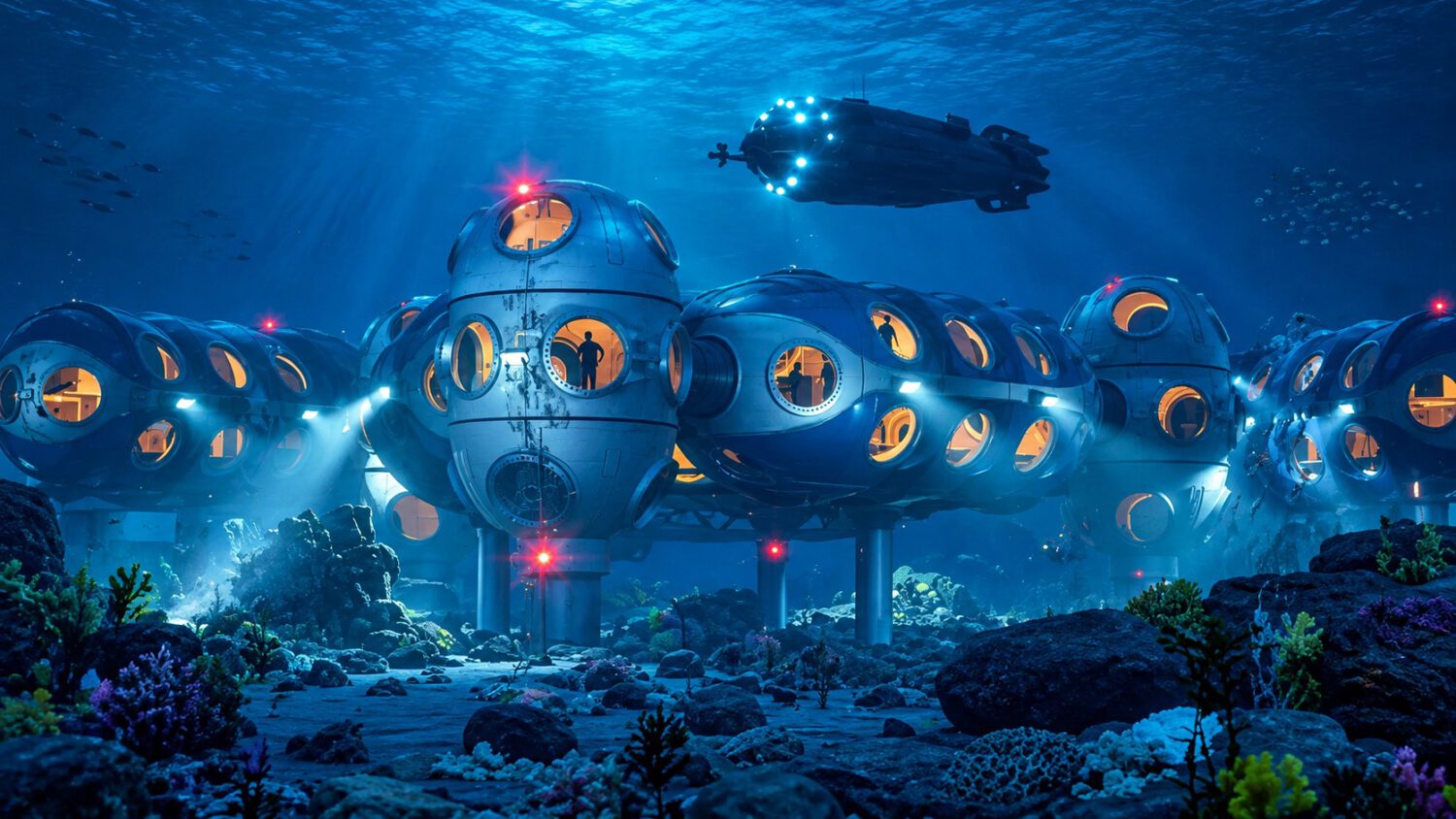
A private company called DEEP claims to have lowered an underwater habitat onto a Florida reef at roughly 56 feet, with plans for week-long stays by a four-person crew. The company says a second, larger habitat for six people is in development for approximately 650 feet, targeting month-long missions. No reliable source reviewed for this article identified DEEP’s founder.
The Last Time Someone Tried This, a Man Died
The U.S. Navy’s SEALAB program is the direct precedent, and it ended in tragedy roughly 610 feet below the Pacific.
In February 1969, the Navy placed SEALAB III at approximately 610 feet off San Clemente Island, California. During a repair dive to fix a helium leak, aquanaut Berry Cannon died. The Navy officially attributed the death to carbon-dioxide asphyxiation, though later analyses published in sources including InDEPTH magazine have disputed whether that fully explains what happened, with some researchers pointing to electrocution or equipment failure as contributing factors. The cause has never been conclusively settled. According to contemporary reporting in The New York Times, the Navy spent approximately $20 million on its deep-diving system and related SEALAB work before shutting down the habitat program after Cannon’s death.
What Saturation Diving Actually Means
The technology is proven in commercial diving; the engineering risks at serious depth are equally well documented.
In saturation diving, occupants remain under elevated pressure until their tissues become fully saturated with inert gas, allowing extended work at depth without repeated ascents that would otherwise require decompression procedures. Returning to surface pressure requires a slow, carefully controlled decompression process that can take days. DEEP’s described design includes a moon pool, a direct opening between the pressurized interior and the surrounding ocean, and pressure management, flooding prevention, atmospheric control, and emergency access all depend on systems that must function without failure.
What DEEP Claims, and What Remains Unverified
A shallow-water demonstration and a 650-foot long-duration habitat present very different engineering problems.
DEEP says its Florida deployment represents a first step toward planned long-duration subsea habitation, though no publicly available documentation reviewed for this article establishes continuous occupation of either habitat. A structure at 56 feet faces substantially different pressure, rescue, and decompression challenges than one operating at 650 feet for a month at a time. Treating the two as equivalent steps in a linear progression would be misleading, and all project details come from the company and have not been independently verified.
$100 Million, No Named Founder
The funding figure is documented as an announced investment; the person behind it is not confirmed.
DEEP announced a $100 million investment in a Florida engineering and development hub and a Houston manufacturing facility. No corporate filing, investor statement, or verified reporting reviewed for this article has confirmed the founder’s identity. That gap is not incidental: it is a material omission in the public record for a project claiming to put humans on the seafloor for weeks at a time.
The Questions That Still Need Answers
Permits, evacuation protocols, and the intended purpose of these habitats remain publicly unaddressed.
Responsible follow-up reporting would need to establish whether the Florida deployment received permits from relevant state, federal, or marine authorities. Evacuation protocols also remain unaddressed, specifically what happens after a medical emergency or loss of surface power. No definitive primary-source statement reviewed here establishes the intended use case, whether research, tourism, commercial work, or defense, and the public material reviewed does not provide a detailed breakdown of the $100 million investment or establish how much has been spent specifically on habitat development.