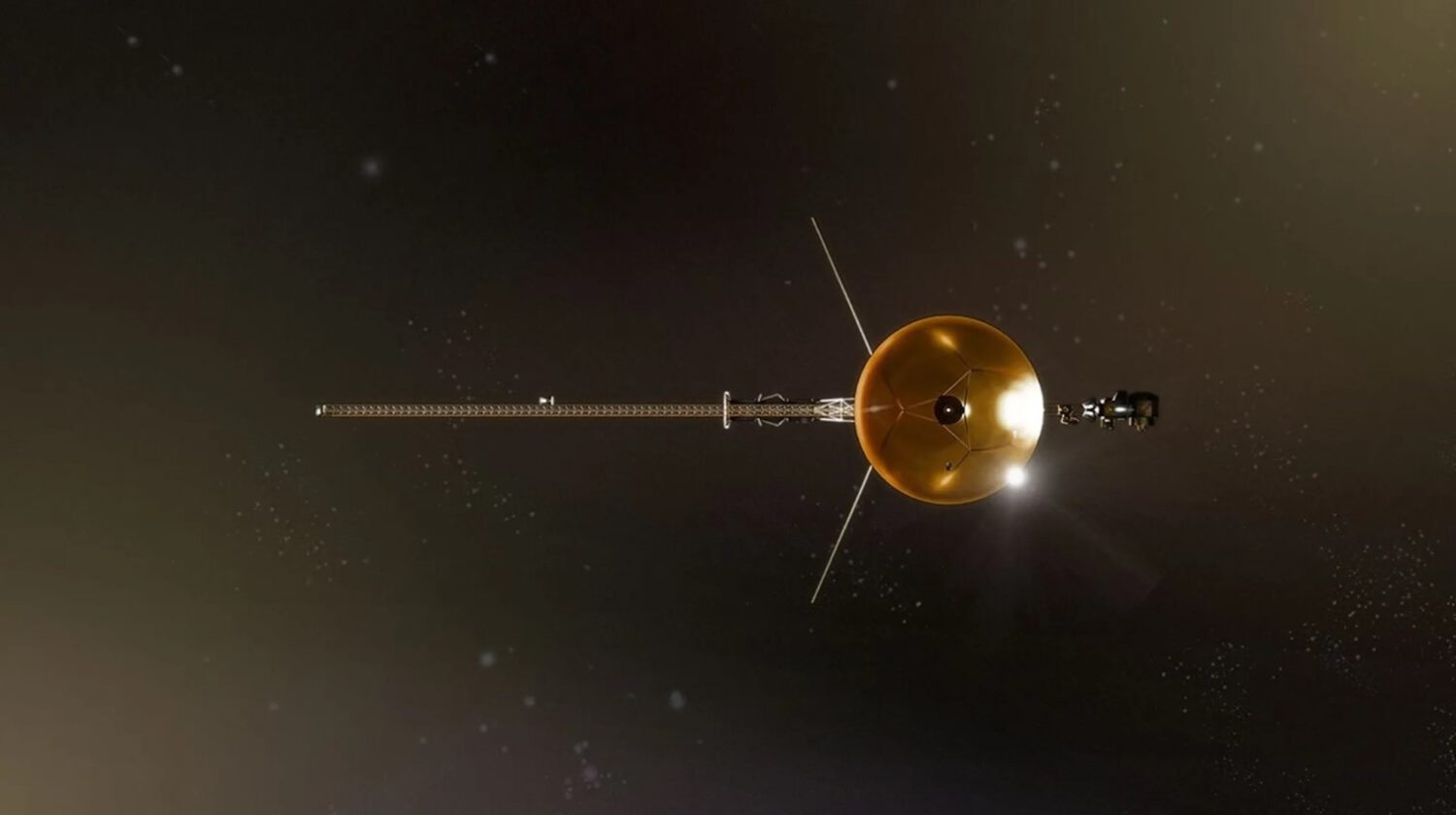
The spacecraft built in the 1970s became the first human-made object to reach approximately 16.1 billion miles from Earth, a distance that now turns every command into a two-day conversation.
At 5:16:07 a.m. Eastern Time on November 18, 2026, Voyager 1 crossed a threshold no human-made object had ever reached: one light-day from Earth, according to NASA. The distance is precisely 25,902,068,356 kilometers, the span that light itself covers in a full 24 hours.
A light-day is a distance, not a duration. Understanding that distinction makes the milestone concrete: Voyager 1 is now so far away that radio signals traveling at the speed of light require approximately 24 hours to reach it. A command sent from Earth and a response from the spacecraft require a round trip of roughly 48 hours, though actual operational exchanges can take longer due to scheduling and onboard processing.
Voyager 1 launched on September 5, 1977, during a rare alignment of the outer planets that allowed mission planners to use each planet’s gravity to slingshot the spacecraft toward the next. It reached Jupiter in 1979 and Saturn in 1980, returning close-up observations of those planets and many of their moons that had never been possible before.
A close flyby of Saturn’s moon Titan redirected Voyager 1 northward, out of the plane shared by the planets, and onto a trajectory that has carried it outward ever since. That geometry ruled out visits to Uranus or Neptune and set the spacecraft on its present course.
On August 25, 2012, Voyager 1 crossed the heliopause at approximately 18.2 billion kilometers from the Sun. The heliopause is the outer boundary of the heliosphere, the vast bubble of solar wind that the Sun blows into surrounding space; beyond it lies interstellar space. Scientists confirmed the crossing through a sharp drop in particles originating from inside the heliosphere and a corresponding rise in cosmic rays arriving from outside it. Later plasma-density measurements resolved remaining uncertainty about the boundary crossing.
The science has continued well past that boundary. Solar disturbances can propagate at least 20 astronomical units beyond the heliopause, according to Bill Kurth of the University of Iowa. Plasma density continues to increase for at least 10 astronomical units past that boundary, indicating that the region immediately outside the heliopause is neither uniform nor quiet.
Voyager 1’s power source, a radioisotope generator running on decaying plutonium, loses roughly 4 watts of output each year as its fuel breaks down. NASA has responded by switching off instruments and reducing energy consumption across the spacecraft. The agency forecasts that one scientific instrument may remain operational into the 2030s, though that outcome depends on continued conservation efforts.
Voyager 2 is traveling in a different direction at more than 3 astronomical units per year and is expected to reach one light-day from Earth in November 2035. Voyager 1’s next scale marker is far more remote. The Oort Cloud is a vast, inferred shell of icy bodies thought to begin roughly 1.6 light-years from the Sun. Even at Voyager 1’s current speed, its inner boundary remains approximately 300 years away.
NASA marked the November 2026 milestone with a public event called “Shine Bright for Voyager’s Light-Day,” inviting people around the world to flash VGR, Voyager’s call sign, in Morse code using phones, flashlights, and building lights. The gesture was symbolic: a message aimed at a spacecraft that now takes a full day just to receive it.