
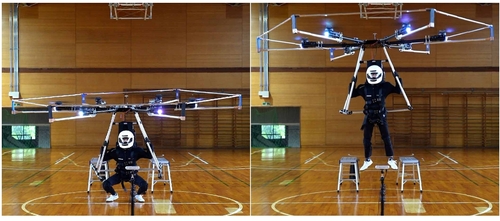
Jun Rekimoto’s research group developed the system, now called Augmented Leap, as a wearable jump-assistance device rather than a propulsion vehicle. A hexacopter mounted in a backpack frame generates continuous upward thrust during a jump, keeping thrust below the wearer’s total body weight at all times. The result is a reduced apparent weight: the person leaves the ground under their own power and travels a higher arc before a slower descent brings them back down. Research into wearable assistive hardware, such as the robotic knee exoskeleton developed at the University of Michigan, reflects the same broader push to augment human movement without replacing it.
The Machine Responds to the Body
Motion sensing keeps the wearer in control rather than handing control to the rotors.
Onboard sensors monitor the wearer’s motion and adjust thrust accordingly. That design choice preserves what the researchers call a sense of agency, with the system amplifying the jump rather than substituting for it. This distinguishes Augmented Leap from vehicle-style flight devices, where the machine dictates movement instead of the person.
Eight Years of Prototypes
The project has moved from a dramatic gravity demonstration to a six-rotor system designed for real-world terrain.
The original prototype, known as Lunavity or Augmented Jump, appeared in 2018. Its multirotor configuration reportedly demonstrated approximately 75% reduced effective gravity and could support roughly 50 kilograms of body weight. The 2026 Augmented Leap revision uses a hexacopter and reduces effective body weight to approximately two-thirds of normal, reflecting a shift from proving the concept to making it functional outside a controlled laboratory setting.
What the Numbers Actually Show
The measured gains are real, but the study design carries significant caveats.
In vertical-jump tests reported in the ACM Digital Library, Augmented Leap increased maximum jump height by approximately 10% to 16% and extended time in the air by approximately 70% to 80% across two participants. Limitations the authors acknowledge include a small participant count and the use of maximum-performance trials rather than averaged results. The study also notes no established statistical significance across repeated measurements.
Early coverage describing jumps two to three times higher draws on the earlier Lunavity concept, not the 2026 Augmented Leap data.
Where the Research Points
Three prospective applications emerge from the research, none representing a commercial product.
The Rekimoto Lab identifies mobility assistance as one direction, specifically helping users clear obstacles, cross uneven ground, or navigate localized terrain challenges such as ditches and earthquake rubble. Augmented sports represent a second area, with reduced-weight jumping enabling longer airtime and altered movement trajectories. The researchers also cite terrestrial simulation of movement under reduced-gravity conditions, such as lunar or Martian environments, as a prospective use rather than a demonstrated one.
Still a Research Prototype
Every result described here comes from controlled demonstrations, and no consumer version exists.
Augmented Leap remains an experimental system. The cited papers and lab materials present it as a research prototype, not a commercial product, and the published results reflect early-stage evidence from a limited participant pool. What the work does establish is a credible mechanism for wearable partial-gravity assistance. The human, not the hardware, remains the primary mover.