A one-way Mars mission using chemical propulsion takes close to a year. Crews would face substantial radiation exposure throughout that journey, a research milestone NASA and international researchers identify as one of the central obstacles to crewed interplanetary flight.
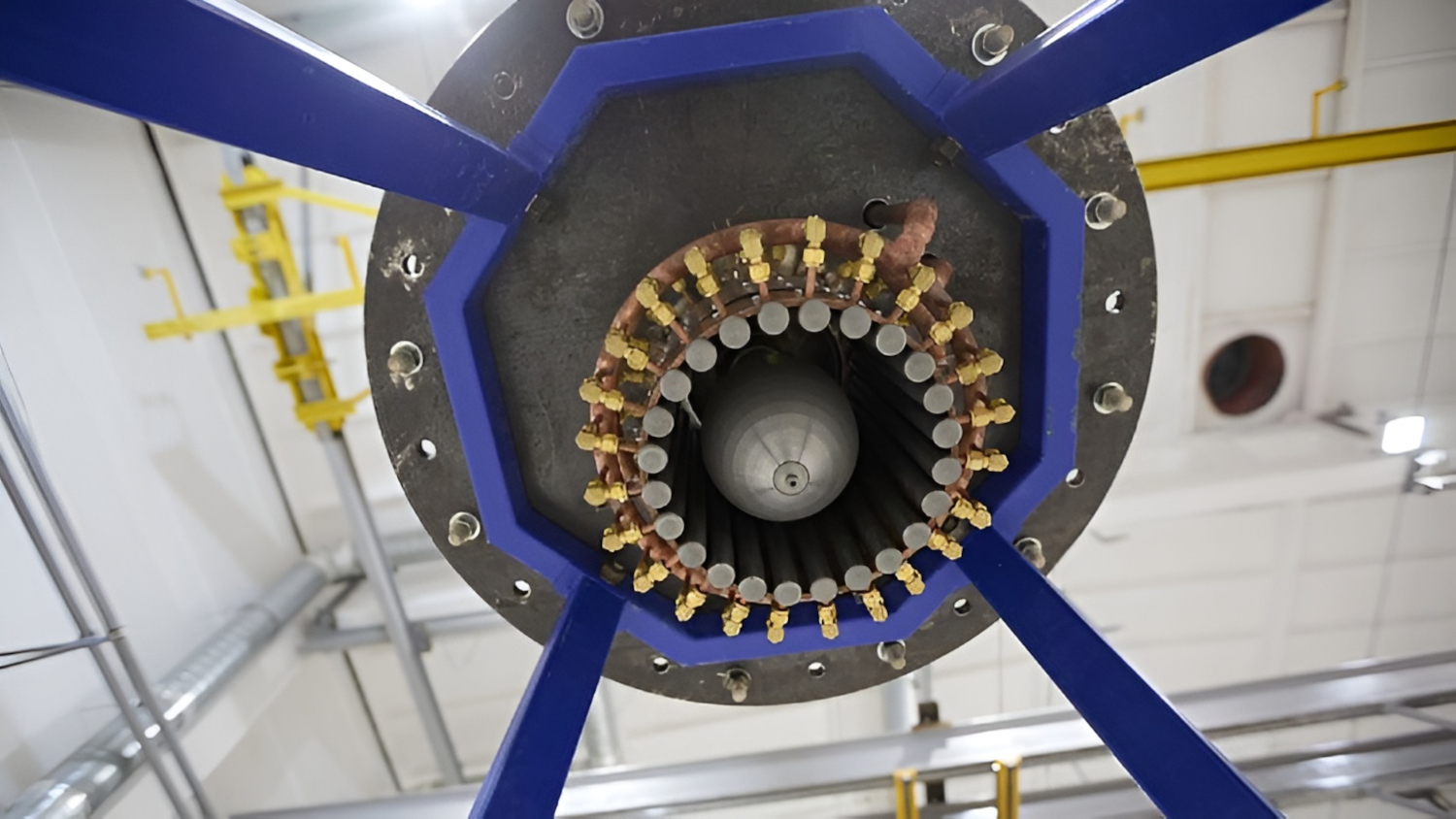
Rosatom, Russia’s state nuclear energy corporation, says its scientists at the Research Institute in Troitsk have built a laboratory prototype of a plasma-electric rocket engine they believe could address that problem directly.
What Rosatom Is Actually Claiming
The 30-day figure is a projection attributed to Rosatom, not a result from a flight demonstration.
At present, a one-way travel to Mars onboard spacecraft with conventional engines can take almost a year, which poses a significant risk to astronauts considering cosmic radiation exposure. However, plasma engines could reduce the duration of flights to just 30 to 60 days, making possible return missions to Mars.
Alexey Voronov, first deputy director general for science at Rosatom’s Research Institute in Troitsk
That figure is Rosatom’s projection for what an eventual propulsion system based on this prototype could achieve. No spacecraft using this engine has flown, and the 30–60-day estimate has not been independently validated.
How the Engine Works, and What the Numbers Mean
Exhaust velocity is not cruising speed, and 6 newtons of thrust will not launch anything from Earth.
The prototype uses a magnetic plasma accelerator, which pushes charged particles through electromagnetic fields to generate thrust rather than chemical combustion. Rosatom reports a thrust of at least 6 newtons, an exhaust velocity of at least 100 kilometers per second, and an average operating power of approximately 300 kilowatts in pulse-periodic mode.
Six newtons is modest by any rocketry standard. The design advantage is sustained, efficient operation over an extended period rather than the brief, high-thrust burn a launch rocket delivers.
That 100 km/s figure describes propellant exit speed, not spacecraft travel speed. Spacecraft velocity depends on thrust duration, mass, propellant load, and trajectory. The vehicle must also decelerate fully on arrival, which the exhaust-velocity figure does not account for on its own , a distinction that matters when considering vehicles that travel faster than speed of sound by orders of magnitude.
The Power Requirement Is Not a Small Detail
Three hundred kilowatts would require unusually large solar arrays or, more plausibly, a space-based nuclear power source.
At 300 kW, this engine would need far more power than standard spacecraft solar panels can practically supply, particularly at Mars distances from the Sun. A space-based nuclear power source would very likely be required, adding reactor mass, heat radiators, and radiation shielding to the vehicle. Each of those elements affects whether the projected travel times are achievable in practice.
The engine would not launch under its own power. A conventional rocket would carry the spacecraft and propulsion system into orbit first, after which the plasma engine would take over for the interplanetary leg.
Where the Project Stands Right Now
A vacuum chamber in Troitsk is the next milestone, not a launchpad.
Voronov described the prototype’s significance this way: “The creation of a prototype is a crucial milestone of the project as it shows whether the engine is suitable for future ‘nuclear tugs’ in space and whether it is possible to reduce the cost of their production.”
A large ground-test stand, approximately 14 meters long and 4 meters in diameter, is being assembled in Troitsk to simulate space conditions. No in-space test is reported in the cited sources. Rosatom’s target for a flight model is around 2030, though that remains a target rather than a confirmed schedule.
NASA is pursuing parallel work on both nuclear-thermal propulsion, which heats propellant directly through fission, and nuclear-electric propulsion, which converts nuclear heat into electricity for an electric thruster. NASA identifies both paths as promising for crewed Mars missions while noting that major technical development remains necessary.
The Rosatom prototype represents a reported laboratory research milestone. Whether it advances to a flight system depends on vacuum test results, independent performance validation, nuclear-power integration, and eventually an in-space demonstration. All of that remains ahead.