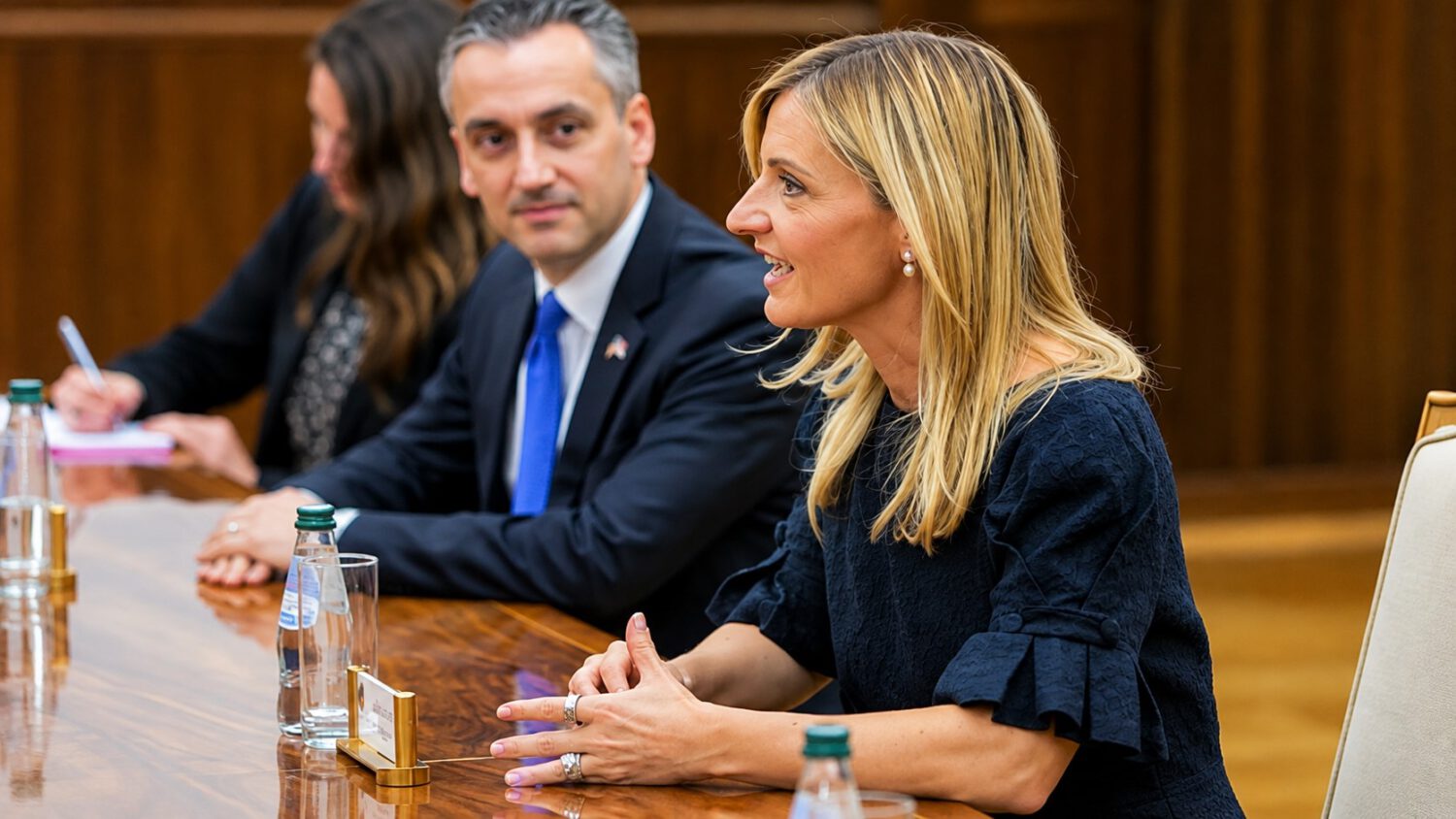
Managing how the United States presents itself to foreign audiences is a role built on credibility and the appearance of impartiality. One month after being sworn in as undersecretary of state for public diplomacy and public affairs, Sarah B. Rogers took a nearly $12,000 vacation on a private jet, paid for by a prominent technology billionaire.
Rogers’ preliminary financial disclosure, obtained by The Washington Post, identifies the sponsor as Patrick Collison, co-founder of Stripe and a member of Meta’s board. Rogers valued the gift at $11,900.
The Itinerary: Destinations, Companions, and Timing
The November 2025 trip covered three countries and included a prominent economist, all as guests of the billionaire who funded it.
The group traveled on Collison’s private plane to Cairo, Tbilisi, and Heraklion, visiting museums, churches, and historical sites. Economist and George Mason University professor Tyler Cowen was also among the travelers. “This is a trip Patrick and I organize every year to various cities throughout the world to visit historic sites and museums with a handful of friends.” Tyler Cowen, economist and George Mason University professor, to The Washington Post.
Official Responses, With Key Caveats
Rogers, the State Department, and Collison’s spokesperson have each offered defenses; none have been independently verified by an ethics authority.
Rogers described Collison as a “pre-existing friend predating my government service” and said the travel was for “purposes of tourism.” The State Department said the trip was planned before her Senate confirmation, that she disclosed it to ethics officials, and that she has not participated in any government matter involving Stripe.
A spokesperson for Collison said no business meetings took place and that Stripe has no business before the State Department. The spokesperson also said Collison has organized similar annual trips for eight years.
Those accounts are coherent. They remain unverified by any independent ethics authority.
What the Ethics Review Did and Did Not Confirm
A departmental attorney reviewed the disclosure, but the Office of Government Ethics had not certified it when The Washington Post published its report.
Rogers’ disclosure was reviewed by a State Department attorney. The Office of Government Ethics, the independent federal agency responsible for executive-branch ethics standards, had not certified the filing at the time of publication. A departmental review and an independent certification are not the same standard.
Ethics experts who reviewed the filing told The Washington Post they could not determine from the available information whether the trip violated federal law. Under current rules, gifts from genuine personal friends qualify for an exemption; gifts connected to an employee’s official government role do not. The distinction turns on intent and relationship, neither of which is easy to verify from a disclosure form alone.
Scott Amey, general counsel of the Project on Government Oversight, identified the cleaner standard: best practice for government employees is to decline even permissible gifts when accepting them could create the appearance of a conflict of interest.
Perception Is the Job. That Raises the Stakes Here.
For an official whose mandate centers on how the United States appears to the world, the appearance of this gift is impossible to separate from her responsibilities.
There is a particular irony in a public diplomacy official needing to defend her own image in the press. Rogers’ role rests on the premise that how something looks matters, and that premise now applies directly to her.
Collison co-founded a payments company and sits on the board of one of the world’s largest technology platforms. That does not make the friendship illegitimate. It does make the appearance problem harder to dismiss, and it is precisely the kind of situation Amey’s standard is designed to prevent.
What to watch: the certified disclosure from the Office of Government Ethics, any recusal agreements Rogers may have signed, and whether her official duties eventually intersect with Collison, Stripe, or Meta-related policy questions. The standard for officials in perception-management roles should be stricter than technical permissibility. Until the independent record is complete, the accountability question remains open.