
COO, short for Covert Ornithological Operations, is a free browser game where players control P-7, a robotic government drone shaped like a pigeon, operating inside a large-scale open-world recreation of Toronto. Developer Yegor Sak released it at no cost, with no download required.
The premise is deliberate absurdity. The technical execution underneath it is not.
Eight Missions and a Suspicion Meter
A stealth mechanic built around pigeon behavior governs how the game’s covert assignments play out.
The game includes eight covert missions, with examples reported by Automaton Media that include stealing a USB drive, hacking a target’s phone, tailing individuals, and eavesdropping on conversations. A suspicion mechanic determines how those missions proceed.
Behave too unlike a real pigeon and nearby pedestrians take notice. Cooing, by contrast, helps P-7 lower suspicion and maintain cover.
Outside of missions, the city is open for exploration. Players can fly freely, hijack video games that were banned vehicles, scan the environment, or drop excrement on pedestrians, according to reporting from Dexerto.
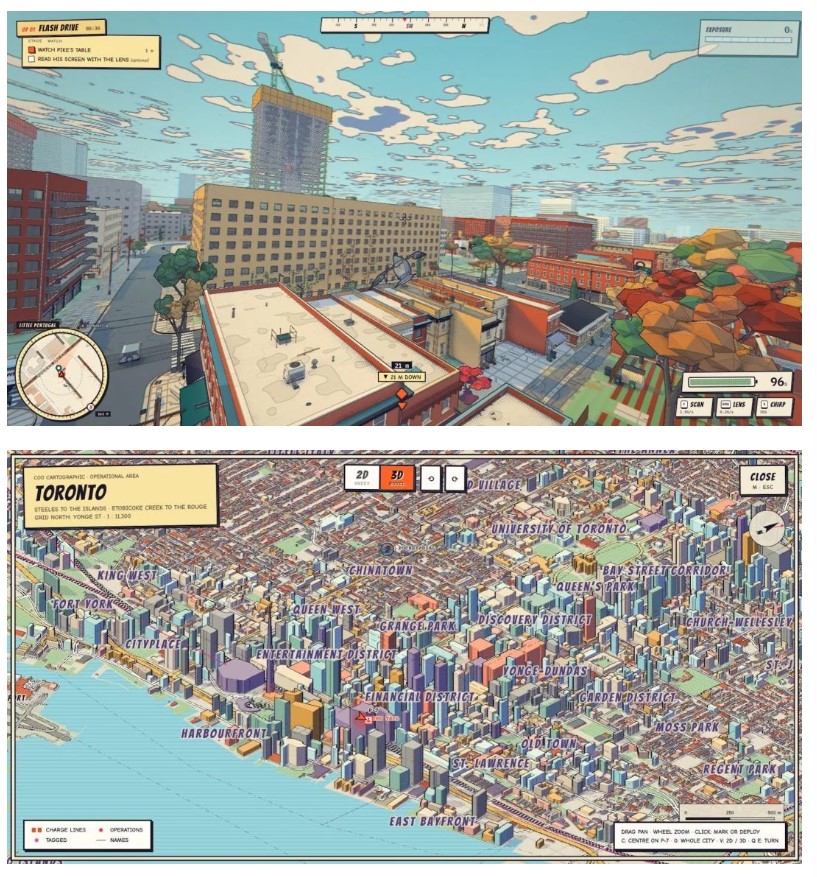
A Toronto Built From Real Data
The map draws on municipal 3D data and live aviation feeds to simulate the city at an unusually detailed scale.
The playable area covers approximately 630 square kilometers, or about 243 square miles, according to multiple reports. The game pulls building-height data from municipal 3D sources and models roughly 438,819 structures across the city, according to Automaton Media.
Aircraft visible in the game sky are based on ADS-B aviation data, so real flights over Toronto can appear overhead. The city also includes a day-night cycle, weather, traffic, and pedestrians.
Visually, COO uses a cel-shaded, low-poly comic-book style. That approach gives the large generated city a consistent look without requiring photorealistic rendering in a browser.
One report from Dexerto describes the Toronto map as roughly nine times the size of GTA V’s map. That figure comes from the developer and has not been independently verified.
How the Developer Built It
The reported development method relies on AI-assisted tooling and raises questions about what that process actually produced.
Sak reportedly built COO in seven days using JavaScript without a conventional game engine, completing it in seven days while running up to 10 parallel AI workstreams, according to reporting from Gizmodo and Automaton Media. Gizmodo attributes tools including Claude to the project.
Seven days is a developer claim, not an independently audited result. The specifics of what AI tooling contributed, and how, remain unclear from available reporting.
Performance and Access
Browser-based rendering of a city this size puts real demands on hardware, and early traffic appears to have compounded that strain.
Performance varies considerably depending on hardware, browser, and network connection, according to Gizmodo. Early player interest appears to have created loading and bandwidth problems at launch.
Slow performance may reflect hardware limits, network conditions, server capacity, or some combination of those factors. COO is free to play at its official site, with no client to install.