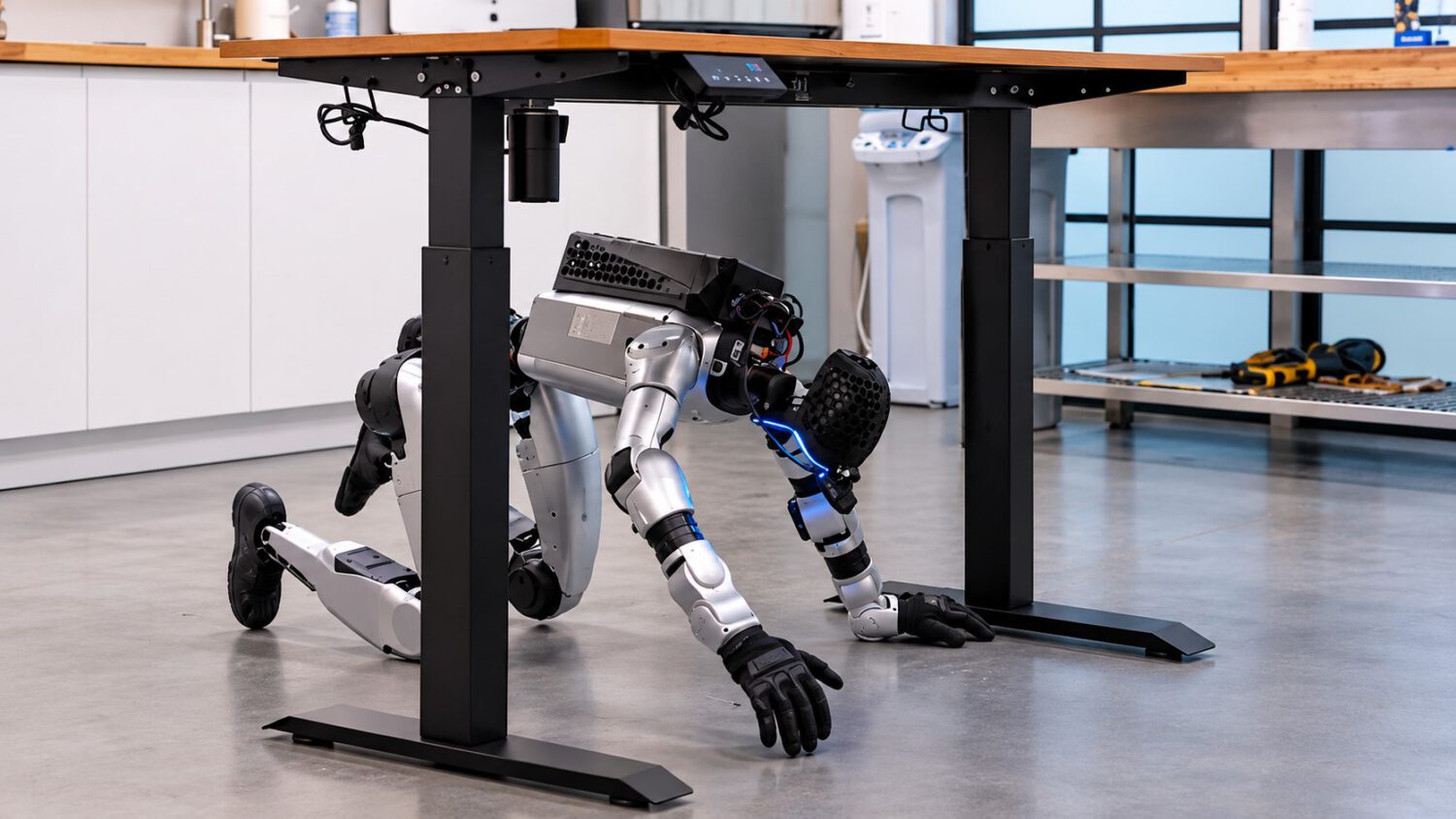
A Mac mini M4 Pro with 64 GB of unified memory rides in an enclosure on the back of a Unitree G1 humanoid robot. A wide-angle OAK-1W camera sits on the robot’s head, while onboard hardware handles lower-level tracking and motor control.
Together, the platform forms HALO, short for Humanoid Autonomy, Learned in simulation, running Onboard. Apple researchers describe the system in an arXiv paper titled “Perceptive Humanoid Motion from Simulation.”
Three Layers, One Walking Machine
HALO splits cognition from motion, letting each layer do only what it needs to do.
The system works in three distinct layers. A language-based orchestrator interprets a broad instruction, breaks it into subtasks, and decides whether to advance, retry, or change approach. It recalculates roughly once every two seconds.
A separate vision-and-motion generator uses a Qwen3.5-2B vision encoder paired with a diffusion-transformer decoder. It produces approximately five seconds of whole-body movement at a time and updates about three times per second. A low-level tracker then executes those plans using the robot’s sensors and body-state feedback.
Learning in Fake Homes, Working in Real Ones
Simulation-to-real transfer means the robot trained in virtual environments it would never physically enter.
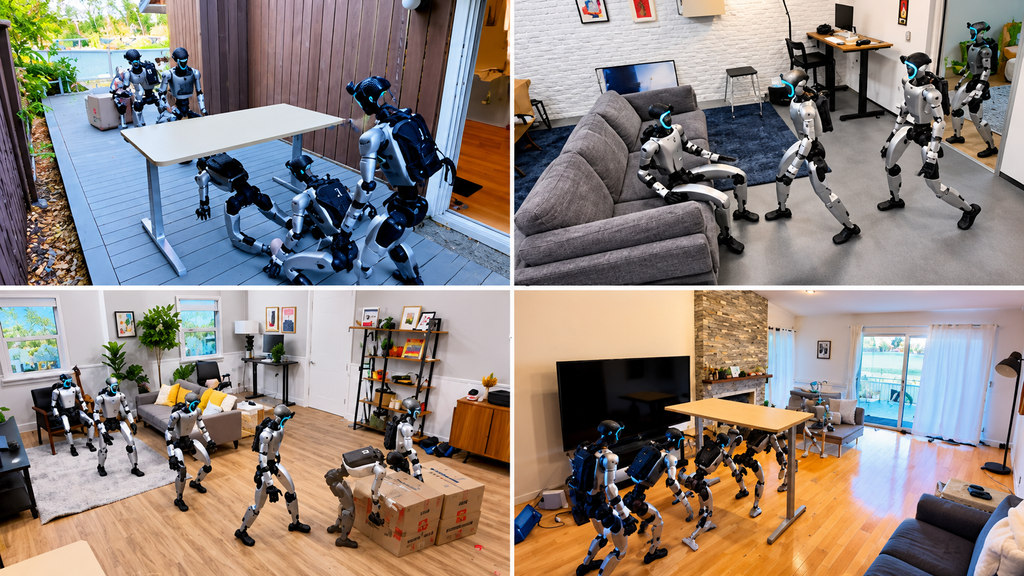
Apple generated roughly 300 hours of paired video, language, and motion data across 1,000 procedurally generated homes. When HALO moved to physical testing, it entered six real environments it had never been shown, scanned, or mapped in advance.
That gap between training space and deployment space is what simulation-to-real transfer means in practice. The robot learned general skills in simulation, then applied them in unfamiliar physical rooms.
Why the Mac Mini Works Here
Unified memory removes a bottleneck that stops most desktop chips from running large AI models locally.
The Mac mini’s unified-memory architecture lets the CPU and GPU draw from the same 64 GB pool. Large AI models load and run without shuttling data between separate CPU and GPU memory pools, reducing a constraint that typically limits local inference on consumer hardware.
That matters for robotics because a household robot cannot depend on a continuous cloud connection for every movement decision. HALO operated fully offline during all physical trials, according to the arXiv paper.
The Qwen Detail Worth Explaining
Apple’s team chose an open-source model associated with Alibaba, and the reason is straightforward engineering.
The orchestrator runs Qwen3.6-35B-A3B, a mixture-of-experts model, quantized to 4-bit precision and served through MLX on the Mac mini. The paper does not describe a formal Apple-Alibaba partnership, and no available primary source substantiates that claim.
The engineering rationale is clear: the research team needed a capable model that runs locally and offline on the hardware already in the system. Treating the choice as a product-strategy signal would read more into the paper than it supports.
What the Numbers Actually Show
A 91% success rate sounds strong until you see what happens when tasks get longer.
Across 360 single-task trials in six real environments, HALO averaged 91% success. Individual task rates ranged from 85% for sitting to 100% for crouching under a table, according to the arXiv paper.
Chained tasks, requiring the robot to execute multiple skills in sequence, averaged 70%. One sequence involving crouching, walking to a box, and pushing it succeeded only 50% of the time.
A Research Signal, Not a Product Announcement
The results demonstrate onboard embodied AI at this hardware scale; they do not confirm a consumer robot is coming.
HALO shows that a compact, self-contained computing platform can coordinate meaningful humanoid behavior in spaces it has never seen. The 91% figure applies to defined single-task trials in controlled conditions, not open-ended household autonomy.
The gap between reliable single-task performance and multi-step reliability is real. Apple has not announced a release timeline, a product design, or any commercial application based on this work. The paper is a research publication, and the results should be read as evidence of technical progress, not a product roadmap.