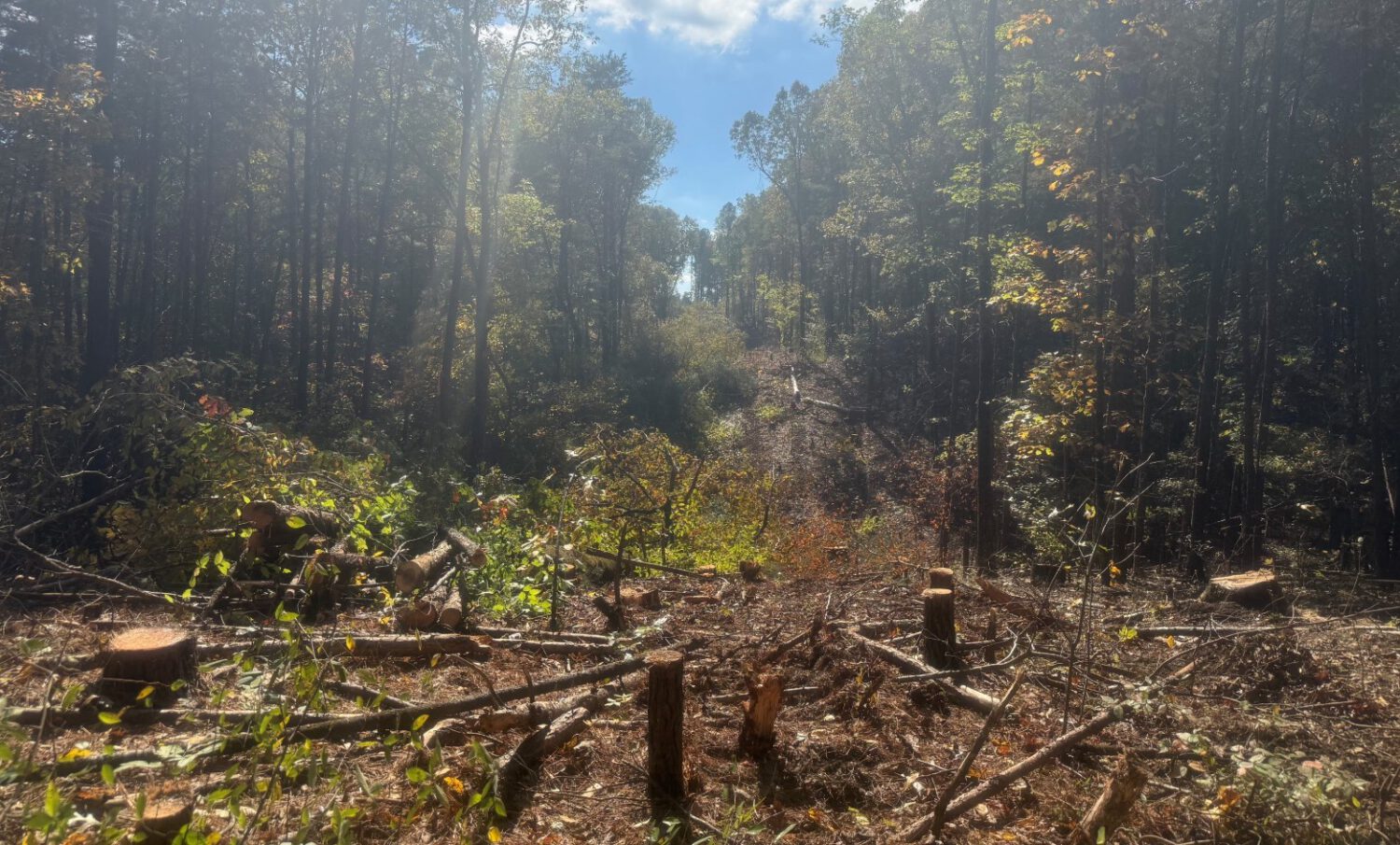
Fenn Church says he found his old-growth oaks gone. More than 200 yards of them, according to Church, who told WVTM 13 on November 5, 2026, that Alabama Power crews had entered and cleared the trees without his knowledge. The allegation has not been confirmed by a court or independent investigation.
What is confirmed is that the underlying legal fight was very much alive when Church says the chainsaws arrived. His property covers approximately 416 acres near Calera, in Shelby County, and includes waterways, wildlife habitat, and the home he is building for retirement.
How the Law Got Alabama Power Onto That Property
Three court actions in roughly two months set the conditions for the dispute: an injunction, an appeal, and a Supreme Court stay.
On September 22, 2026, Shelby County Circuit Judge Jonathan A. Spann temporarily barred Alabama Power from entering Church’s property. The court found that entry and clearing could cause immediate and irreparable harm while the condemnation case continued.
Alabama Power appealed. The utility argued the injunction improperly blocked rights it claimed under Alabama law and the state constitution, noting it had already deposited the condemnation award into court and posted an appeal bond.
On October 21, 2026, the Alabama Supreme Court granted Alabama Power’s emergency request. The stay lifted the lower court’s order and allowed work to resume while the appeal continued. That order did not resolve who was right about the underlying property dispute; it removed the specific barrier that had kept crews out, and Alabama Power treated it as permitting work to proceed.
The Day Before the Trees Came Down
Alabama Power sought a 300-foot buffer zone on November 4, alleging Church refused to leave the active work area.
One day before Church’s allegation became public, Alabama Power filed a request asking a Shelby County judge to keep Church at least 300 feet from clearing crews and heavy equipment. The company alleged he had refused to move from the work area and said further delays could jeopardize the project’s May 2027 completion target.
No hearing date had been set on that request, according to WVTM 13. The buffer request came before the tree-clearing story broke, which means both sides were already in direct friction on the ground.
Two Legitimate Positions, One Unresolved Question
Church wants a different route; Alabama Power says condemnation authority and the Supreme Court’s stay permitted it to proceed.
Church’s objection goes beyond compensation. He has proposed alternative routes that would shift the line through commercial timberland and away from his home, waterways, old-growth habitat, and private roads.
Alabama Power’s position is that it holds condemnation authority, that the Alabama Supreme Court’s stay permitted work to resume, and that the $248 million, 74-mile Autaugaville-East Pelham transmission line is a grid-reliability investment the region needs. One central legal question remains unresolved: did Alabama Power have enforceable authority to enter and clear after the stay? A second question follows: did it meet all applicable condemnation and notice requirements? No final ruling has addressed either.
A Procedural Gap That Deserves Legislative Attention
Alabama’s eminent-domain process gives utilities broad entry power, but the procedural record in this case raises fair questions about pre-entry notice obligations.
Here is the structural problem that Church’s case puts on the table. Alabama eminent-domain law gives utilities significant power once condemnation authority is established, but the procedural distance between a Supreme Court stay and actual crew arrival on contested land can collapse quickly. Nothing in the reviewed record establishes that Alabama Power was required to notify Church before equipment appeared on his property after the stay was granted; that absence of a documented requirement is itself worth examining.
Any rural landowner whose property sits in the path of a utility corridor can face a comparable sequence: a lower court protects them, an appellate court lifts that protection on an emergency basis, and the landowner may have little warning before crews appear. The procedural possibility, illustrated clearly here, deserves public scrutiny.
Credible improvement is not difficult to describe. Utilities operating under a Supreme Court stay during an active condemnation appeal should be required to provide documented pre-entry notification to the landowner. That notification should include a defined minimum notice window before physical clearing begins.
A second reform would address clearing scope: independent confirmation that crews remove only what the condemnation order authorizes would give landowners and courts a verifiable record. Alabama’s legislature should clarify what a Supreme Court stay on an injunction actually permits utility crews to do on private ground before the underlying case is resolved. The people absorbing the cost of any ambiguity in that area are landowners whose losses (old-growth trees, wildlife corridors, retirement properties) cannot be fully addressed with a compensation check.
Church’s case is still moving through the courts. The trees he says were cut are not coming back.