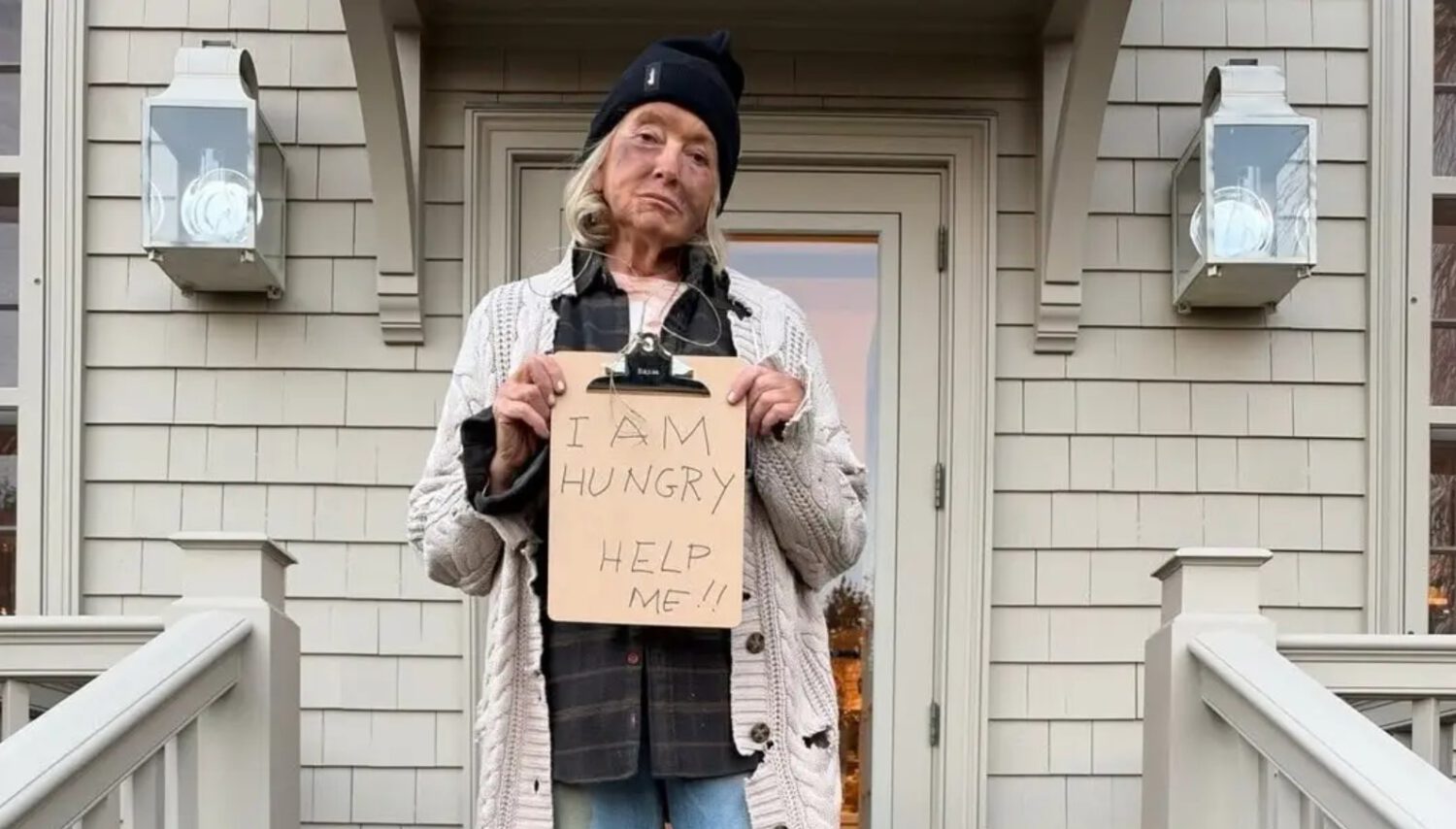
On Halloween, Martha Stewart published an Instagram carousel showing herself in distressed clothing, dirt-like makeup, and holding a handwritten sign reading “I AM HUNGRY HELP ME!!”
The same carousel promoted her candle collection available through QVC, with a caption reading “My QVC candles are perfect for Halloween!!!” according to BBC reporting.
That placement put poverty-themed imagery and a retail call-to-action inside the same scrollable asset.
The combination shaped how critics interpreted the post.
What Critics Said
Backlash spread quickly, and the embedded product promotion drew criticism alongside the costume itself.
Backlash arrived quickly across social media. Critics accused Stewart of trivializing homelessness and treating economic hardship as a costume, describing the presentation as insensitive and disconnected from the experiences of people facing poverty.
The costume and the product pitch occupied the same post. When criticism targeted one, it attached to the other, according to reporting from CBC and CNN.
Available reporting confirms the QVC candle promotion appeared in the carousel. What the reporting does not establish is whether QVC issued a public statement or participated in the creative decisions behind the post.
A Two-Stage Response
Two public statements followed the backlash, each going further than the last.
Stewart’s first public statement framed the costume as an attempt to raise awareness of homelessness. She said she had not intended to offend anyone.
That explanation did not satisfy critics, and a fuller apology followed. In it, Stewart acknowledged that her initial response had not gone far enough.
She said many people were economically struggling and described the costume as “insensitive and not funny,” according to reporting from People and the BBC.
Deletion Did Not Contain the Story
Removing the original post stopped new direct engagement with it, but the image had already left Stewart’s control.
Stewart removed the original post after criticism escalated. By that point, users and media organizations had captured screenshots and redistributed them across other platforms, according to CBC.
The image continued circulating through those copies. Coverage from outlets including the New York Times and Entertainment Weekly extended the story further.
A Pattern Worth Noting
The episode illustrates a structural risk in celebrity social commerce: personal expression and product promotion cannot always be separated once controversy arrives.
Stewart’s case reflects a documented tension in how celebrities combine identity content and retail promotion in a single post. Personal expression, entertainment, and product promotion cannot be cleanly separated once one element draws criticism. The others absorb it.
Stewart issued an initial statement and later a fuller apology, each distributed through the same Instagram presence that generated the controversy. The costume is gone from her feed. The screenshots are not.