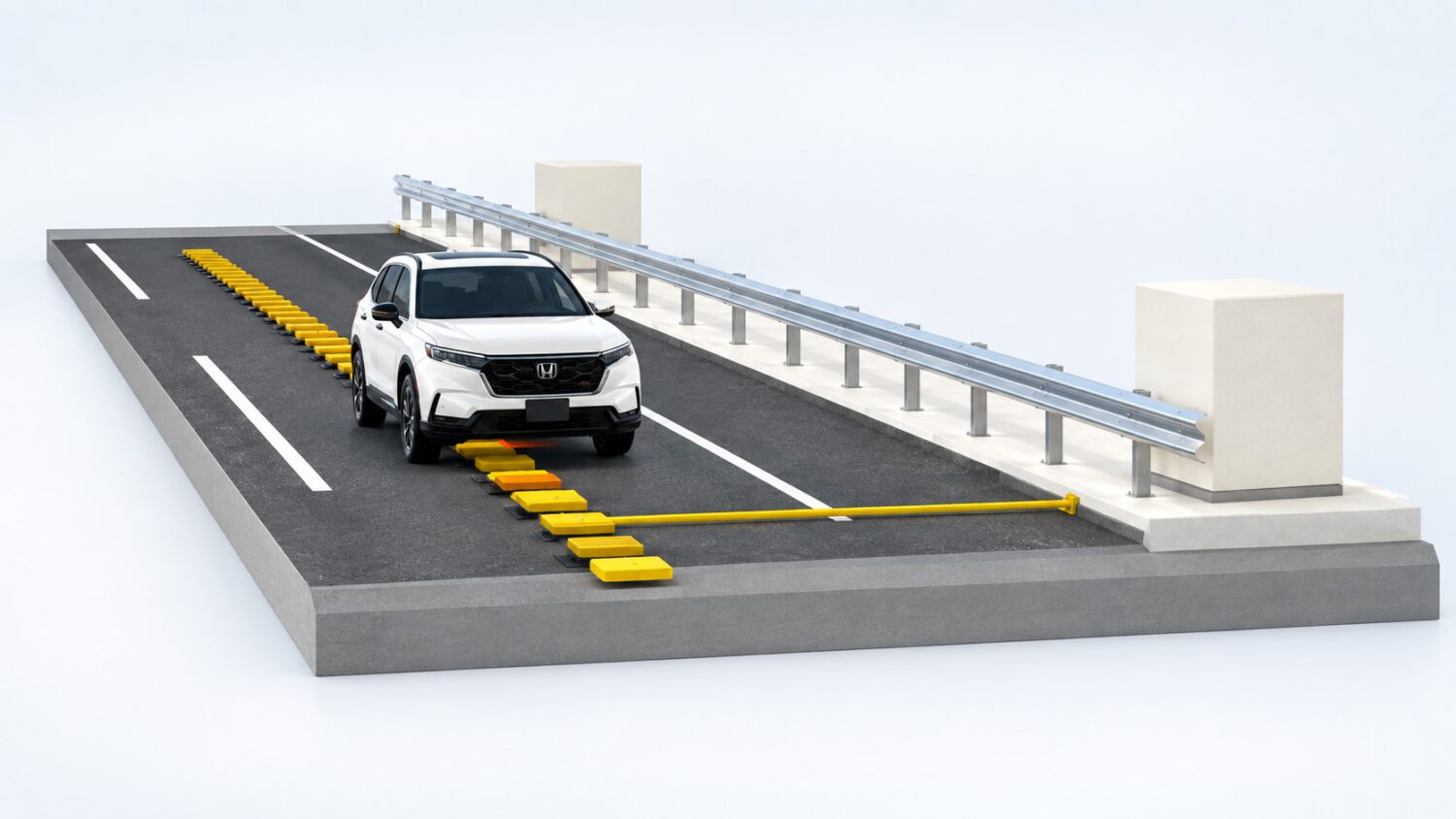
Every hour a freight truck sits at a charging depot is an hour it isn’t delivering anything. Honda’s answer to that problem is to move the charging infrastructure off the lot and into the road itself.
Honda R&D, working with construction firm Taisei Corporation and road specialist Taisei Rotec, announced the technology in October 2026. The partners plan to demonstrate it on Japan’s Tateyama Expressway in Chiba, run by NEXCO East, beginning in fiscal 2027, which starts April 1, 2027. This is a validation project, not a commercial launch.
How the Road Charges the Truck
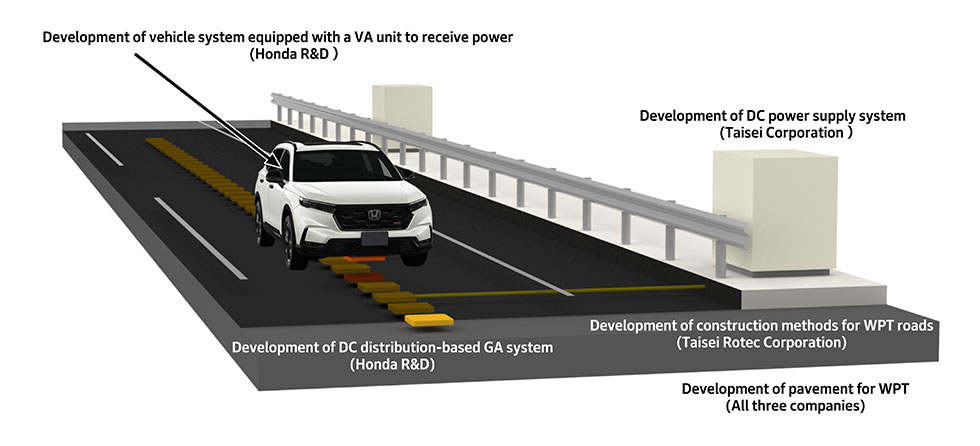
Magnetic coupling in the pavement transfers power to a compatible truck’s battery while the vehicle stays in motion.
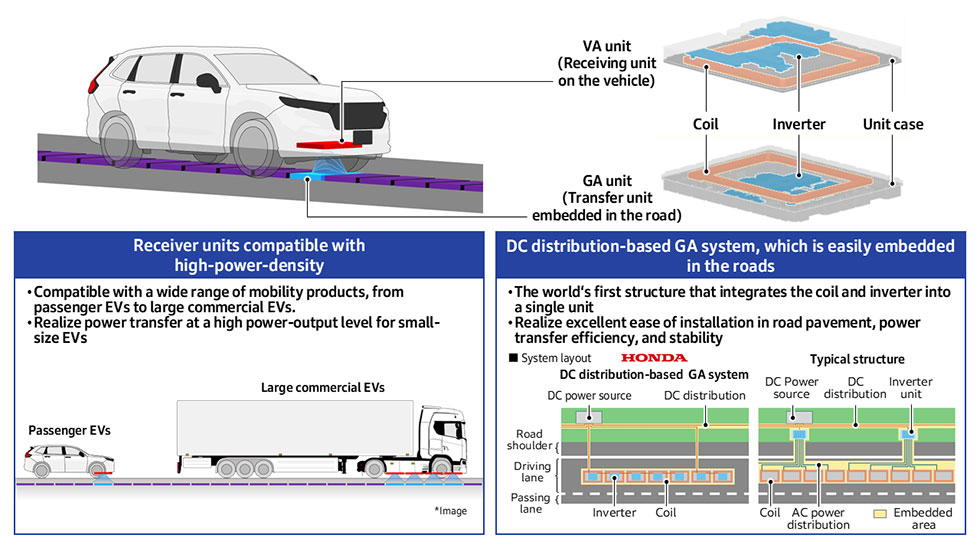
Transmitter units embedded beneath the pavement generate a magnetic field. A receiver mounted under a compatible truck captures that energy and routes it to the vehicle’s battery while the truck keeps moving. The principle is the same inductive coupling used in phone charging pads, scaled to highway-grade power levels.
Honda’s design uses a DC distribution system where each ground unit integrates both an inverter and a charging coil. That consolidation reduces wiring, components, and installation labor compared with more distributed arrangements, according to Honda’s announcement. The equipment is also designed to fit into sections cut from existing pavement, potentially enabling installation during road work rather than requiring full reconstruction.
One important boundary: ordinary EVs cannot use this system without a compatible receiver and associated power electronics installed beneath the vehicle.
What’s Actually Being Tested
Durability and power-transfer targets are testing objectives, and none should be read as confirmed highway performance results.
A separate test road, planned for construction in late 2026, will put the pavement through the equivalent of one million wheel-load cycles at 49 kilonewtons per wheel, using vehicles around 20 metric tons. That stress test addresses durability, not performance.
Power delivery of up to 150 kilowatts and reliable wireless transfer at higher vehicle speeds are listed as verification targets for future testing. These are objectives Honda intends to examine, not confirmed outputs from any completed trial.
Why Trucks First, and What’s Still Unanswered
Predictable freight routes and the productivity cost of charging stops make commercial fleets a more tractable starting point than consumer EVs.
Commercial trucks run predictable routes, which means infrastructure investment can be concentrated along specific corridors rather than spread across an entire road network. Charging stops cost money in lost productive time, and fleet operators have a direct financial reason to support technology that reduces them.
The harder questions remain open. Honda’s announcement does not provide a commercialization date, installation cost, operating cost, charging efficiency figure, or final production specification. Pavement repairs, accessing failed components under live traffic, electromagnetic-field management, and interoperability standards between road transmitters and vehicle receivers are all important open engineering and deployment challenges.
Honda is not alone in this space. Florida has planned a roughly three-quarter-mile wireless-charging section on State Road 516 with a reported design target of up to 200 kilowatts. Electreon has separately pursued buried-coil charging projects, including work associated with Detroit. The cited projects indicate that multiple organizations are exploring dynamic charging; none has established that it is commercially economical or ready for broad deployment.
The Real Milestone
A successful Tateyama demonstration would provide evidence about durability and road-speed performance, not a signal that charging highways are ready to scale.
A successful Tateyama demonstration would provide evidence that the pavement survives heavy use and that wireless power transfer works reliably at road speed. Fleet trials, regulatory approval, interoperability standards, and a viable maintenance model would still follow before any freight corridor sees a charging road. What Honda is building right now is the evidence base for those future conversations.