Placing traffic cones around a highway crash is one of the most dangerous jobs in road maintenance, with direct implications for workplace safety. Workers step into live lanes while vehicles approach from behind.
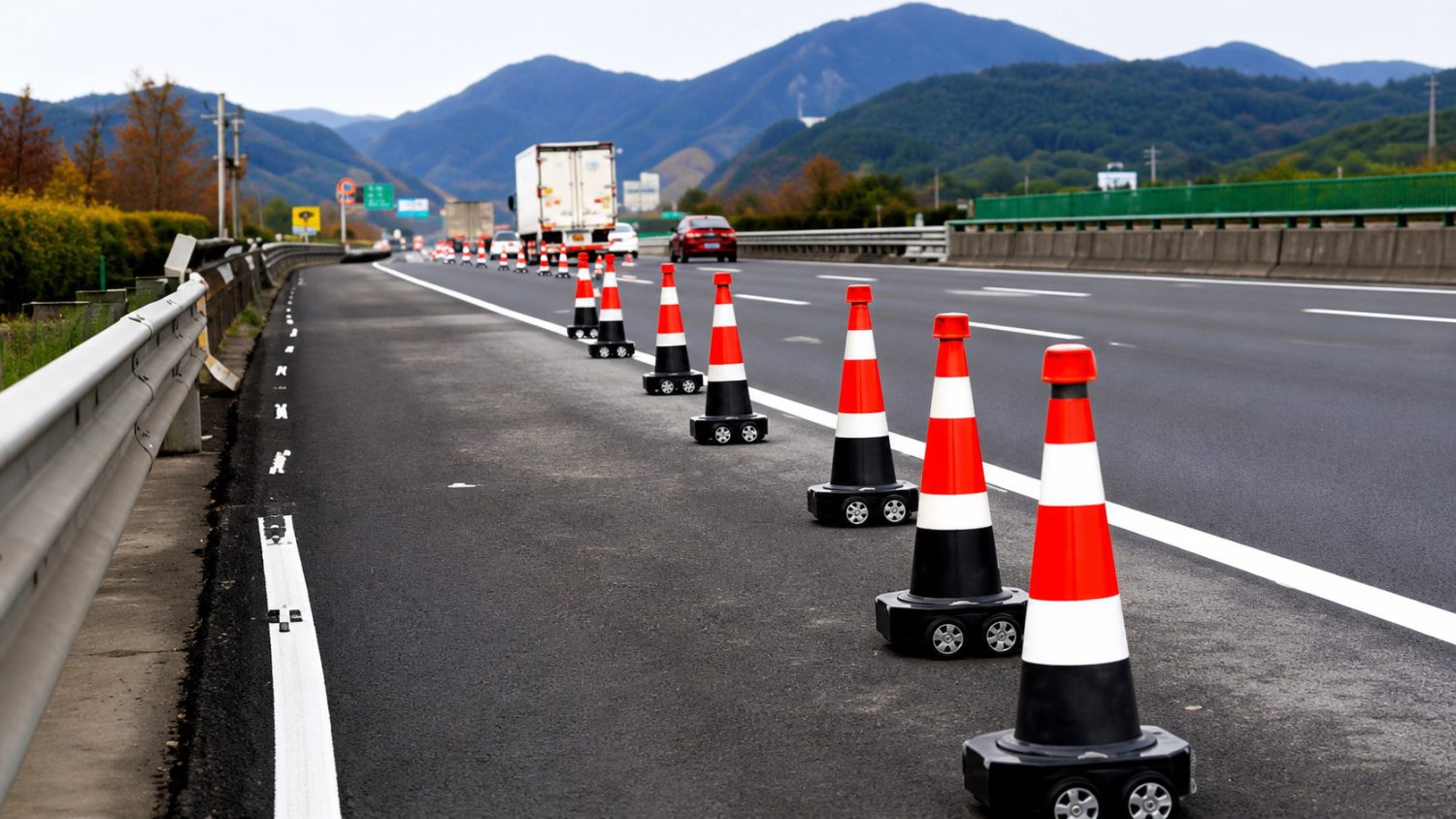
Chinese developers are testing a potential answer: wheeled traffic cones that roll off a response vehicle, move into a coordinated formation, and create a safety perimeter without anyone stepping onto the road.
The systems are at the testing, pilot, and limited-deployment stage. They are not a finished, standardized product, and key performance claims remain unverified outside controlled demonstrations.
From Truck to Road in Seconds
Multiple Chinese developers are building wheeled cones that operators can deploy remotely, without placing a single cone by hand.
The devices travel on motorized bases and can form coordinated barrier lines in straight formations, with some secondary reporting describing curved arrangements. Operators control them remotely via 4G or 5G networks, or direct them locally.
Some models reportedly support autonomous navigation guided by onboard sensors. Capability varies by developer and should be treated as a reported feature, not a confirmed specification across all units.
Reported units include flashing warning lights and solar charging, with docking stations available as a backup during poor weather or extended deployments. Several Chinese companies are developing versions of the concept, including a Ningbo-based intelligent-equipment firm, Zhongwei Electronics, and Hefei Boteng Nengtong. That range of developers signals an emerging product category, not one established device.
Keeping Workers Out of Live Lanes
The primary safety argument is straightforward: the most dangerous moment in incident response is the one these deployed robots are designed to eliminate.
A developer says its system can close a lane in under 10 seconds under suitable conditions. That figure comes from company descriptions of rapid highway lane closure, not from independent standardized testing, and real-world results will vary.
Manual cone placement can take several minutes, depending on incident size, the number of cones required, and traffic conditions. One Chinese report describes traditional highway incident closure taking approximately 20 to 30 minutes, though timing varies by procedure and scene.
That comparison is not a controlled benchmark, but it reflects a genuine operational gap that faster remote deployment could narrow. Beyond crash scenes, Chinese reporting describes applications in tunnels, on bridges, near highway barriers, and in maintenance zones where crews cannot safely remain on the roadway.
Real Roads Are Not Demonstration Conditions
The concept addresses a genuine problem; what it cannot yet address is the full list of questions that real deployment would raise.
The reviewed sources do not provide an independently verified specification sheet for any of these systems. Dimensions, weight, maximum speed, weather resistance, obstacle-handling, sensor packages, and failure rates are not confirmed in the available reporting.
Remote operation over public 4G or 5G networks introduces reliability and cybersecurity considerations. At least one developer uses public-network communications, according to Chinese reporting, but no such independent security testing was identified in the reviewed sources.
Solar panels may underperform in rain, darkness, snow, or shaded road corridors. Docking stations can compensate for some of those limitations, though they add infrastructure requirements. Descriptions of the devices as “AI-powered” or “autonomous” cover a wide range of actual capabilities depending on the model, much like the autonomous systems involved when a driverless vehicle smashed through traffic barriers. Neither term represents a confirmed technical standard here.
Regulatory approval status for any of these systems is not established in the reviewed sources.
Robotic traffic cones address a real worker-safety problem, and the core idea of removing humans from the most hazardous moments of incident response is sound. What the reviewed evidence supports is promising pilot activity and limited operational use, not a proven solution ready for broad deployment. Independent testing, performance standards, and regulatory frameworks have not been established in the available reporting.