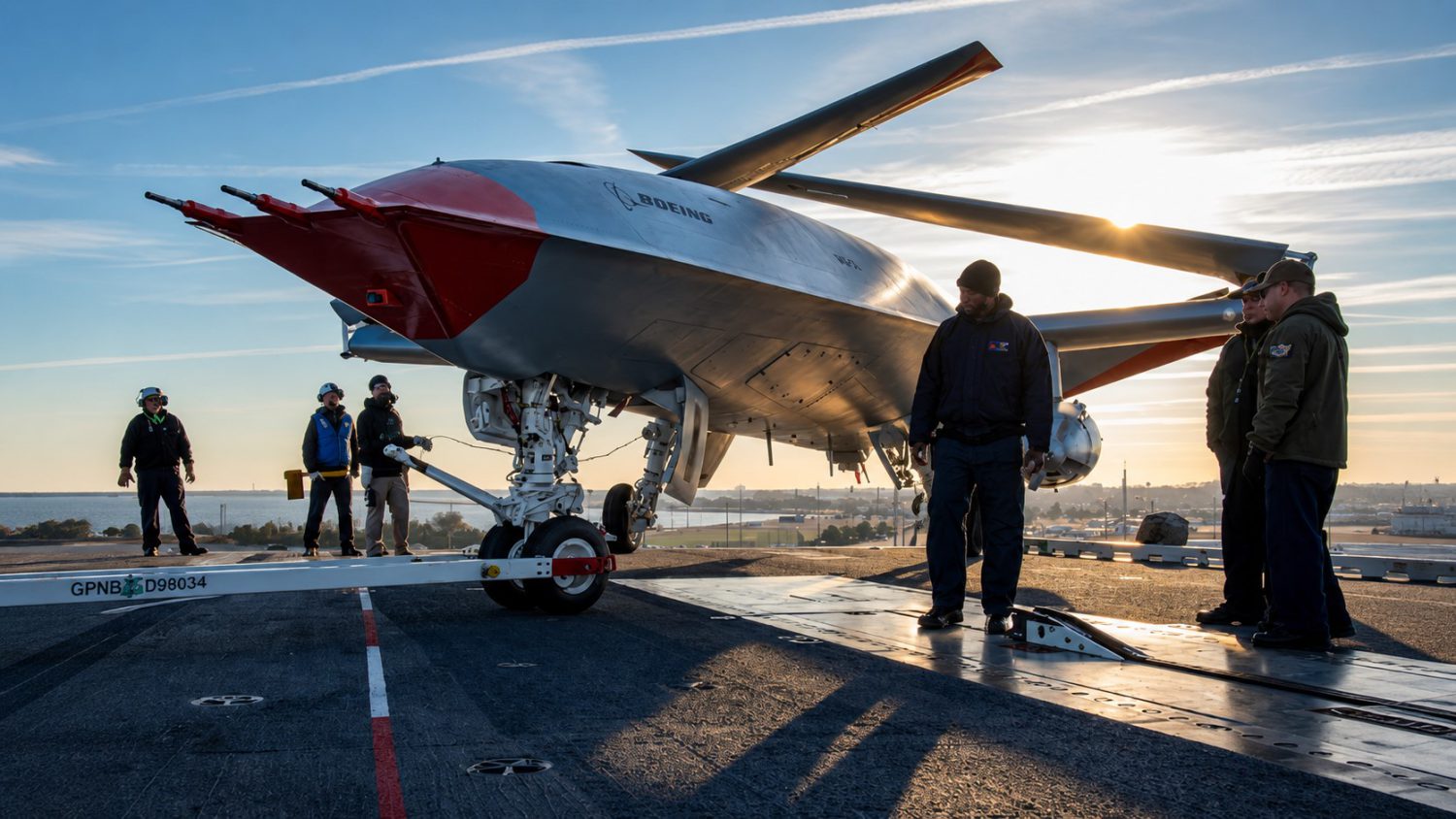
Right now, F/A-18E/F Super Hornets are doing double duty on carrier decks: flying combat missions and hauling fuel to other aircraft. That changes when the MQ-25A Stingray arrives. The U.S. Navy has awarded Boeing a $562 million fixed-price incentive contract for Lot 1 low-rate initial production (LRIP, the first stage of manufacturing before full-scale production begins) of the Stingray, with initial deliveries targeting 2029.
What $562 Million Actually Buys
This contract moves the Stingray from a test program into early manufacturing, with three aircraft in the first production lot and a fleet target of 76 total.
According to the U.S. Navy press release, the contract covers three Lot 1 production aircraft plus long-lead components for three additional Lot 2 aircraft. Combined with 11 previously contracted test airframes, the Navy now has 14 Stingrays under contract. The program of record calls for 76 total aircraft: 67 operational and 9 for testing. Contract completion is projected around July 2031.
Freeing Fighters for Combat
Every Super Hornet flying a tanker mission is one fewer available for strike, escort, or suppression, and the MQ-25 breaks that tradeoff.
Per the Government Accountability Office, the Stingray is designed to transfer at least 14,000 pounds of fuel use at a range of 500 nautical miles. That reach extends the combat radius of carrier air wings considerably.
The aircraft itself is substantial: 51 feet long with a 75-foot wingspan, powered by a Rolls-Royce AE 3007N turbofan. It operates at speeds above 500 mph and at altitudes exceeding 39,000 feet.
During testing, the MQ-25 has already refueled an F-35C Lightning II, an F/A-18 Super Hornet, and an E-2D Hawkeye, covering nearly every aircraft type currently operating from carrier decks.
Five Years Late, Still First of Its Kind
Schedule pressure is real, but recent milestones show the program moving with purpose toward its revised 2029 service entry.
The original IOC (initial operational capability, the point at which a system is ready for combat use) target was 2024. Technical risks and a Boeing labor strike pushed that date to 2029, a five-year slip consistent with the pressures that routinely affect complex defense programs.
On April 25, 2026, a fleet-representative MQ-25A completed its first flight. The aircraft autonomously taxied, took off, flew, and landed using the Navy’s Unmanned Carrier Aviation Mission Control System. Milestone C approval followed in May 2026, formally clearing the program to enter production.
Carrier infrastructure is advancing in parallel. Pentagon acquisition documentation, as cited by Army Recognition, confirms: “In March 2026, the USS Theodore Roosevelt (CVN 71) UAWC became the first fully operational/deployable MQ-25 capable aircraft carrier.” The UAWC, or Unmanned Air Warfare Center, is the carrier-based command and control hub that enables drone operations alongside manned aircraft.
What Comes Next
Successful Stingray fielding reshapes how carriers project power at standoff range, with the Indo-Pacific as the most consequential test case.
With an unmanned tanker capable of operating 500 nautical miles from the ship, the carrier itself can hold at greater standoff range while its air wing still reaches deep into contested airspace. Watch whether Boeing holds the 2029 delivery schedule and whether the Navy accelerates UAWC installation across additional carriers. Both will signal how quickly this shifts from program milestone to operational reality, with weapons like hypersonic missiles representing the next frontier in that contested environment.