Psychiatry has one of the worst clinical trial success rates in medicine, and a central reason is straightforward: mouse brains are not human brains. Stanford neuroscientist Prof Sergiu Pașca’s lab has now made that gap significantly smaller. A study published in Nature on September 16, 2026, describes mice whose cerebral cortex is largely composed of living human neural tissue grown from stem cells.
How the Mice Were Built
Stanford engineered mice with almost no cortex of their own, then filled the space with human brain organoids.
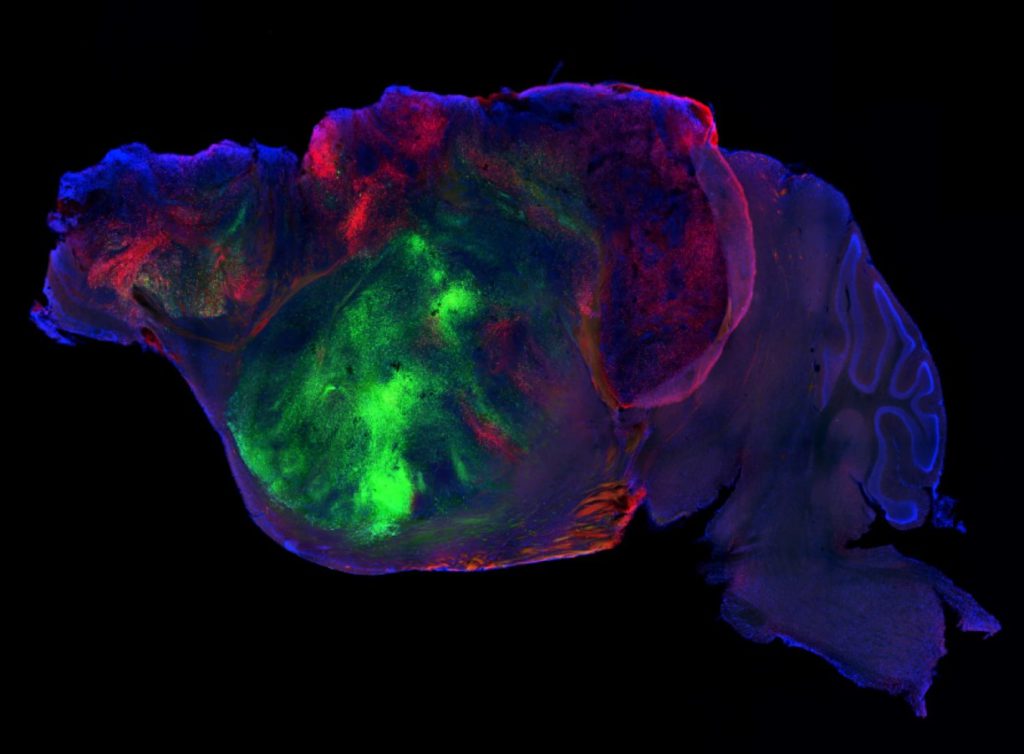
The process began with genetic engineering. Researchers modified mice so that the precursor cells forming the cerebral cortex and, in some cases, the hippocampus would not survive, leaving large cavities in the developing brain. Human skin cells were then reprogrammed into induced pluripotent stem cells and grown into cortical organoids. These are three-dimensional clusters of brain-like tissue that mimic structural and functional features of the human cortex.
Those organoids were implanted into young mice aged 5 to 17 days old. Within two to three months, the human tissue expanded roughly 4.7 times in volume, eventually occupying about 92% of the available cortical space, according to reporting on the Nature study. The human cells formed connections with the surrounding mouse brain circuitry and extended projections into the animals’ spinal cords.
Critically, the transplanted tissue spontaneously generated cell types found only in human and primate brains, not in mice. That detail matters: it suggests the human developmental program remained intact even inside a rodent nervous system.
What This Could Mean for Brain Disease Research
Patient-derived organoids implanted into these mice could test therapies in living human neural tissue for the first time.
Standard rodent models repeatedly fail to predict how psychiatric drugs will behave in humans. “Here we have a new model that allows us to actually capture aspects of human brain function in a way that has not been possible before,” Pașca told BBC News. The target disorders are serious and undertreated: epilepsy, autism, cerebral palsy, and schizophrenia, among others.
The model’s practical power lies in its specificity. Researchers can take cells from an individual patient, grow them into organoids, and implant those organoids into xenocortical mice. The result is a living model of that patient’s own neural tissue in a functioning brain environment, a meaningful step beyond studying organoids in a dish.
The limits are real. Dr Ilary Allodi of the University of St Andrews, commenting via BBC News, described the human cortex formed inside the mice as looking “a bit messy,” lacking the clean layered structure of a normal cortex. The human tissue replaced only about 14 million missing mouse neurons with roughly 4 million human ones, occupying around half the brain by volume, according to The Guardian. Multiple experts agree these mice will serve a limited number of labs for specific research questions, rather than becoming a standard tool.
Behavior and Ethics
The mice performed largely like normal mice; independent ethicists say no human-like awareness was detected, but harder questions remain.
In basic behavioral tests, mice with human cortical organoids moved and acted like typical mice. In maze trials, animals with implanted human tissue outperformed those lacking both cortex and hippocampus but without any human cells, suggesting some cognitive contribution from the transplanted tissue. There is no evidence these animals possess human-like consciousness or self-awareness.
The research was conducted under independent ethical oversight and strict welfare guidelines. “No indication that what’s being created here are mice that can think like humans, or a human brain in a mouse body,” said Dr Sarah Chan, a bioethicist at the University of Edinburgh, speaking to BBC News. Chan noted that the work forces researchers to reconsider how they assess animals whose neural experiences may differ from those of typical lab mice, while Prof James Ainge of St Andrews cautioned that ethical concerns around housing living human brain tissue in animals could limit the model’s broad applicability.
As neuro-chimeric models grow more sophisticated, regulatory frameworks built for conventional animal research will face pressure to evolve. The question of where to draw the line on human-animal brain integration is no longer theoretical. International consensus on permissible boundaries is becoming an urgent, concrete debate.