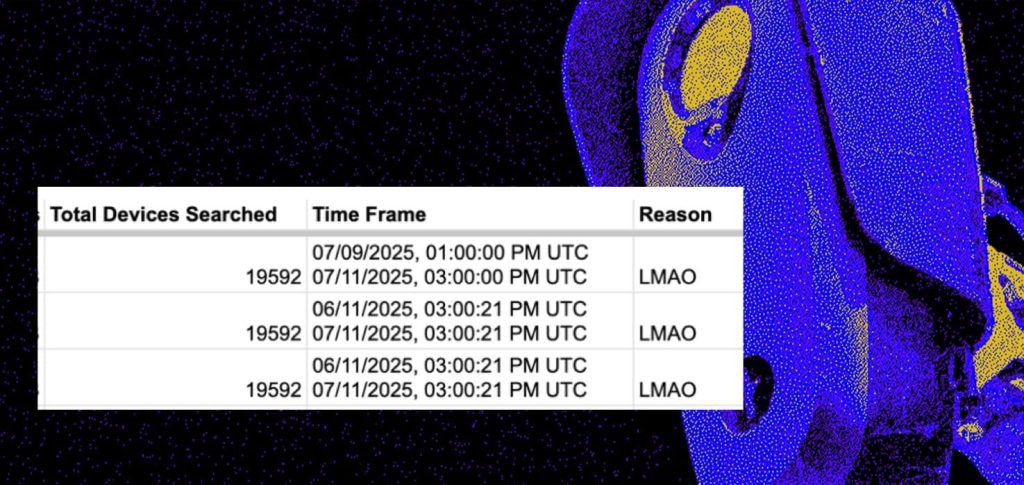
Last summer, a Lake County, Indiana deputy used Flock Safety’s nationwide search tool to query more than 19,000 cameras across 1,558 cities and towns. The official reason logged in the system: “LMAO.”
That single entry is not an outlier. It is a window into how officers across the country treat one of the most powerful location-tracking networks ever built for domestic law enforcement.
What the Logs Actually Show
Officers typed “asdfg,” “idk,” and “WEIRD KID” into a field meant to document legal justification for searching a nationwide surveillance database.
The Electronic Frontier Foundation obtained Flock Safety audit logs through public records requests and published its findings in September 2026, covering police searches from 2023 through late 2025. According to the EFF’s analysis, as reported by 404 Media, officers regularly entered reasons including “LOL,” “Hehe,” “Haha,” “idk,” “blah,” “TBD,” and “robbery I don’t remember the case number leave me alone.”
Insults appeared too: “idiot,” “dickhead,” “shithead,” and “WEIRD KID” all showed up as official justifications for accessing sensitive location data. Then there were the button-mashers, who typed strings like “asdfg,” “gyghkkghghjkghjk,” and “nmbvcbnm” and called it a day.
The joke entries sit alongside a deeper structural problem. In a separate dataset of 11.4 million Flock nationwide searches over six months, the ACLU found that more than 14% of entries contained only the word “investigation,” with no case number attached.
What Happens When You Get Caught
Agencies responded with counseling sessions, union contract loopholes, and the occasional claim that searching for someone “driving around being weird” counted as legitimate police work.
When the EFF contacted departments whose officers logged joke reasons, the consequences were thin. Some officers were “counseled.” Others faced no action at all. Union agreements imposed 90-day disciplinary windows that had already expired by the time the entries surfaced.
The Fishers Police Department in Indiana said one detective logged “blah” only when frustrated with slow system performance, framing the conduct as a technical complaint rather than misconduct. Another department concluded that a search documented as “driving around being weird” served, in their assessment, “legitimate public safety purposes,” according to 404 Media.
At the time of those searches, every agency whose cameras were queried had access to the same audit logs. None of them flagged the entries in real time, and none caught them afterward either.
After earlier reporting exposed searches targeting abortion seekers and immigrants, surveillance fusion centers reportedly advised officers to be “as vague as permissible” in the reason field, according to 404 Media. That guidance amounted to a roadmap for obscuring intent while maintaining the appearance of compliance.
In late 2025, Flock replaced its free-text reason box with a drop-down menu of pre-set justification categories. The EFF characterized the change as “a loss for transparency,” because the granular, searchable text that made abuses visible in public records no longer exists.
The joke entries share the same audit logs as searches that used terms like “gypsy vehicle” and “possible gypsy” to target Romani people, queries flagged with immigration-related language, and a Texas search documented with the phrase “had an abortion, search for female,” according to prior EFF and 404 Media reporting.
Legal pressure is building. The ACLU and EFF filed suit against San Jose, California, arguing that its nearly 500 Flock cameras and warrantless search access violate the state constitution. A letter from Sen. Ron Wyden’s office cited EFF data on the weakness of Flock’s justification requirements as a matter of federal concern.
If courts require warrants and legislators impose meaningful logging standards, Flock’s product changes fundamentally. If a drop-down menu satisfies regulators, the audit trail narrows, the searches continue, and the next “LMAO” never makes it into a public records request.