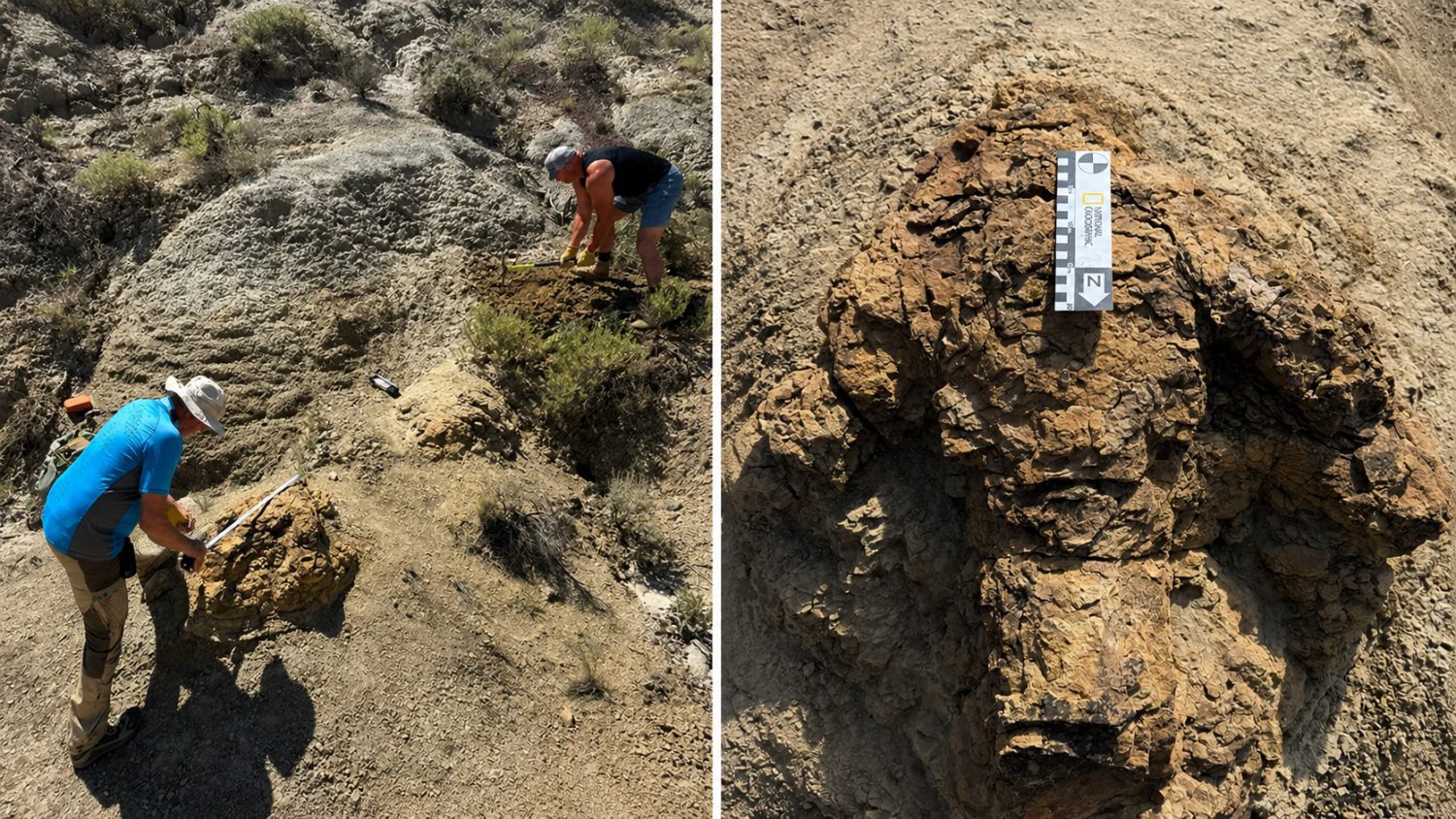
Four three-toed footprints, each larger than the carry-on bag you would fit in an overhead bin, were pressed into ancient mud 66.5 million years ago and locked in sandstone ever since. Kent Hups, a Colorado high school teacher and amateur fossil hunter, stumbled onto them in 2025 on federal land near Marmarth, North Dakota. The find is now published in the Journal of Vertebrate Paleontology as the first known continuous trackway attributable to an adult Tyrannosaurus rex.
What the Tracks Reveal
Four prints, seven meters, and the most direct evidence yet of how an adult T. rex actually moved.
The trackway consists of four tridactyl footprints arranged as two left and two right, spread across roughly 7 meters (about 23 feet) of ancient floodplain. Here are the key measurements the study documents:
| Detail | Value |
|---|---|
| Age | 66.5 million years old, late Maastrichtian Cretaceous |
| Location | Hell Creek Formation, near Marmarth, North Dakota |
| Print size | Approximately 1 meter long, 60 to 80 centimeters wide |
| Trackway length | 7 meters total across four footprints |
| Estimated walking speed | 5.6 to 7.2 km/h (roughly 3.5 to 4.5 mph), comparable to a brisk human walk |
Scientists cannot confirm T. rex with absolute certainty because weathering limits the fine anatomical detail preserved in the tracks. The attribution rests on four converging factors: exceptional print size, narrow toe impressions, the late Maastrichtian age of the rock, and the density of T. rex skeletal remains throughout the surrounding Hell Creek Formation.
Before this discovery, only two isolated footprints worldwide had ever been attributed to an adult T. rex, one in New Mexico and one in Montana. No continuous trackway had ever been recorded.
The stride length of roughly 4 meters between successive prints of the same foot gives researchers something skeletal reconstruction cannot: direct locomotion data. Speed estimates derived from that stride length place the animal at a relaxed walking pace, not sprinting, just moving through its world. “With a trackway, we can actually follow an animal as it moved across the landscape. That is incredibly rare for T. rex. Bones tell us an enormous amount about these animals, but footprints capture a moment of behaviour,” according to Tyler Lyson, senior curator of vertebrate paleontology at the Denver Museum of Nature & Science.
From Mud to Museum
A Cretaceous accident of geology turned soft mud into enduring scientific evidence.
The prints survived because the original depressions filled with fine sandstone shortly after they were made, then groundwater carrying calcium carbonate cemented that sediment into durable concretions. Over millions of years, softer surrounding rock eroded away and left raised sandstone casts of the animal’s feet. The result is not a mold or a void; it is a physical piece of rock shaped by a living animal mid-step.
Three of the four footprints are scheduled to be airlifted by helicopter from the field site and transported to the Denver Museum of Nature & Science for conservation and public display. The land falls under U.S. Forest Service jurisdiction, and the recovery required federal coordination before excavation could begin.
Hups not only spotted the tracks but earned a co-authorship on the published paper, alongside lead author Peter Falkingham of Liverpool John Moores University and the Denver Museum team. His involvement is a clear example of how amateur fieldwork still drives major scientific finds. The Hell Creek Formation has been studied for more than a century, and a schoolteacher on a fossil hunt found something the discipline had never formally documented.
When the three prints arrive in Denver, they will be accessible to anyone who walks through the museum door. That makes the most direct evidence yet of how T. rex moved available on public display, not locked in an academic journal.