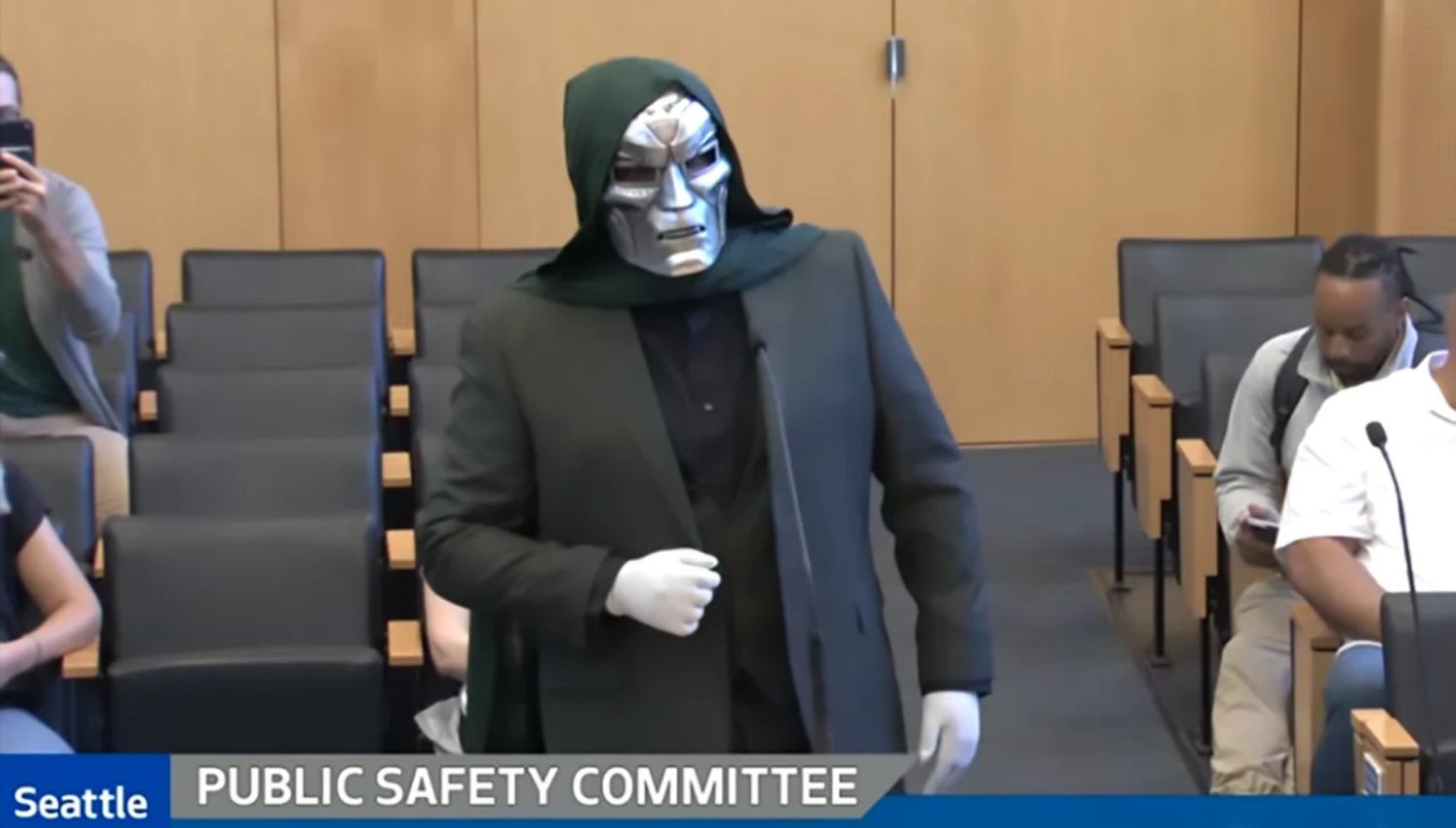
At a routine Seattle City Council Public Safety Committee meeting, a figure in a Doctor Doom costume approached the podium and proceeded to thank the city for its surveillance cameras. The man behind the mask was Clifford Cawthon, a policy advisor for the Washington State Department of Commerce and a member of advocacy group Community Not Cameras, which is pushing Seattle to scale back its reliance on systems sold by Axon and Flock.
The Villain’s Case for Watching Everyone
The costume is the hook, but the argument underneath it is serious.
Cawthon’s remarks, reported by 404 Media, were delivered entirely in character: “Doom has total dominion over the city of Seattle. Doom will be behind the cameras watching those seeking reproductive or gender-affirming care. Doom will be able to find your immigrant neighbors.”
The sarcasm is the point. Whoever controls the surveillance infrastructure holds real power over the people moving through it, and that power does not come with a villain’s mask to tip you off. Governments have even built a secretly tracking users playbook that shows how quietly that control can be exercised.
Community Not Cameras has toured Seattle’s Real-Time Crime Center and raised concerns about how broadly the city’s surveillance architecture has been built, according to NW Asian Weekly.
The costume is funny. The infrastructure behind it is not.
What Seattle’s Surveillance Network Actually Does
The system is more integrated than most residents probably realize.
Axon’s platform, as described in the company’s own materials, pulls body-worn cameras, drones, ALPRs, and CAD dispatch data into a single interface. Think less CSI command center and more “everything, everywhere, all at once” for whoever holds the login credentials.
Its Fleet 3 ALPR hardware reads plates across three lanes at closing speeds up to 140 mph. The system stores that data in Axon Evidence and flags hits against hotlists in real time.
Seattle’s local ALPR policy requires plate data to be deleted within 24 hours unless the plate appears on a hotlist, according to the Seattle Times. All access is logged by name, date, and reason.
Washington state has no comprehensive law governing ALPRs. Local rules and vendor contracts are filling the gap that state legislation has left open, and city policies can change with an administration far more quietly than state law can. San José’s experience with the same vendor illustrates the stakes , its Flock problem sparked grassroots resistance that Seattle activists are watching closely.
The Other Side Has a Point, Too
Supporters argue the technology works, and on coordination and efficiency, they are not wrong.
Axon describes its platform as bringing “all the sensors and data sources, from body-worn cameras to drones, ALPRs to CAD, into one seamless interface,” per the company’s real-time response materials. Supporters argue the system improves investigative efficiency and emergency coordination, and that argument carries real weight for dispatchers managing active incidents.
Real-time crime centers are not a Seattle quirk. They are expanding across American cities, and the coordination benefits are genuine.
The debate is not whether the tools work. It is who they work for, and under what rules.
What Comes Next
The unglamorous policy questions are the ones that will actually determine how this ends.
Cawthon and other Community Not Cameras members have already walked through the Real-Time Crime Center and pressed city officials on the scope of what they saw, per NW Asian Weekly reporting. That kind of direct scrutiny is exactly the pressure that shapes how cities govern these contracts. The risks are not hypothetical , operatives have already built a surveillance app to target political dissidents, a reminder of how quickly these tools can be turned against the public.
The questions worth watching include data retention windows, public records access, third-party data sharing, and whether Seattle’s city council can actually oversee a system this integrated. A Doctor Doom costume gets the meeting on record. The hard work is what happens after the mask comes off.