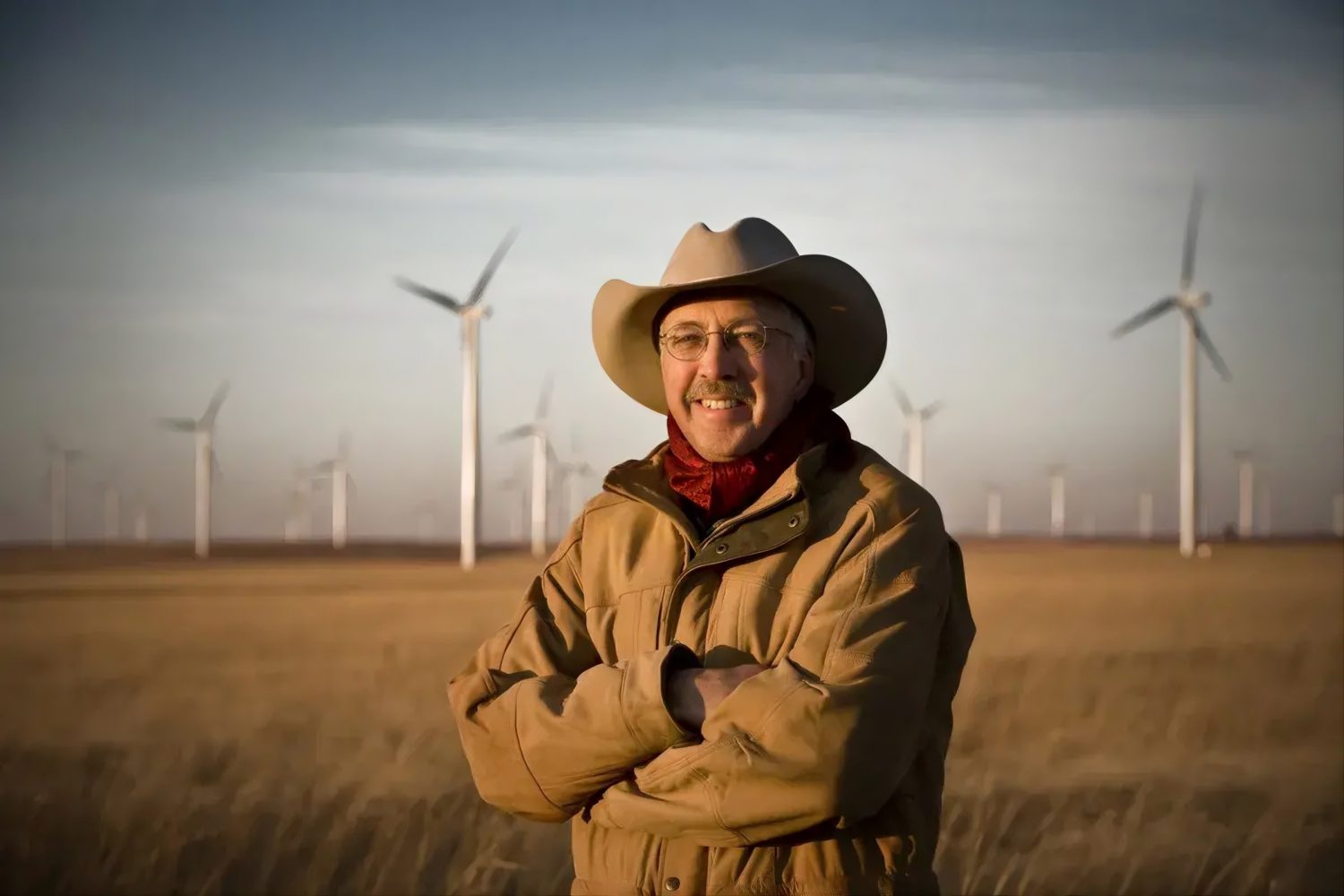
The Ferrell family started pulling electricity from the wind in 1923 — a Jacobs Windjammer turbine paired with a Delco glass battery, long before the grid reached Beaumont, Kansas. Today, Pete Ferrell lives in that same ranch house on 7,000 acres of Flint Hills tallgrass, but the scale has changed considerably. Fifty industrial turbines now rise across the western half of the property — half of Kansas’s Elk River Wind Project, enough generation to power roughly 60,000 homes annually. Wind royalties now constitute approximately half of Ferrell’s annual income. The economics were always the point. The politics came later.
From Skeptic to Signed Lease: The Education of a Rancher
A trip to California’s Altamont Pass changed everything — then Ferrell fielded six competing offers before signing with Greenlight Energy Resources.
When a Fortune 500 developer knocked in the 1990s, Ferrell said no. He feared turbines would gut the prairie he’d spent his life stewarding. The developer flew him to Altamont Pass anyway, where a California rancher hosting turbines shrugged and said, “What turbines? We are still caring for our land as we always did.” That line reframed everything. The original developer eventually walked, and Ferrell fielded six competing offers before signing with Greenlight Energy Resources, which brought Elk River online in 2005.
The economics, as Ferrell lays them out, are straightforward. Each turbine nets host landowners roughly $10,000 a year, according to Nicholas Glover of the Environmental Defense Fund, while occupying less than an acre — cattle graze around every tower on the Ferrell ranch. Since 2005, royalties have covered roughly half of Ferrell’s income, drought years included, and wind projects generate local tax revenue credited with improving school funding and lowering property taxes in counties like Iowa’s O’Brien County. Ferrell calls wind his “best insurance policy” — steady royalty payments will service ranch debt through succession, letting him pass the full 7,000 acres to his two children and four grandchildren without financial burden.
“The fuel is free… It just shows up.” — Pete Ferrell
Drought is “the big scary word in agriculture” in the Flint Hills — it can vaporize forage and revenue in a single season. Wind doesn’t care about drought. The turbines keep spinning regardless of whether the grass is burning or the cattle market is collapsing. That consistency is what separates wind royalties from everything else available to a rancher on this land.
The Wall Going Up: Politics, Opposition, and Who’s Funding It
Local siting restrictions jumped 16% in a single year — and counties locking themselves out today are forfeiting the exact revenue Elk River delivers.
Ferrell caught fire from both directions when Elk River broke ground. Left-leaning critics called turbines a blight. Right-leaning neighbors accused him of feeding at the government subsidy trough. His read on who was really organizing the opposition — and this is his view, not an independently verified claim — is unambiguous: “Every dollar against us came from fossil fuel interests.” He learned quickly to drop “environment” from his vocabulary when talking to neighbors. Economics, debt relief, succession — those words stayed in the room.
“Economics will ultimately win over political rhetoric.” — Pete Ferrell
The headwinds are growing faster than the turbines. Columbia Law School’s Sabin Center for Climate Change Law documented 459 counties and municipalities across 44 states with severe local restrictions on renewable siting by the end of 2024 — a 16% increase in a single year. More than 300 counties have effectively banned or imposed moratoria on wind or solar. Every county locking itself out is forfeiting the landowner income, tax revenue, and grid capacity that Elk River has delivered for nearly two decades.
The Regret Is Already There
As U.S. electricity demand heads toward a projected 50% increase by 2050, quiet envy is spreading across Ferrell’s neighboring ranches.
Ferrell’s neighbors mostly stay quiet publicly. Privately, he says, they tell him they wish they’d gotten a few turbines on their land. That quiet regret isn’t ideological — it’s arithmetic. A century after the first Ferrell pulled electricity from the Kansas wind, the question for neighboring ranches is no longer whether the technology works. It’s how long they can afford to wait — especially as AI and data centers push U.S. electricity demand toward a projected 50% increase by 2050, compounding the cost of every lease left unsigned.