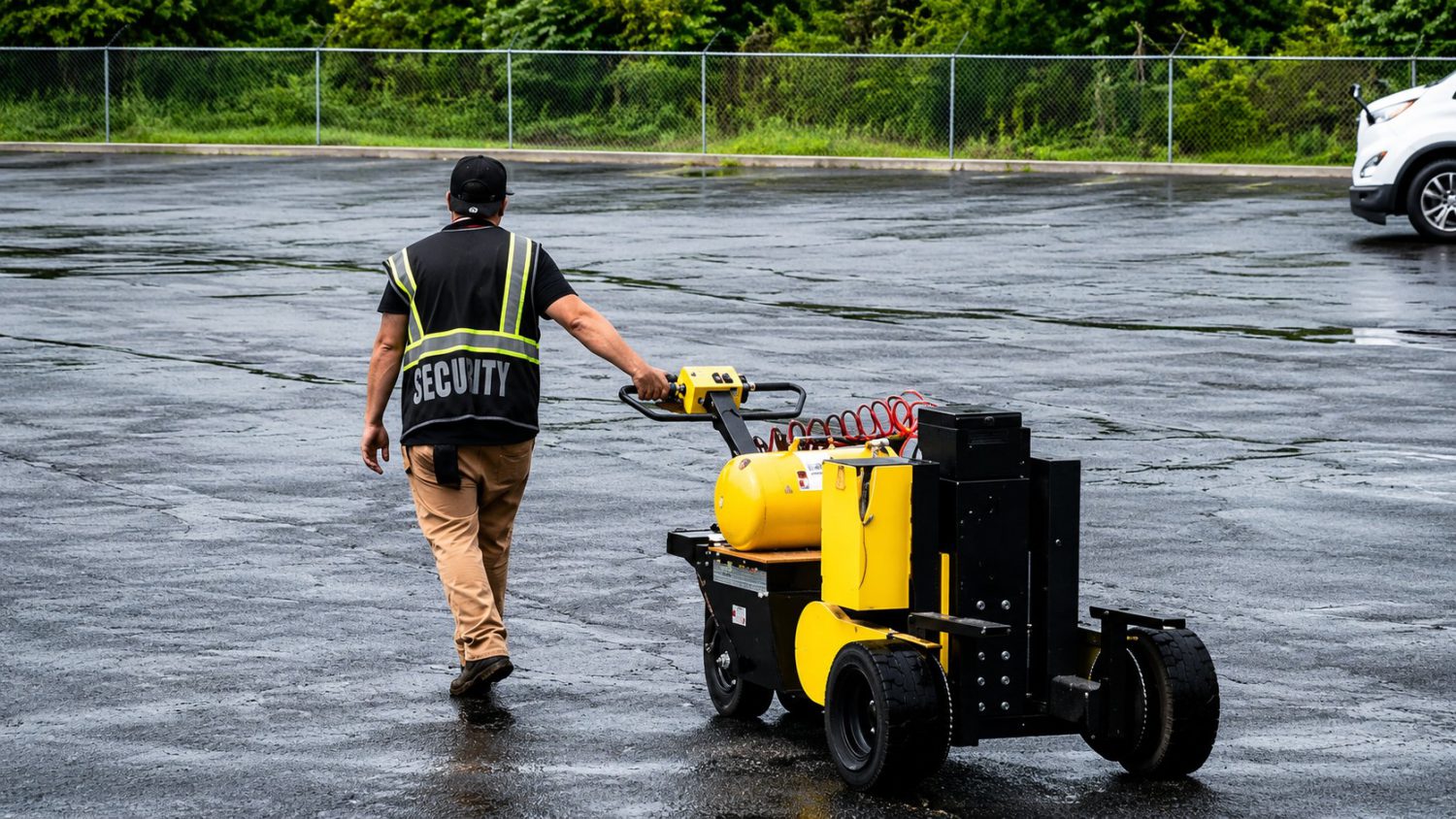
A machine roughly the size of a riding lawn mower moves a fully loaded semi-trailer like it weighs nothing. That’s what people saw when a clip of an alleged Amazon yard worker using a powered trailer spotter went viral, reported by Daily Dot on August 17, 2026. The comments exploded. Worth noting upfront: the claims in the original X commentary — “no CDL required,” yard workers earning around $19/hour — were not independently verified by Daily Dot.
Yard Dogs Have a Cheaper Cousin Now
The powered trailer spotter strips out everything a traditional terminal tractor does — except the part where the trailer actually moves.
Traditional yard operations depend on terminal tractors — hulking semi-tractor units, also called yard dogs or hostlers — to shuffle trailers between dock doors and staging areas. A powered trailer spotter is the stripped-down alternative: a compact, battery-powered motorized dolly built to push and pull large trailers without a full tractor. DJ Products markets its TrailerCaddy 15k 48V explicitly as a “more affordable yard truck alternative“ — smaller footprint, lower purchase price, better maneuverability in tight spaces.
It’s a switcher locomotive for the warehouse yard. Minus the locomotive.
Licensing Law Is More Complicated Than the Comments Section
Whether a powered trailer spotter can legally be operated without a CDL depends entirely on weight ratings — not the confidence of anonymous commenters.
Here’s what federal rules actually say:
- A Class A CDL is required for combination vehicles when the gross combination weight rating (GCWR) reaches 26,001 lbs or more — and only when the trailer’s GVWR also exceeds 10,000 lbs, per FMCSA guidance.
- If the combined rating stays under 26,001 lbs, no CDL is federally required, absent hazmat cargo or 16+ passengers.
- California and Delaware apply stricter rules — a CDL is required whenever trailer GVWR exceeds 10,000 lbs, regardless of GCWR, per NATM reporting.
- The X account commentary claiming “no CDL required” and “$19/hour yard workers” was not independently verified by Daily Dot.
- DJ Products markets the TrailerCaddy on its “minimal price tag” compared to yard tractors — the cost-saving framing companies use to justify adoption.
Efficiency Is the Word. Wage Compression Is the Subtext.
When a CDL gets engineered out of the job description, the savings are real — the question is where they land.
Traditional yard spotting required CDL-licensed drivers, workers with federally mandated training and typically higher hourly pay. Powered spotters, deployed within the right weight thresholds, can potentially shift that work to non-CDL yard staff. The viral clip fed directly into a pre-existing cultural dread — watching technology quietly eat your job description, the same anxiety white-collar workers felt watching AI dismantle their spreadsheet workflows. Some commenters called it “training his replacement.”
That framing is emotionally resonant. It’s also factually incomplete. CDL thresholds, hazmat rules, and state-level variations still meaningfully constrain where and how these devices can be deployed.
Wider adoption — especially paired with GPS yard-management systems already tracking trailer movements — points toward increasingly automated fulfillment yards. The technology itself isn’t the controversy. The real question is who captures the savings when a CDL gets quietly engineered out of the job description.