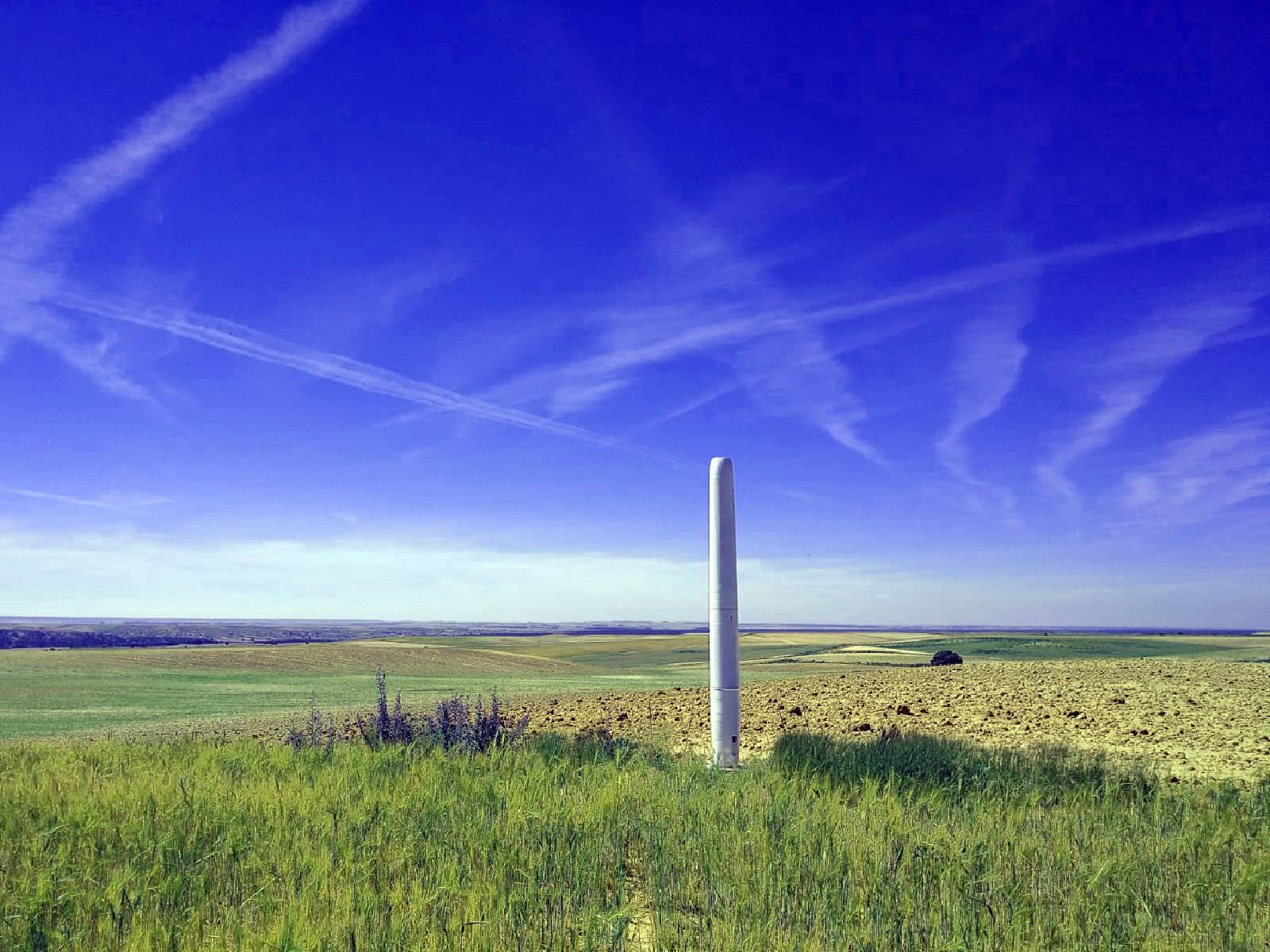
Noise complaints. Dead birds. Zoning battles. Conventional wind turbines have a PR problem that no amount of green credibility fixes. Communities block them. Planners avoid them. Promising sites stay undeveloped because a 300-foot spinning blade is a hard sell near a school or a suburb. That’s the gap Vortex Bladeless is building into — not by making a better turbine, but by ditching the blade entirely and replacing it with a wobbling mast that generates electricity through sheer oscillation.
How a Wobbling Rod Makes Electricity
The physics are stranger than the pitch — and they actually work.
Wind flowing around the cylindrical mast creates alternating vortices that push the structure side to side. That rhythmic swaying drives electromagnetic induction at the base, converting motion into current. No gearbox. No spinning hub. Fewer mechanical failure points than a conventional turbine. Think of it like a metronome catching a crosswind — deceptively simple, mechanically elegant. The efficiency gap compared to bladed turbines is real, but the mechanism itself is well-established physics, not vaporware.
What the Design Actually Solves
These are direct answers to the objections that have stalled wind expansion for decades.
- Noise: no rotating blades means no low-frequency hum rattling your windows at 2 a.m.
- Wildlife: birds and bats aren’t threatened by a mast that sways rather than chops
- Maintenance: fewer moving parts means fewer things that break expensively
- Footprint: compact enough for rooftops, courtyards, and urban installations
- Pairing potential: its compact scale also makes it a natural fit alongside rooftop solar — the distributed-energy equivalent of pairing two complementary tools in the same ecosystem
According to reporting from ioplus.nl, this technology is solving a different problem than efficiency. It’s solving access and acceptance.
The Honest Caveat
Less efficient than bladed turbines — and you deserve to know that upfront.
Bladeless turbines capture less energy than conventional bladed turbines at comparable scale. Full stop. They are not a replacement for utility-scale wind farms, according to reporting from Grist and BGR. Their ceiling is lower. Their realistic role is complementary — distributed power in space-constrained or politically sensitive environments where a traditional turbine would never get permitted in the first place.
That’s actually the point. Raw wattage isn’t the value here. Unlocking locations is. A rooftop in a suburb. A school courtyard. A building façade in a neighborhood that would never survive a zoning fight over a conventional turbine. If Vortex Bladeless delivers on its quieter promises, the win isn’t beating wind farms. It’s going where they never could. Much like aircraft designers who cut fuel use by rethinking the fundamentals, sometimes the biggest gains come from abandoning assumptions entirely.