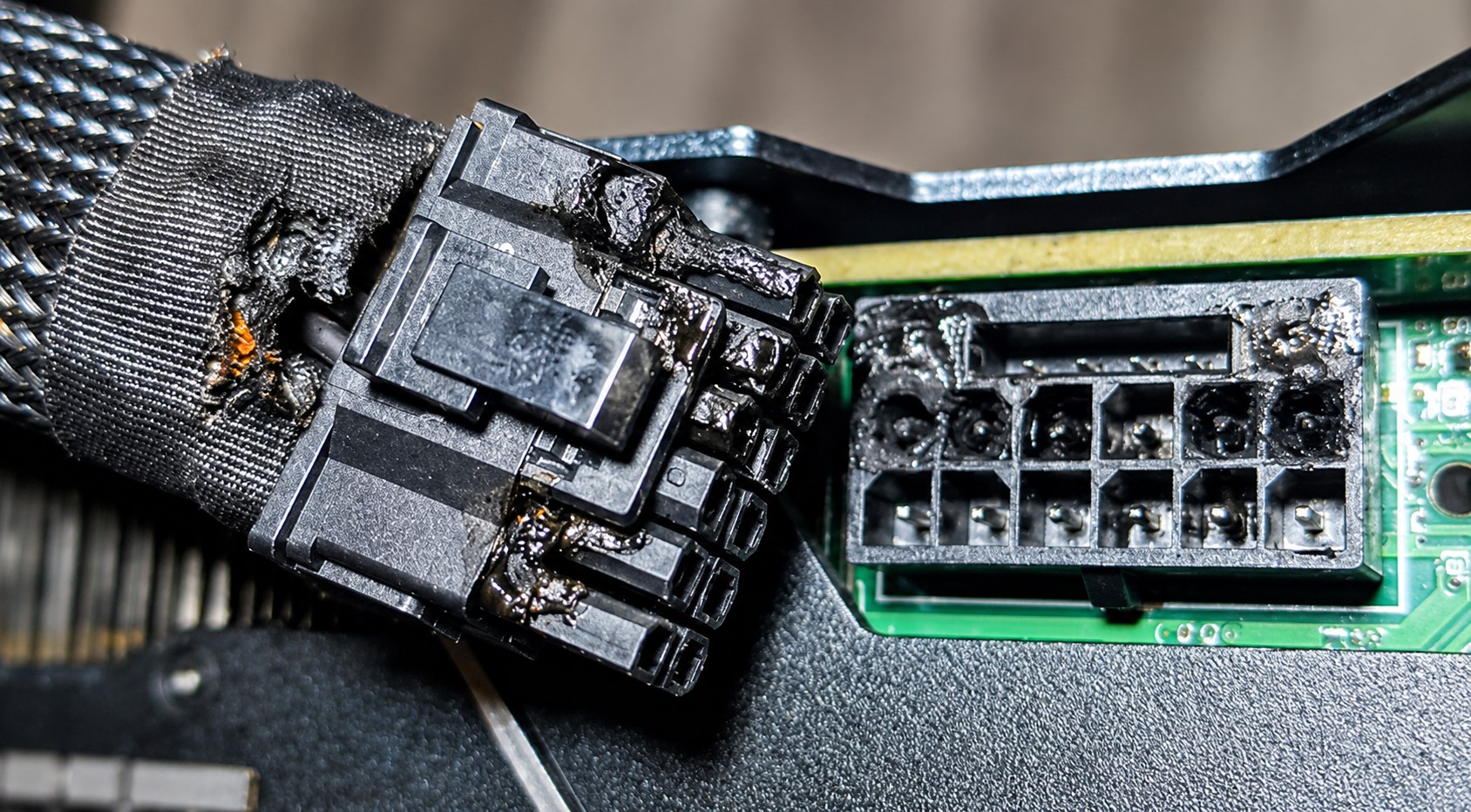
Spending $2,000 on a graphics card only to watch its power connector melt is every PC builder’s nightmare. The connector feeding that card has a documented history of doing exactly that. Nvidia denied fault. ASUS built monitoring software. And yet some owners are now trusting a Reddit user’s Python script as their last line of defense. The tool is called 12VHPWR Guard, built by Humza Khalid, and it does something brutally simple: it watches per-pin current on your power connector and kills your PC before things go sideways. These kinds of hardware failures sit alongside the most frustrating computer problems enthusiasts face today.
What Happens Under the Hood
The tool reads sensor data most users never see and turns it into a panic button.
The mechanics are straightforward, even if the setup isn’t casual. Here’s what 12VHPWR Guard actually does:
- Reads per-pin current directly from the card’s sensor chip over the I2C bus — a low-speed communication channel between hardware components
- Falls back to HWiNFO shared memory if direct sensor access fails
- Triggers when any single power pin exceeds 9.5A for 15 seconds straight
- Force-closes running applications, then shuts down the PC
- Thresholds and timing are fully configurable
As stated on the project’s GitHub page, the tool “reads per pin 12VHPWR current straight from the card’s own sensor chip and force shuts down your PC if any pin stays over 9.5A for 15 seconds.” Compatibility is limited to select ASUS ROG Strix and TUF Gaming RTX 5090/5080 cards, along with the ROG Matrix RTX 5090 — the models that expose per-pin sensors. The tool runs on Windows only and requires Python, which limits its reach considerably for casual adopters.
Parts of the codebase were reportedly rewritten with Claude AI assistance — a detail that says a lot about how DIY hardware safety tools get built in 2024.
Reasonable Precaution or Expensive Anxiety?
The community splits between calling the tool essential and calling it overkill.
Khalid frames the utility as “a last line of defense, not a first one.” That distinction matters. ASUS already ships Power Detector+ monitoring inside GPU Tweak III for ROG Strix and TUF Gaming RTX 40-series cards, signaling the company acknowledges the connector-current risk exists. Skeptics counter that proper connector seating and conservative power configuration solve the problem before software ever needs to intervene — and that no script helps if the connector is already arcing.
This anxiety traces back to the RTX 5090 launch era. Melting connectors. Nvidia’s denials. Community reports that still bounce between “zero issues” and photos of charred plastic. Nvidia acknowledged roughly 50 cases but attributed the failures to connectors not being fully seated, rather than a design flaw. The community has never fully accepted that verdict.
The next version may ditch the full shutdown approach entirely, instead throttling GPU power through Nvidia’s management API. That would be a meaningfully smarter response — like pulling the car over instead of cutting the engine at highway speed. For now, 12VHPWR Guard highlights something manufacturers should notice: their customers are building safety nets because they don’t fully trust the ones already provided.