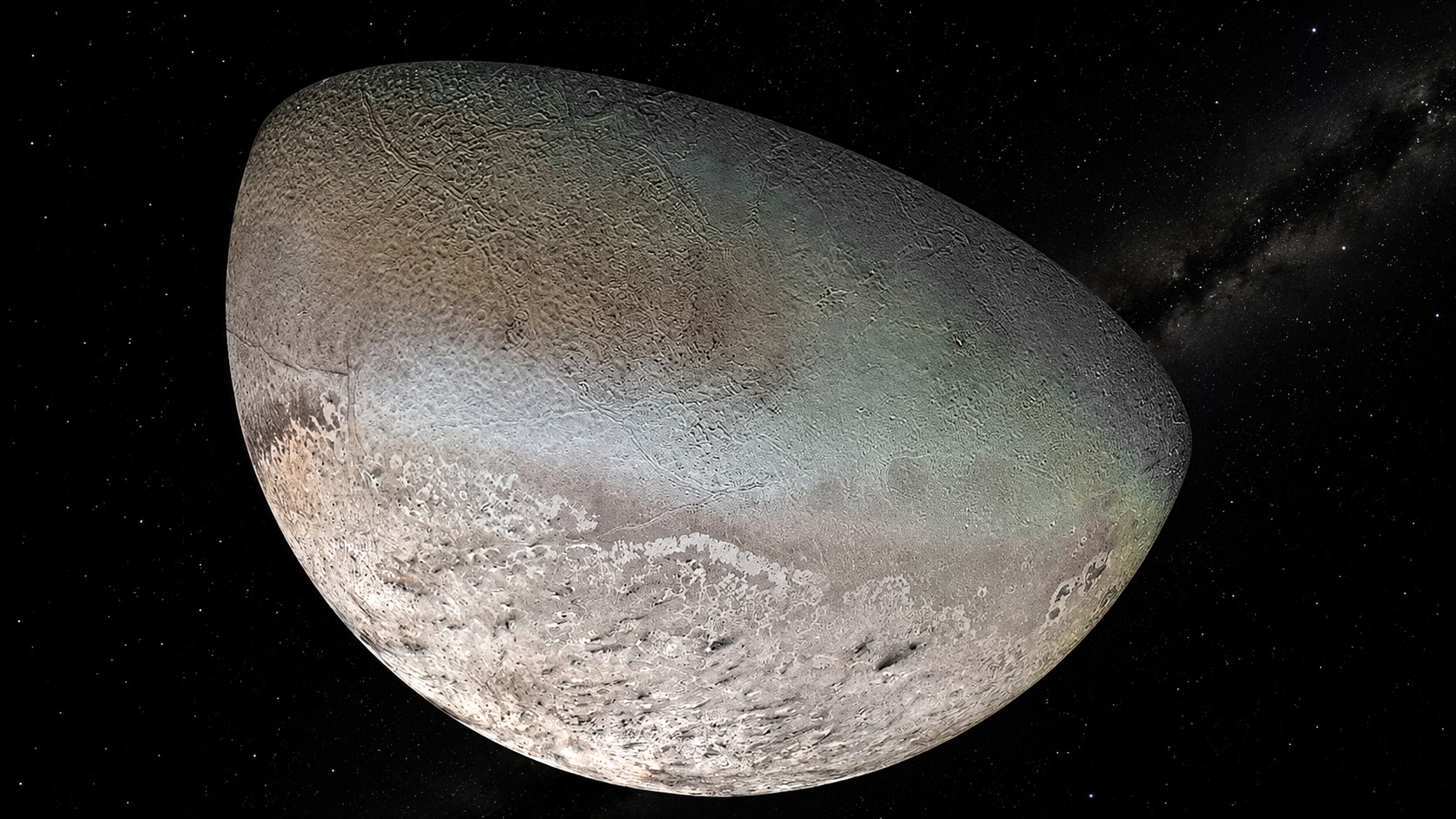
Roughly four billion years ago, Neptune hosted a respectable collection of large moons orbiting in tidy, predictable paths — think Jupiter’s system, orderly and stable. Then a Pluto-sized body barreled in from the Kuiper Belt and obliterated everything. The James Webb Space Telescope didn’t witness the carnage, but it just found the forensic evidence: clay minerals from the deep interiors of destroyed worlds, scattered across the surfaces of what survived, according to Reuters.
The Evidence Written in Clay
Minerals that shouldn’t exist on tiny, frozen moons point to something much bigger — and much older.
JWST’s infrared instruments detected magnesium-rich clay minerals — phyllosilicates, the same material found on dwarf planet Ceres and certain meteorites — on three small inner moons:
- Proteus
- Larissa
- Galatea
These minerals also turned up in Neptune’s dusty rings. The catch? They only form through prolonged contact between liquid water and rock, deep inside large icy bodies. “The moons themselves are far too small and cold for that chemistry to have occurred in place,” lead author Ryleigh Davis told Reuters, “We were shocked to find the observed clays, which had to come from objects that were much, much bigger than Neptune’s small inner ring moons.”
Those larger worlds no longer exist. Neptune’s small moons are effectively wearing the exposed interiors of dead worlds on their surfaces.
The Interloper That Started It All
Triton orbits Neptune backwards, accounts for over 99% of the system’s mass, and almost certainly destroyed everything that came before it.
Triton orbits Neptune in retrograde — the planetary equivalent of merging onto a highway going the wrong way. Its composition matches Kuiper Belt objects, not homegrown moons. Current models suggest it arrived as half of a binary pair, something like Pluto-Charon, before Neptune’s gravity separated them and kept Triton. Less a capture, more a hostile acquisition that liquidated every existing asset in the portfolio.
Today, Triton accounts for more than 99% of the total mass orbiting Neptune. Everything else — 16 known moons, the rings — amounts to wreckage. “Neptune ended up with a captured interloper dominating its satellite system rather than the orderly family of moons we see at the other giant planets,” Davis told Reuters.
One moon may have escaped. Nereid, with its wildly elliptical orbit and water-rich composition, looks like a surviving original. Researchers also acknowledge a less likely scenario — another Kuiper Belt body caused the disruption entirely — but Triton fits the full weight of evidence best.
The strange upside to all that ancient destruction? Neptune’s shattered system is now the only place where scientists can directly study the deep interiors of large icy worlds — material otherwise locked beneath thick ice shells on places like Europa and Enceladus. Sometimes the wreckage becomes the window.