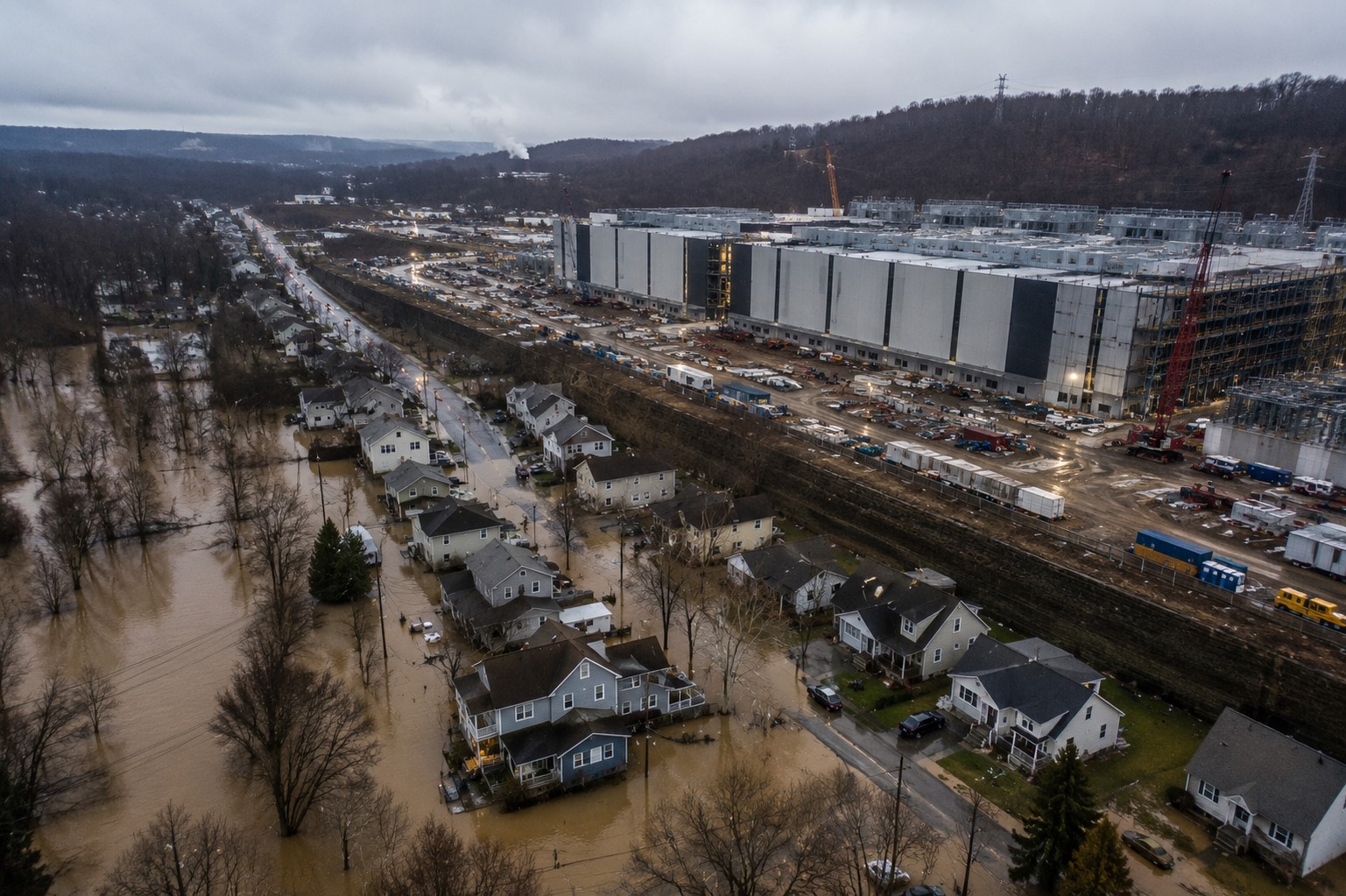
When residents of Meadowlands Estates in Mason County woke up on May 23, water was already in their garages. HVAC systems drowned. Crawlspaces filled with sediment-laden runoff. Some homeowners estimated damage between $20,000 and $30,000, according to local news coverage. The source sat uphill: 1,100 acres of hillside, freshly stripped bare for an AI data center campus. Then it happened again on July 11. State regulators stepped in.
A Month of Rain in 48 Hours — And Controls That Couldn’t Handle It
The Monarch Cloud Campus stormwater failures weren’t just about extreme weather — regulators found construction started before protections were in place.
Here’s what the record shows:
- The Monarch Cloud Campus, backed by Nscale and Fidelis New Energy, covers roughly 1,100 acres in Mason County — West Virginia’s first major AI-focused data center complex.
- On May 23, a silt retention area breached during heavy rain, sending sediment-loaded water directly into homes. Project manager Jason Bechtle told reporters the site received “a month’s worth of rain in 48 hours,” per People.
- On July 11, it happened again. The West Virginia Department of Environmental Protection (WVDEP) issued a unilateral enforcement order, according to WV Public Broadcasting.
- WVDEP inspectors found that land-disturbing work had begun before required erosion controls were installed — meaning the failures weren’t purely about rainfall intensity.
Nscale has since committed to cover repair costs. Crews are cutting additional drainage channels and raising elevations to redirect water away from the neighborhood.
Strip 1,100 acres of trees and ground cover, regrade the terrain, and every downpour becomes a flood looking for the nearest exit. WVDEP framed these incidents as preventable: when required controls fail or work starts without protections, the agency stated, enforcement follows. That language matters — it rejects the “act of God” defense entirely. Cloud services and AI tools depend on physical infrastructure; in this case, that means 1,100 acres of bare hillside draining into a neighbor’s basement.
Mason County Is a Preview, Not an Exception
At least four major data center projects are advancing across West Virginia, and state law now bars local governments from blocking them.
The pattern extends well beyond one campus. A proposed complex in Tucker County could eventually span 10,000 acres. The Ohio River Valley Institute estimates that facility alone would consume more than 10 million MWh annually — roughly equal to all West Virginia residential electricity use combined. Environmental advocates describe it as potentially one of the world’s largest data center developments, warning of “visible environmental impact” far beyond the site footprint, according to WV News.
Meanwhile, state legislators have stripped local governments of zoning authority over data centers and their attached power plants. Communities absorbing the flood risk, noise, and deforestation have almost no formal say. Residents compare it directly to mountaintop removal mining — different industry, same extraction logic, same pattern of outside companies reshaping the land while locals shoulder the consequences.
The hidden cost of always-on AI isn’t just electricity. It’s altered terrain, overwhelmed stormwater systems, and neighbors left mopping up what “move fast and break things” looks like when applied to actual hillsides. Whether that trade-off changes — through stricter siting standards, stronger stormwater engineering, or restored local oversight — is a question worth tracking every time your next AI query goes through.