You know the drone buzzing above a nesting bird colony, sending every animal scattering? Or the one hovering near a bridge inspection site, drawing stares from every driver on the highway? Northwestern University engineers asked a different question: what if the drone was already there and you simply couldn’t process it? Their answer, Phantom Twist, is a UAV designed not around radar or camouflage but around the blind spots in human vision. The research was presented July 16 at Robotics: Science and Systems 2026 in Sydney.
Spinning Into Invisibility
The entire drone body counter-rotates against its own propeller, leaving no stationary parts for the human eye to lock onto.
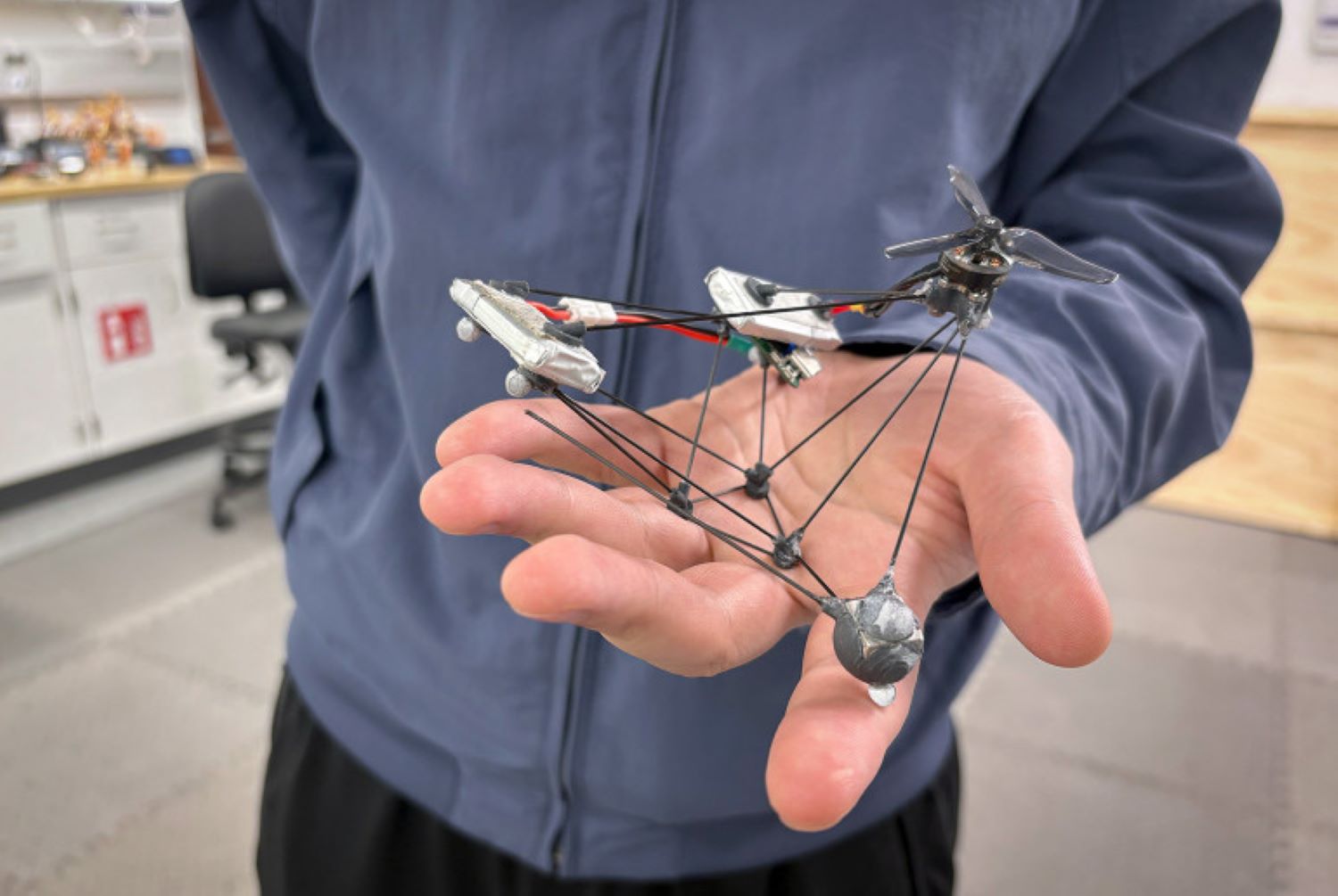
Phantom Twist runs a single propeller spinning one direction while the entire drone body rotates the opposite way. Nothing stays still. “Most efforts to hide drones focus on making them look like their surroundings. Instead, we asked whether we could design the drone itself around the way humans perceive motion,” said lead researcher Michael Rubenstein, associate professor at Northwestern’s McCormick School of Engineering. At up to 25 rotations per second, the whole structure dissolves into what co-author Emma Alexander describes as “a slight haze” — like a box fan’s blades vanishing the moment you flip the switch.
The team measured visibility using LPIPS, a perceptual metric calibrated to how human eyes actually judge images, not how machines do. Human eyes accumulate visual signals over time — like a camera on long exposure — and Phantom Twist is built to exploit exactly that. Result: the drone scored roughly 10 times less perceptible than a conventional quadcopter across varied backgrounds.
The design pipeline behind Phantom Twist:
- AI generated roughly 20,000 stable UAV configurations satisfying aerodynamic constraints
- Each design simulated against hundreds of real-world background images
- Visibility scored via LPIPS; 500 lowest-scoring designs selected and further optimized
- Components — motor, batteries, PCB, counterweights — spread at varying heights and angles to prevent visual overlap
- Final design fabricated and flight-tested, confirming stability and controllability
The intended applications sound almost wholesome: monitoring nesting birds, surveying wetlands, and inspecting aging infrastructure without spooking wildlife or bystanders — the kind of fieldwork where a visible drone causes real disruption. Conservation photographers and infrastructure safety crews alike stand to benefit. But honesty matters here. Phantom Twist is loud. Wires remain partially visible at close range. “Low-visibility” is not “invisible.” The NSF-funded team plans future iterations with transparent materials and quieter propulsion. This is a prototype, not a product.
For drone enthusiasts and robotics researchers, the real headline is the method itself. Scale that pipeline to sound and thermal signatures, and truly unobtrusive drones stop being science fiction — for better or worse.