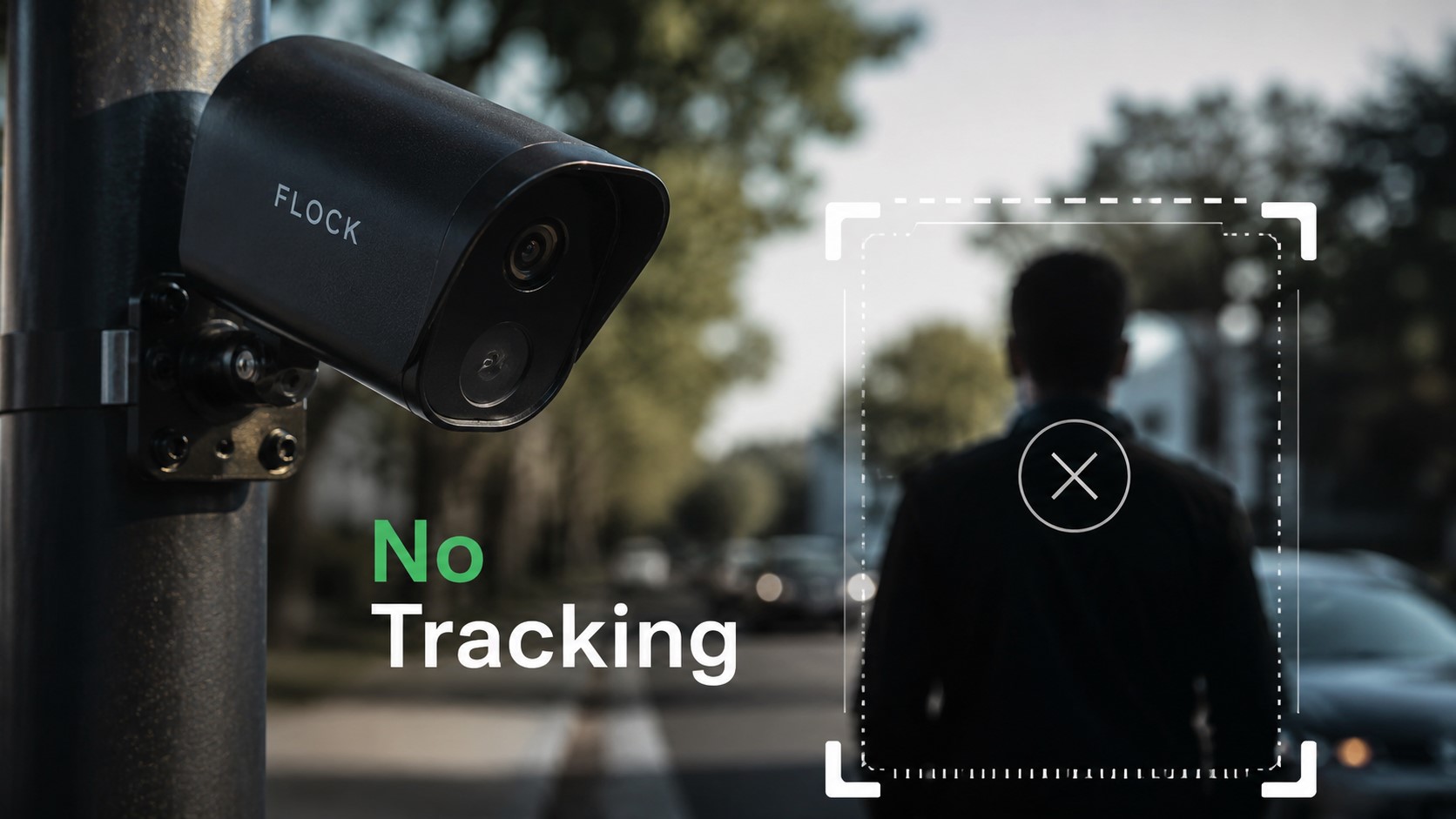
During a June 2026 demonstration documented by InvestigateTV, a Condor camera mounted on a public trail pivoted, followed, and zoomed on a passing reporter in real time. Standing nearby, a Flock Safety representative was asked directly: “You’re saying Flock does not track people, correct?” The answer was no — even as the screen showed otherwise. Flock Safety, the company behind tens of thousands of surveillance app readers across the country, now sells a camera called Condor that does exactly what its public messaging says it doesn’t: track human beings.
What Condor Actually Does
Flock’s newer camera line goes far beyond reading plates — it actively follows people.
Condor is a pan-tilt-zoom (PTZ) camera with AI built to detect and follow human movement, streaming live video directly to police. Unlike Flock’s Falcon plate readers, which photograph the rear of passing cars, Condor locks onto people. InvestigateTV’s investigation found that Flock’s own training webinars show officers how to track suspects “from location to location to location” using the system. For those concerned about privacy, exploring legitimate home security systems with transparent consent practices may be worth considering.
The documented capabilities, drawn from investigative reporting and civil-liberties research, are worth laying out plainly:
- Condor auto-zooms on faces as people walk past, according to civil-liberties groups and independent investigators
- 404 Media journalists found live Condor feeds exposed to the open internet — no passwords required
- Some cameras zoomed close enough to read content on a passerby’s phone screen, according to 404 Media journalist Joseph Cox
- Archived footage was also accessible on those same unsecured streams
- Flock training materials demonstrate cross-camera suspect tracking across multiple locations
“The functional equivalent of a GPS tracker attached to your vehicle — except you never opted in.” — Security researcher Benn Jordan, as reported by Newsbreak
The scale behind that quote is difficult to process. ACLU estimates cited by the Washington Times put Flock’s network at roughly 80,000 to 100,000 cameras performing over 20 billion scans monthly. ACLU reporting cited by Benn Jordan also indicates that ICE and CBP have accessed Flock data for immigration enforcement without warrants. Condor adds a people-tracking layer on top of that existing infrastructure — think of it as your Google Maps location timeline, except someone else built it, controls it, and you never agreed to a thing.
Flock’s Defense vs. What the Cameras Show
The company’s official messaging applies to its plate readers — and pointedly sidesteps its newest product.
Flock’s official blog states its cameras “focus on vehicles, not people” and that its ALPR system does not use facial recognition. A company spokesperson told the Washington Times that ALPR cameras “do not and cannot track vehicles, much less individual people,” with data deleted after 30 days by default. Those statements appear carefully scoped to the plate-reader product line. They don’t account for Condor. When InvestigateTV’s reporter pressed a Flock representative on the contradiction — asking “You’re saying Flock does not track people, correct?” — the denial came even as a Condor camera visibly followed the reporter in real time. The irony is documented on camera.
Communities are beginning to catch up. Grassroots campaigns like DeFlock now crowdsource camera location maps because residents frequently discover Flock installations only after they go live. No public vote. No opt-in. No warrant required. The next time you walk through a parking lot, a park, or a trail, a Condor camera may already be secretly tracking users every step — and the company that built it will tell you it isn’t.