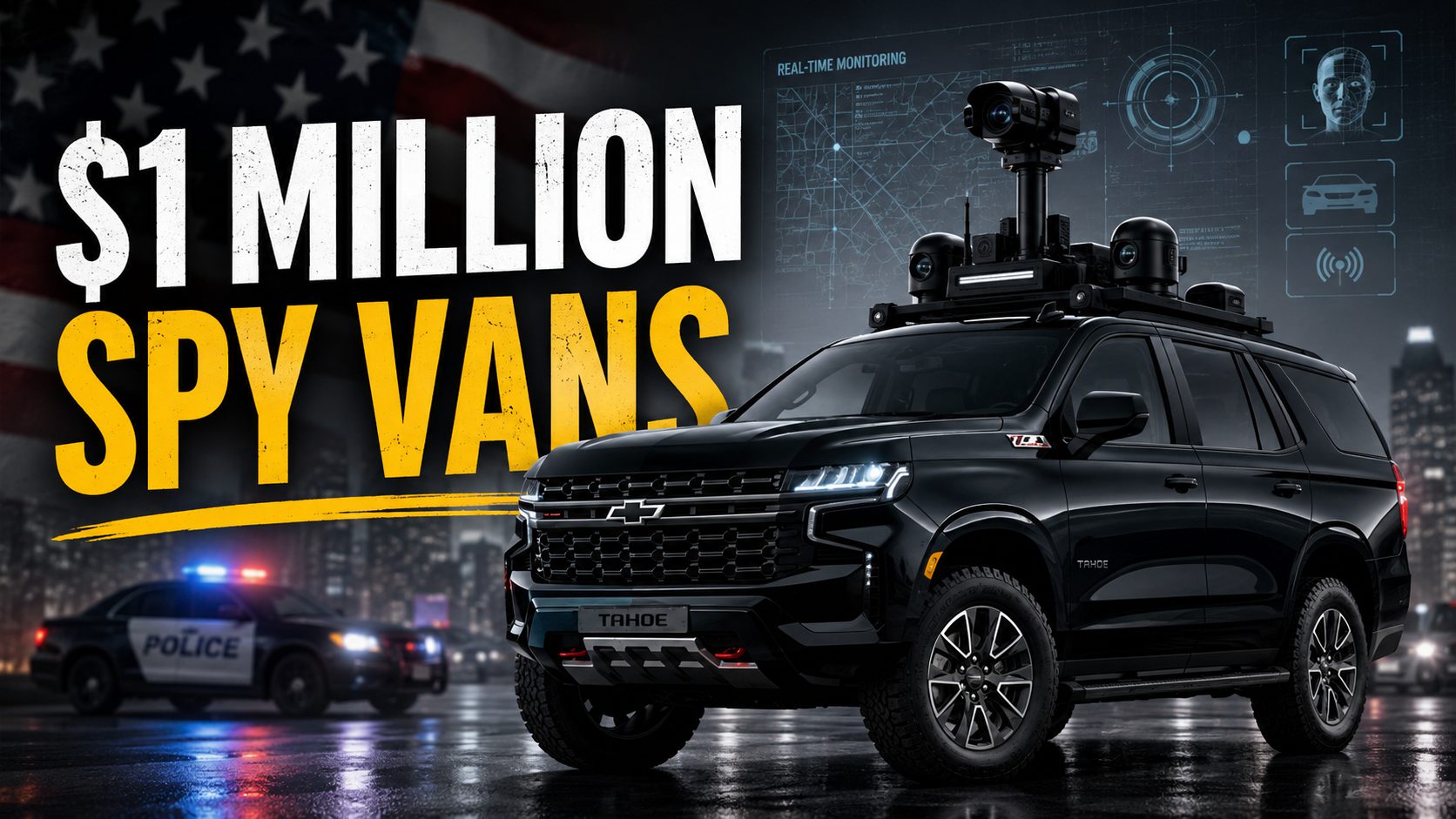
A standard Chevy Tahoe rolls through Texas traffic, indistinguishable from any other police SUV on the road. Inside, hardware is silently harvesting the phone identifiers of every person within range — commuters, shoppers, bystanders, all of them. The system doing the harvesting is called FalcoNet, built by Cognyte, an Israeli surveillance firm spun out of Verint and traded on Nasdaq. Texas DPS bought four of those Tahoes in March 2026 for $4.5 million total — roughly $1.1 million per vehicle, according to The Drive. The purchases are spreading.
What FalcoNet Actually Does
FalcoNet is less a phone tracker than a phone vacuum — and it doesn’t ask who belongs to whom.
- FalcoNet is a cell-site simulator (IMSI catcher) that impersonates a real cell tower using Software Defined Radio, forcing nearby phones to connect to it instead of legitimate infrastructure
- It sweeps 2G through 5G simultaneously, capturing device identifiers and location data from every phone in range — not just suspects’
- Cognyte claims setup takes about three minutes, with the system processing thousands of devices per minute and antennas hidden behind false raised roofs, making equipped Tahoes indistinguishable from standard police SUVs
- The same technology deploys from backpacks and helicopters — Florida’s FDLE spent $765,000 on an airborne FalcoNet kit for Operation Vigilant Sentry, targeting Caribbean migration routes, per researcher Jack Poulson’s reporting
Cognyte carries a market cap around $560 million. Its U.S. revenue climbed from $10 million in 2023 to $15 million in 2025, according to Forbes — small, but accelerating. The company also sells analytics platforms that ingest police datasets and flag behavioral patterns. Palantir’s pitch, essentially, paired with active phone interception hardware that Palantir doesn’t offer.
“FalcoNet can’t selectively ignore phones that don’t belong to a suspect.” — Privacy critics cited by Cybernews
Beyond Texas, FalcoNet is already deployed with New York State Police patrolling the U.S.–Canada border and with the Albuquerque Police Department, per Forbes. A U.S. Department of Defense office reportedly bought a backpack unit for approximately $400,000 the same month as the Texas deal. This is no longer a pilot program.
The Part Nobody’s Talking About
FalcoNet is the reboot of a controversy that took a decade to resolve the first time — and it arrives faster and better hidden.
Stingray devices sparked years of legal battles after their use surfaced in the early 2010s. Courts eventually pushed toward warrant requirements, with the Supreme Court’s 2018 Carpenter v. United States ruling reinforcing Fourth Amendment protections around location data. FalcoNet is the next generation: faster, multi-network, and concealed in vehicles that look like every other SUV on your commute — something straight out of a Mr. Robot prop department, except taxpayer-funded.
Poulson’s analysis notes these SDR base stations can “jam normal signals and force phones to connect,” a capability central to their use in airborne migrant surveillance. U.S. guidance generally requires warrants for cell-site simulators, but carve-outs for exigent circumstances grant wide discretion. The public rarely knows when or where these devices activate.
As FalcoNet embeds deeper into standard police fleets — from Texas highways to Caribbean airspace — the line between targeted investigation and rolling dragnet keeps moving. The phone in your pocket doesn’t know the difference.