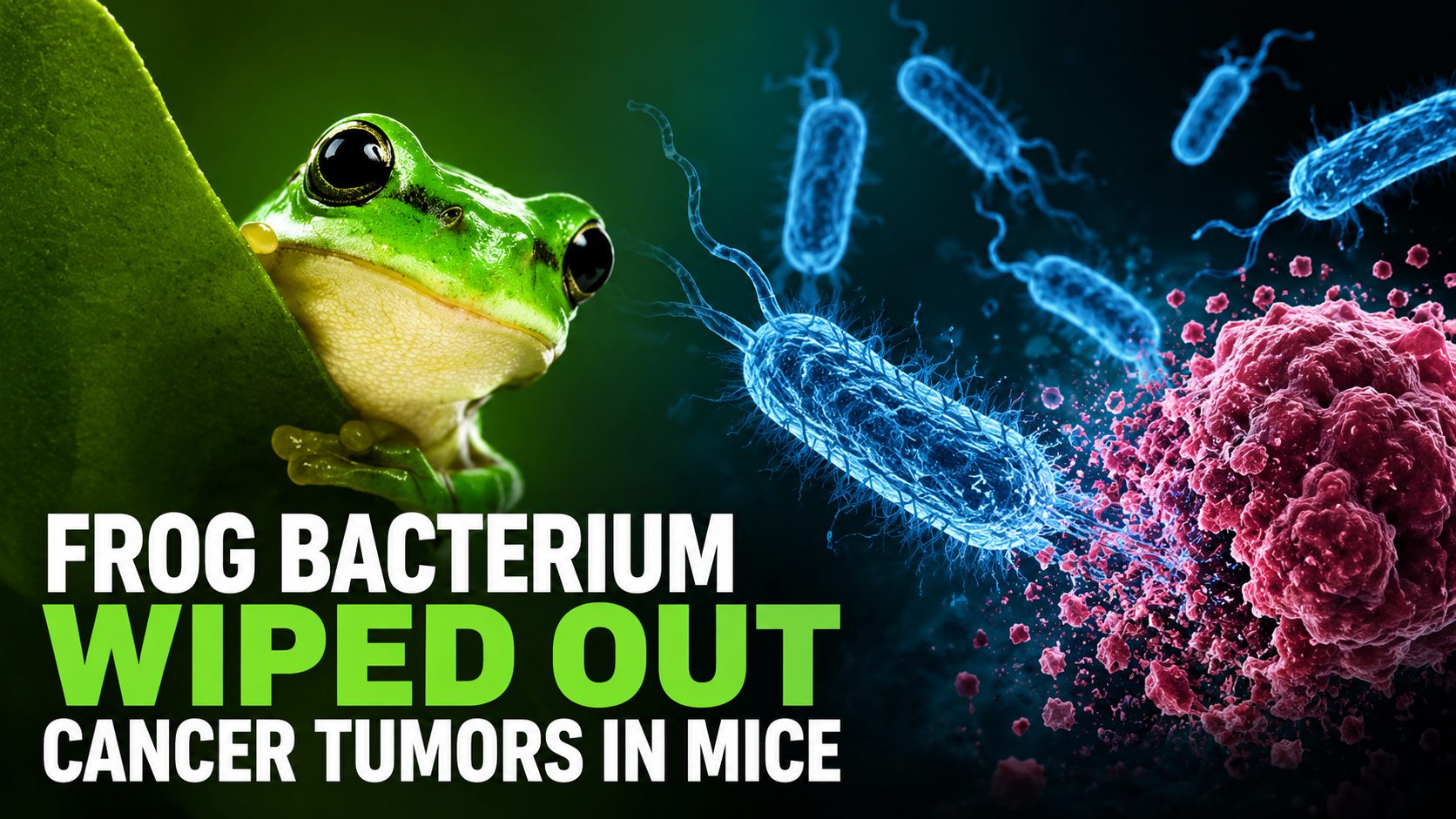
Every treated mouse. Complete tumor disappearance. One injection. That’s the headline result from a JAIST research team that screened 45 gut bacterial strains harvested from frogs, newts, and lizards — and found one that obliterated colorectal tumors in a mouse model with a precision that outperformed both chemotherapy and immunotherapy, according to a study published in Gut Microbes. For readers following unconventional oncology breakthroughs, a recent case saw a man use AI to design a cancer vaccine that saved his dog’s life.
One Billion Bacteria, One Shot, Zero Remaining Tumors
A single IV dose of Ewingella americana cleared tumors faster than standard cancer drugs in direct head-to-head comparison.
The bacterium, Ewingella americana, was pulled from the intestines of Japanese tree frogs (Dryophytes japonicus). Researchers led by Prof. Eijiro Miyako injected roughly one billion bacteria in 200 microliters into mice bearing human colorectal tumors. Tumors vanished within one to two days. In direct comparisons, E. americana outperformed an anti-PD-L1 checkpoint inhibitor and liposomal doxorubicin — two frontline cancer treatments. As Lifespan.io observed, “Rarely do cancer studies produce such convincing results: E. americana achieved fast and complete tumor eradication in all mice.”
The Dual-Action Hit
This bacterium kills tumor cells directly while simultaneously triggering a coordinated immune assault on the cancer.
The mechanism involves two crews working the same job simultaneously. E. americana is a facultative anaerobe — meaning it thrives in both oxygenated blood and the oxygen-starved interior of solid tumors. Here’s how it exploits tumor biology:
- Leaky tumor blood vessels let bacteria slip inside more easily than into healthy tissue
- Low-oxygen tumor cores create ideal bacterial breeding conditions
- Cancer cells’ own immune-evasion signals (CD47) inadvertently shelter the bacteria too
- Altered tumor metabolism provides nutrients that concentrate bacterial growth on-site
Within 24 hours, bacterial counts inside tumors surged roughly 3,000-fold. The bacteria secrete toxins that destroy cancer cells directly, while simultaneously flooding the tumor with T cells, B cells, and neutrophils releasing inflammatory signals including TNF-α and IFN-γ. The Gut Microbes paper describes “remarkably potent cytotoxic activity” combined with “robust activation of host immune responses.” Blood half-life averaged just 1.2 hours, no colonization appeared in healthy organs, and 60-day follow-ups showed no chronic toxicity. When cured mice were later re-challenged with cancer cells, none developed new tumors — the immune system had remembered.
The Canyon Between Mouse and Human
Spectacular preclinical results have a well-documented history of stalling before they reach a single patient.
This finding needs honest framing. Mouse models are the trailer of cancer research — compelling footage that sometimes bears little resemblance to the finished product. Yahoo News characterized these as “encouraging preclinical findings rather than an immediate solution for human patients.” Dosing, delivery, human immune reactions, manufacturing live bacterial therapies at scale, and regulatory oversight all stand between this result and a clinic. Scientists working on other biological frontiers have similarly confronted translational challenges, as seen in research reviving frozen brain tissue after a week-long deep freeze.
The biodiversity angle still deserves attention. If a tree frog’s gut bacteria can produce results this striking at the preclinical stage, the case for exploring non-human microbiomes as a drug discovery frontier just got considerably more concrete. For anyone tracking where oncology’s next generation of treatments might originate, frog guts are now required reading.