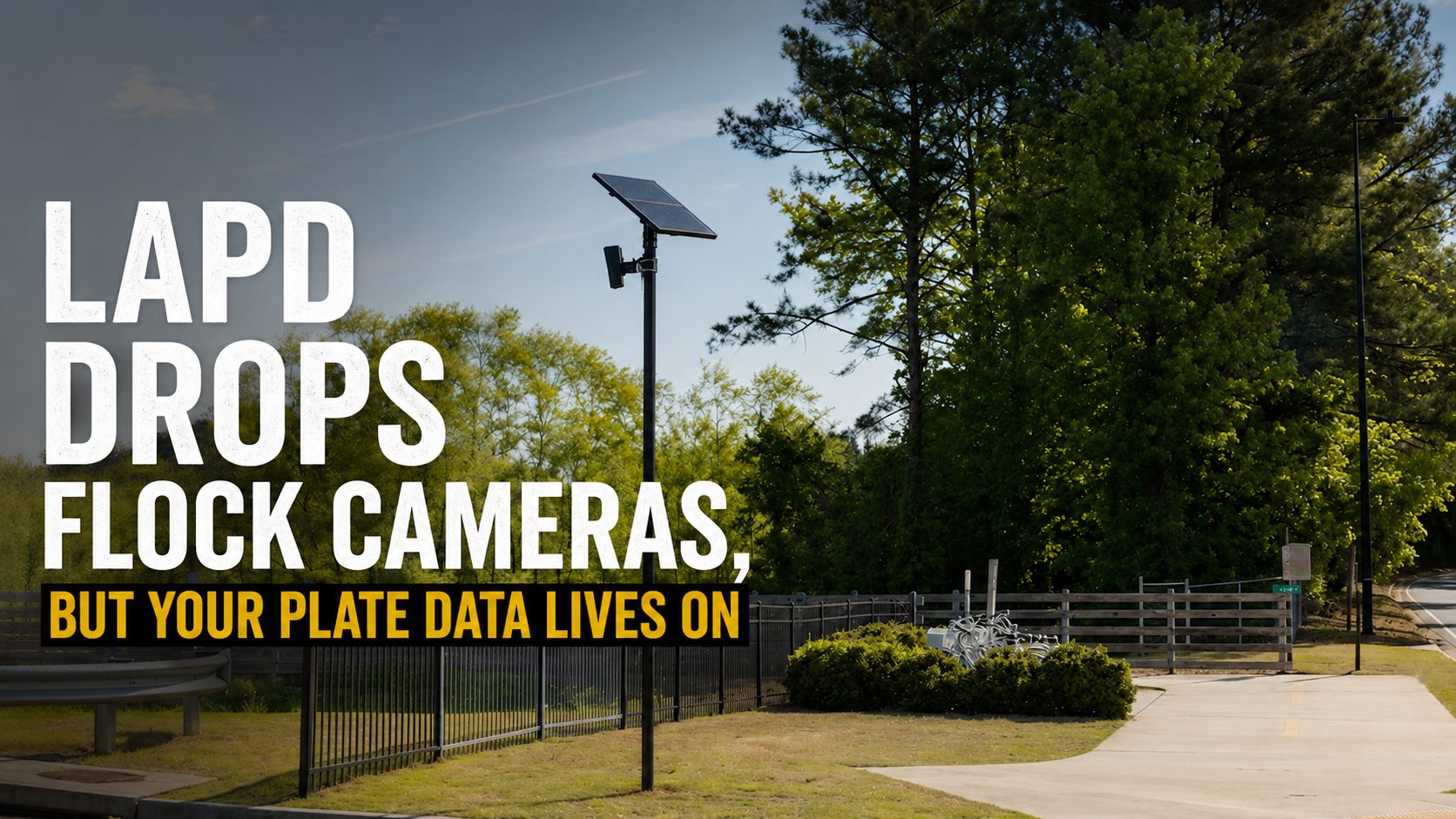
For every driver who passed a pole-mounted camera on an LA residential street, it wasn’t just reading a license plate. Flock Safety‘s system was building what the company calls a “vehicle fingerprint“ — make, model, color, bumper stickers, roof racks, all searchable across a national surveillance app-linked database. Now LAPD has let its three-year Flock contract expire, citing unresolved questions about who owns that data and where it ends up. The cameras bolted to HOA poles? Many of those are still up.
What Flock Actually Collects – And Where It Goes
The surveillance network is bigger than one contract, and the data travels further than most drivers realize.
LAPD Chief Information Officer Dean Gialamas put it plainly: “This contract is not being renewed because of serious concerns around civil liberties and civil rights issues, particularly around privacy and the data that is being collected from these cameras.” The scale is worth noting:
- 138 Flock cameras operated within a broader LAPD network of 248 pole-mounted ALPRs
- Data was retained 7 to 30 days under department policy
- Many cameras are owned by homeowner associations — their post-suspension status remains unclear
- An LAPD Inspector General audit (August–September 2025) recommended halting all new ALPR deployments until enforceable data rules exist
Flock’s national network reportedly serves roughly 5,000 law enforcement agencies. Think of it like a group chat where one member screenshots everything — local departments opt in for broader search access but lose control of what happens downstream.
University of Washington researchers found eight Washington State agencies had enabled direct sharing with U.S. Border Patrol. In Syracuse, U.S. Customs and Border Protection agents created Flock accounts to search data from thousands of local departments. Policy trackers documented over 4,000 lookups conducted for immigration purposes through local agencies — the “side-door” route Flock insists doesn’t exist.
Flock Says “Misconceptions.” The Fine Print Says Otherwise.
The company claims communities control their data, but its own template agreement tells a different story.
Flock called LAPD’s decision a “surprise” and maintains that federal sharing is off by default. The ACLU of Massachusetts, however, found something uncomfortable buried in the contract language: “Even when a police department chooses in Flock’s application to restrict data access to its own officers, the template agreement gives Flock the right to disclose the local police department’s data both to law enforcement nationwide and federal agencies for ‘investigative purposes.’”
Mountain View, California discovered Flock had placed its cameras into a national lookup setting without the city’s knowledge — then terminated its contract entirely. A California class action filed in April 2026 alleges violations of the state’s sanctuary law, SB 54, and the ALPR privacy statute, Civil Code §1798.90.55(b).
LAPD’s suspension sets a precedent. Councilmember Ysabel Jurado has moved to block any new Flock agreements or pilot programs. Stop LAPD Spying Coalition organizer Hamid Khan argues the suspension doesn’t go far enough, calling for an end to all ALPR use. The cameras may be coming down — but the data from your last three years of driving around LA landed somewhere, and the questions about where are far from answered.